
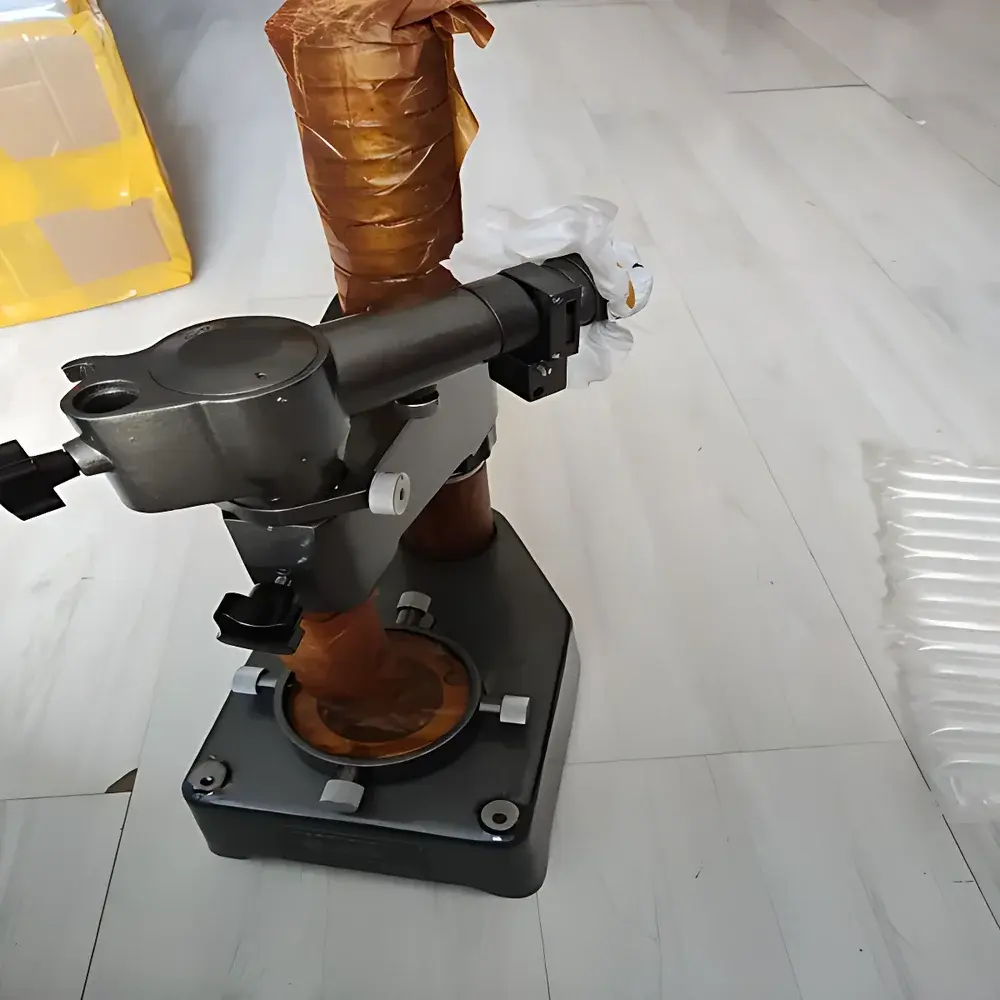
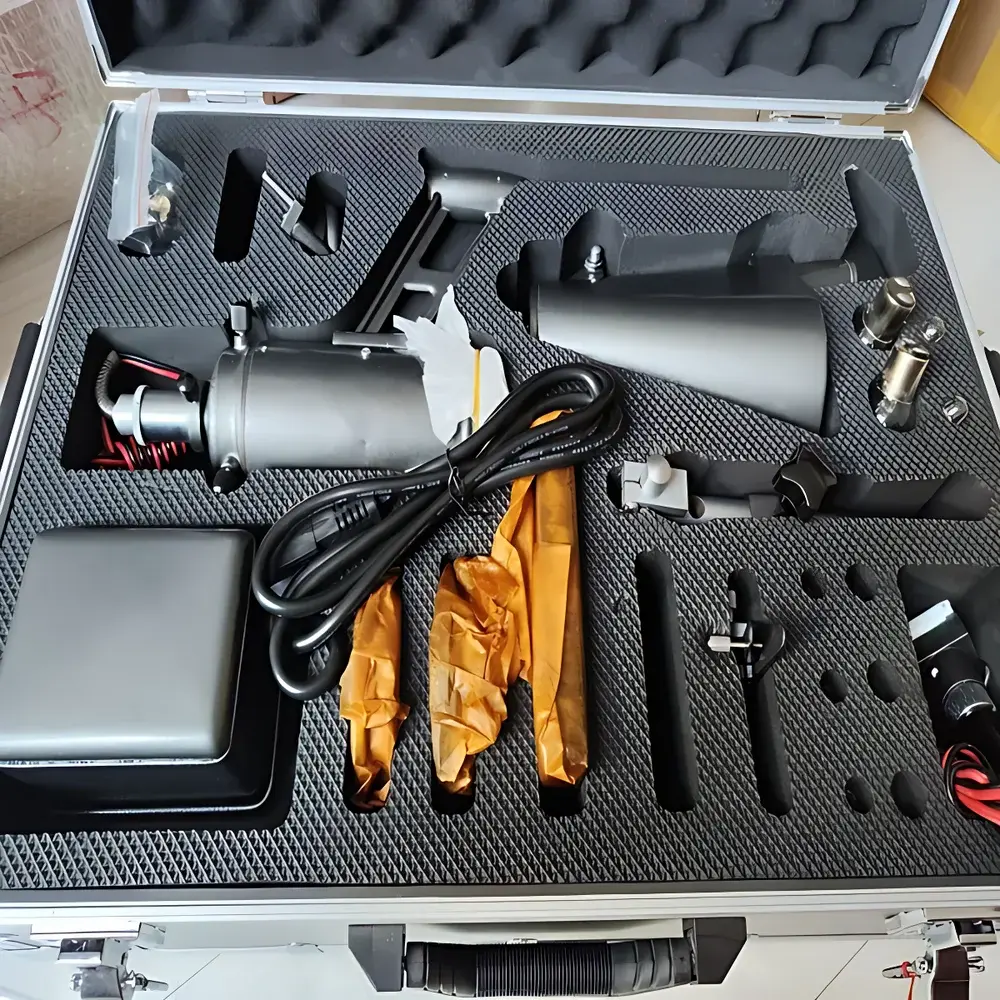
Zhongruixiang ZRX-17991 Vertical Projection Optical Comparator
| Brand | Zhongruixiang |
|---|---|
| Origin | Beijing, China |
| Manufacturer Type | Authorized Distributor |
| Country of Origin | China |
| Model | ZRX-17991 |
| Price | Upon Request |
| Eyepiece Magnification | 12× |
| Optical Lever Magnification | 80× |
| Total Optical Magnification | ≈1000× |
| Scale Division Value | 0.001 mm |
| Apparent Scale Interval in Field of View | ≈1 mm |
| Scale Range | ±0.1 mm |
| Plunger Free Travel | ≈0.4 mm |
| Measuring Force | 200 g ±20 g |
| Optical Tube Mounting Diameter | 28d mm |
| Zero Adjustment Range | ±0.01 mm |
| Measurement Length (without projector) | 180 mm |
| Measurement Length (with projector) | 120 mm |
| Distance from Column Edge to Platform Center | 115 mm |
| Instrument Uncertainty | ±0.00025 mm |
| Indication Stability | 0.0001 mm |
| Measurement Uncertainty | ±(0.5 + L/100) µm |
| Adjustable Circular Stage Diameter | 88 mm |
| Fixed Square Stage Dimensions | 142 × 130 mm |
| Fixed Small Round Stage Radius | R20 mm |
| Fixed Small Flat Stage Diameter | 8 mm |
| Reflector Diameter | 50 mm |
Overview
The Zhongruixiang ZRX-17991 Vertical Projection Optical Comparator is a precision mechanical-optical metrology instrument engineered for high-accuracy comparative measurement of dimensional deviations in manufactured components. Based on the principle of optical lever amplification and calibrated scale projection, it enables non-contact, high-magnification visual assessment of geometric features—particularly suited for calibration laboratories, metrology service centers, and high-precision machining environments where traceable verification of gauges, plug gages, ring gages, and cylindrical or planar workpieces is required. Its design conforms to fundamental metrological practices defined in ISO 3611 (Geometrical product specifications — Geometrical tolerancing — Verification of conformity of geometrical specifications) and supports traceability to national length standards via certified gauge blocks (e.g., Grade K or Grade 0 according to JJG 146–2011 / equivalent to ISO 3650). The instrument operates without electronic sensors or digital encoders; instead, it relies on passive optical magnification (≈1000× total), mechanical stability, and human-operator-based visual interpolation—making it inherently robust against electromagnetic interference and suitable for GLP-compliant manual calibration workflows.
Key Features
- Optical lever system with 80× mechanical amplification combined with 12× eyepiece magnification for effective ≈1000× total magnification—enabling resolution down to 0.001 mm on the reticle scale.
- Calibrated linear scale with ±0.1 mm range and 0.001 mm division value, supported by fine zero-adjustment mechanism (±0.01 mm range) for precise baseline alignment.
- Dual-stage configuration: adjustable 88 mm circular platform (for rotational alignment of cylindrical parts) and fixed square stage (142 × 130 mm) for stable positioning of larger or irregularly shaped components.
- Modular optical tube (28d mm mounting interface) designed for field relocation—can be detached and mounted directly onto machine tools for in-situ dimensional control using gauge blocks as reference standards.
- Controlled measuring force of 200 g ±20 g ensures consistent contact pressure during tactile probing, minimizing elastic deformation errors in soft or thin-walled parts.
- Integrated 50 mm reflector and collimated illumination path optimized for high-contrast shadow projection—critical for edge definition in profile and thickness measurements.
Sample Compatibility & Compliance
The ZRX-17991 accommodates a broad range of physical geometries: cylindrical parts (pins, shafts, gage plugs), flat plates (thickness verification), linear profiles (slot widths, step heights), and annular features (ring gages, bore diameters). It supports calibration of grade K and grade 0 gauge blocks per JJG 146–2011 (equivalent to ISO 3650), as well as class AA and class A cylindrical gages per ISO 1938. While not an automated CMM, its manual operation meets requirements for secondary calibration tasks under ISO/IEC 17025:2017 when used within validated procedures, documented uncertainty budgets, and operator competency assessments. The instrument’s mechanical construction—cast iron base, hardened steel column, and ground optical mounts—ensures long-term dimensional stability under controlled lab conditions (20 ±1 °C, <50% RH).
Software & Data Management
This optical comparator operates entirely without embedded firmware or proprietary software. All measurements are recorded manually by trained personnel using standardized lab notebooks or LIMS-integrated forms. For audit readiness, users may digitize readings via structured templates compliant with FDA 21 CFR Part 11 (when paired with electronic signature-capable systems) or ISO 15189 Annex A. No data storage, real-time export, or network connectivity is provided—consistent with legacy-grade metrology instruments deployed in regulated environments where deterministic repeatability and procedural transparency take precedence over automation.
Applications
- Verification of dimensional conformance for master gauges, setting standards, and working gages prior to shop-floor deployment.
- Thickness measurement of thin metal sheets, plastic films, and ceramic substrates with minimal deflection risk.
- Profile inspection of machined edges, gear teeth, and thread flanks using projected silhouette overlays.
- In-process dimensional monitoring on milling, grinding, or turning machines via re-mounted optical tube configuration.
- Educational demonstration of optical lever principles, Abbe error mitigation, and classical length metrology fundamentals.
FAQ
Is the ZRX-17991 compliant with international calibration standards?
Yes—it supports traceable calibrations aligned with ISO 3611, ISO 3650, and JJG 146–2011. Final compliance depends on laboratory-specific validation protocols and uncertainty budgeting per ISO/IEC 17025.
Can this instrument measure internal diameters?
Not directly. It measures external profiles and thicknesses; internal dimensions require indirect methods (e.g., using master rings or split collets) or complementary equipment such as bore gages.
What environmental conditions are recommended for optimal performance?
20 ±1 °C ambient temperature, relative humidity below 50%, and vibration-isolated granite surface mounting are strongly advised to maintain stated uncertainty levels.
Does the system include calibration certificates or NIST-traceable references?
No—certificates and reference standards must be procured separately from accredited providers; the instrument itself is supplied without pre-calibration documentation.
Is operator training required for ISO/IEC 17025 accreditation?
Yes—personnel must demonstrate documented competence in optical comparator operation, uncertainty estimation, and record-keeping per Clause 6.2 of ISO/IEC 17025:2017.




