
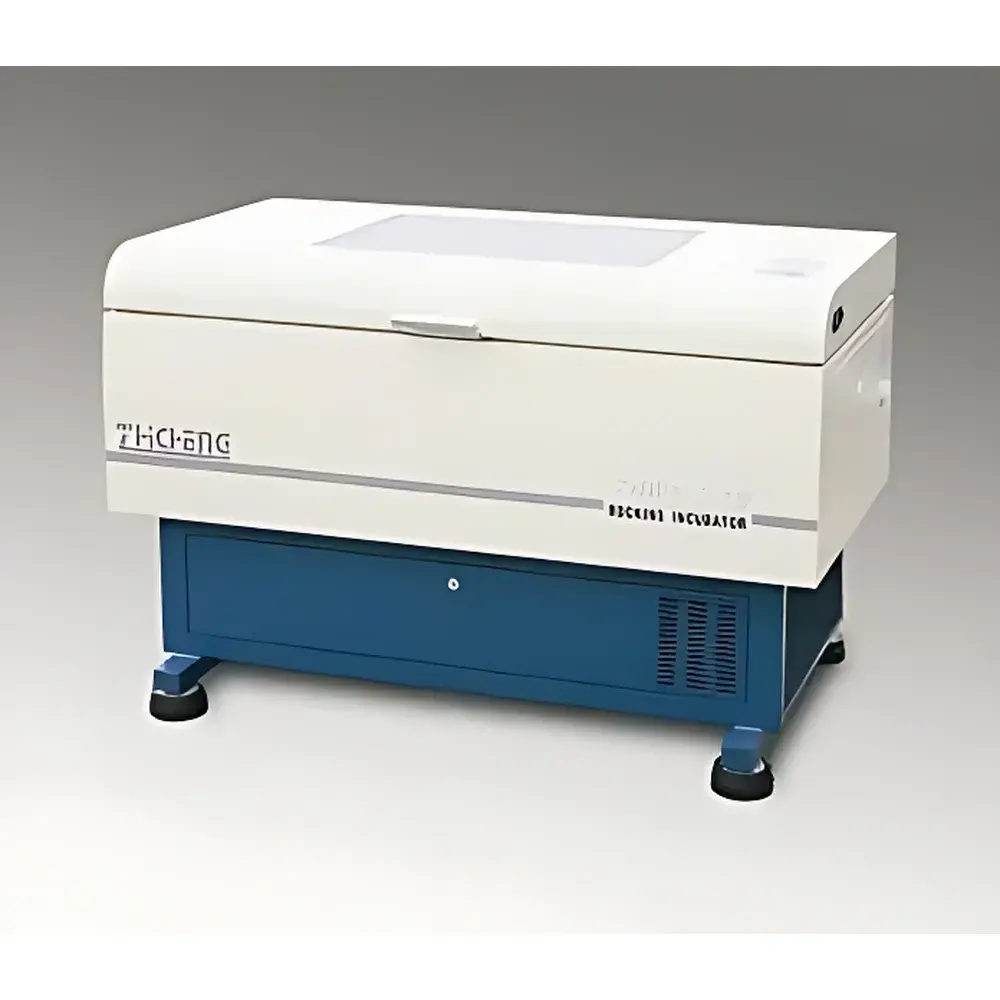
Zhongwei ZWY-111B Heavy-Duty Benchtop Incubated Orbital Shaker
| Origin | Shanghai, China |
|---|---|
| Manufacturer Type | Authorized Distributor |
| Origin Category | Domestic (China) |
| Model | ZWY-111B |
| Pricing | Upon Request |
| Temperature Control Range | Ambient +5°C to 60°C |
| Temperature Resolution | 0.1°C |
| Temperature Uniformity | ≤ ±1.0°C (at 37°C) |
| Temperature Stability | ≤ ±0.1°C (at 37°C) |
| Orbital Speed Range | 30–300 rpm |
| Speed Accuracy | ±1 rpm |
| Orbit Diameter | Φ26 mm |
| Timer Range | 0–500 h |
| Chamber Volume | 168 L |
| Shelf Dimensions | 920 × 500 mm |
| Max Capacity | 15 × 1000 mL flasks or 64 × 50 mL tubes |
| Internal Chamber Dimensions | 975 × 565 × 305 mm |
| External Dimensions | 1200 × 740 × 800 mm |
| Net Weight | 159 kg |
| Power Consumption | 680 W |
| Input Voltage | AC 220 V, 50/60 Hz |
| Cooling Method | None (Heating-Only) |
| Air Circulation | Forced-air convection |
| Oscillation Mode | Orbital (Circular) |
| Drive Mechanism | Multi-dimensional balanced drive |
| Door Operation | Manual front-opening |
| Ambient Operating Temperature | 5–25°C |
| Safety Features | Over-temperature alarm, motor overheat protection, auto power recovery after outage, soft-start acceleration control |
| Compliance | Designed for GLP-compliant laboratories |
Overview
The Zhongwei ZWY-111B Heavy-Duty Benchtop Incubated Orbital Shaker is an engineered platform for scalable, temperature-controlled suspension culture in life science and bioprocessing applications. Utilizing precision orbital motion (circular oscillation with Φ26 mm amplitude) combined with forced-air convection heating, the system maintains tight thermal uniformity (≤ ±1.0°C at 37°C) and stability (≤ ±0.1°C at 37°C) across its 168 L chamber — optimized for high-density flask and tube configurations. Its microprocessor-based PID temperature controller continuously scans ambient and internal conditions, dynamically adjusting heater output to compensate for load variation, door opening events, and ambient drift. Unlike compact benchtop shakers, the ZWY-111B’s structural architecture — including a reinforced steel frame, static-dissipative electrostatically sprayed enclosure, and tempered glass viewing window — supports continuous operation under GMP-aligned workflows where mechanical robustness and thermal repeatability are non-negotiable.
Key Features
- Intelligent PID microprocessor controller with real-time environmental scanning and adaptive thermal regulation
- Large-format LCD display with backlighting: shows setpoints and actual values for temperature, speed, and timer simultaneously
- Parameter lock function prevents unauthorized modification of operational settings during unattended runs
- Non-volatile memory retains all user-defined parameters after power interruption
- Extended timer capability up to 500 hours with audible/visual end-of-run alert
- Brushless AC induction motor ensures maintenance-free operation, constant torque delivery, and speed stability across full 30–300 rpm range (±1 rpm accuracy)
- Dual safety architecture: independent over-temperature cutoff (heater and motor circuits), plus automatic restart upon power restoration
- Gentle ramp-up algorithm minimizes shear-induced cell damage during start-up, critical for sensitive microbial and mammalian cultures
- Ergonomic design includes wide-opening front access, seamless stainless-steel interior, and vibration-damped mounting system
Sample Compatibility & Compliance
The ZWY-111B accommodates diverse vessel formats on its single 920 × 500 mm platform: up to 15 × 1000 mL Erlenmeyer flasks, 28 × 500 mL bottles, or 64 × 50 mL tubes — supporting parallel scalability from screening to pilot-scale cultivation. Its chamber geometry and airflow path are validated to minimize thermal stratification, satisfying ISO 20387:2018 requirements for biobanking equipment performance verification. While not refrigerated, its heating-only configuration complies with USP Analytical Instrument Qualification guidelines for Class II instruments when deployed in controlled ambient environments (5–25°C). The system supports 21 CFR Part 11–ready data logging when integrated with third-party compliant software, and its parameter lock and audit trail–capable firmware align with GLP documentation standards for QC microbiology and fermentation process development labs.
Software & Data Management
The ZWY-111B operates as a standalone instrument with embedded firmware but interfaces seamlessly with external data acquisition systems via RS-232 or optional USB-to-serial adapters. All operational logs — including timestamped temperature/speed profiles, alarm events, and door-open duration — can be exported in CSV format for traceability. When paired with validated laboratory information management systems (LIMS) or electronic lab notebooks (ELN), the device contributes to full lifecycle instrument qualification (IQ/OQ/PQ) documentation. Firmware updates are performed offline via SD card, ensuring cybersecurity integrity without network exposure — consistent with IEC 62443-3-3 recommendations for laboratory instrumentation.
Applications
This shaker serves core functions in upstream bioprocess development, including aerobic bacterial culture (e.g., E. coli, Bacillus spp.), yeast propagation, plasmid amplification, enzyme production, and hybridoma expansion. Its uniform thermal field and low-vibration orbital motion make it suitable for protein expression studies requiring precise oxygen transfer control. In pharmaceutical QA/QC, it supports media growth promotion testing per USP and . Academic and clinical labs deploy it for molecular biology workflows involving genomic DNA extraction buffer equilibration, antibody conjugation kinetics, and phage library amplification. Environmental microbiology labs use it for BOD incubation and activated sludge acclimation protocols where reproducible agitation and temperature coupling are essential.
FAQ
Does the ZWY-111B include refrigeration capability?
No — it is a heating-only incubated shaker. Temperature control spans ambient +5°C to 60°C.
Can multiple shelves be installed?
No — the ZWY-111B is configured with a single fixed-position shelf optimized for maximum load stability and airflow distribution.
Is the unit compatible with CO₂-enriched environments?
Not natively. It lacks gas-tight sealing or CO₂ sensor integration; however, it may be operated inside externally controlled CO₂ incubators if mechanical vibration transmission is mitigated.
What validation documentation is provided?
Factory calibration certificates for temperature and speed sensors are included. Full IQ/OQ protocol templates aligned with ISO/IEC 17025 are available upon request.
How is maintenance performed on the drive system?
The brushless AC motor requires no routine lubrication or carbon brush replacement. Annual verification of speed accuracy and thermal uniformity is recommended using NIST-traceable probes.
Related Products




