
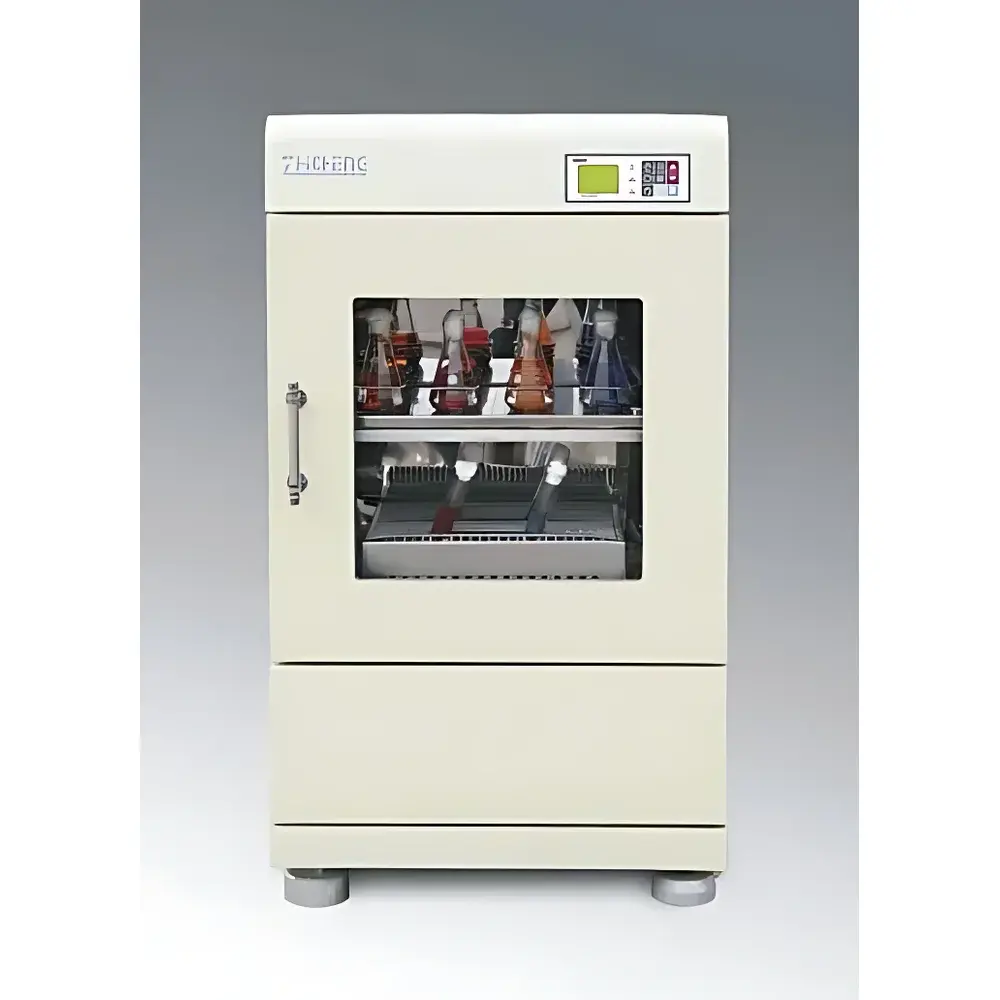
Zhongxun ZWY-A2102C Dual-Layer Programmable Temperature-Controlled Orbital Shaker
| Origin | Shanghai, China |
|---|---|
| Manufacturer Type | Authorized Distributor |
| Regional Origin | Domestic (China) |
| Model | ZWY-A2102C |
| Pricing | Upon Request |
| Temperature Range | 4–60 °C |
| Temperature Uniformity | ≤±1 °C (at 37 °C) |
| Temperature Stability | ≤±0.1 °C (at 37 °C) |
| Temperature Resolution | ±0.1 °C |
| Orbital Speed Range | 30–300 rpm |
| Speed Accuracy | ±1 rpm |
| Orbit Diameter | Φ26 mm |
| Timer Range | 0–500 h |
| Programming Capacity | 6 segments × 12 steps (with cycle, ramp, hold, and stepwise temperature profiles) |
| Chamber Volume | 173 L |
| Shelf Dimensions | 496 × 350 mm (2 shelves) |
| Internal Chamber Dimensions | 615 × 440 × 640 mm |
| Overall Dimensions (W×D×H) | 720 × 630 × 1275 mm |
| Net Weight | 165 kg |
| Power Supply | AC 220 V, 50/60 Hz |
| Rated Power | 950 W |
| Refrigerant | R134a |
| Cooling Method | Air-cooled, frost-free, auto-controlled cooling capacity |
Overview
The Zhongxun ZWY-A2102C Dual-Layer Programmable Temperature-Controlled Orbital Shaker is an engineered platform for precise, reproducible incubation and agitation of biological samples under tightly regulated thermal and mechanical conditions. Designed for laboratories requiring high-fidelity environmental control in microbial culture, enzymatic assays, cell suspension expansion, and molecular hybridization protocols, the instrument employs PID-controlled microprocessor logic with real-time environmental scanning to maintain setpoint stability across dual independently accessible shelves. Its orbital motion—characterized by a consistent Φ26 mm circular trajectory—ensures homogeneous mixing without shear-induced cellular damage, while the forced-air convection system delivers uniform temperature distribution (≤±1 °C at 37 °C) throughout the 173 L chamber. The shaker operates within a biologically relevant temperature range of 4–60 °C, with resolution and stability rated at ±0.1 °C—meeting baseline requirements for ISO 13485-aligned QC workflows and GLP-compliant cell banking applications.
Key Features
- Dual-layer stainless-steel chamber with electropolished trays, mirror-finish 304 stainless steel interior, and tempered glass observation window for non-invasive monitoring
- Programmable multi-segment control: 6 segments × 12 steps supporting ramp-hold, cyclic, and stepwise temperature/speed profiles—each segment configurable up to 100 h
- Integrated embedded thermal printer for real-time logging of setpoints, actual values, alarms, and timestamps—compliant with ALCOA+ data integrity principles
- Intelligent water-level detection system with audible/visual low-water alarm and auto-refill capability to prevent evaporation-related sample concentration drift
- Comprehensive safety architecture: independent overtemperature cut-off (adjustable), door-open stop, leakage current protection, motor overload tripping, compressor overheat safeguard, and dual-limit speed deviation alerts
- Brushless AC induction motor delivering constant torque across full speed range (30–300 rpm), maintenance-free operation, and soft-start acceleration to minimize flask displacement and foam formation
- RS-232 interface for external data acquisition and remote parameter synchronization; password-protected parameter encryption and persistent memory retention after power interruption
Sample Compatibility & Compliance
The ZWY-A2102C accommodates diverse vessel formats via interchangeable tray configurations—including universal spring clamps, universal bottle holders, and flat-platform adapters—supporting maximum load capacities of 750 mL × 18, 500 mL × 22, or 100 mL × 56 per shelf. Its design conforms to IEC 61010-1:2010 safety standards for laboratory equipment and incorporates safeguards aligned with FDA 21 CFR Part 11 expectations for audit-trail-enabled devices (via timestamped print logs and parameter change history). While not certified to ISO/IEC 17025 as a calibration standard, its temperature and speed performance meets typical validation thresholds for in-house qualification per ASTM E2500 and USP . The unit is suitable for use in GMP environments where environmental monitoring and procedural traceability are mandated.
Software & Data Management
No proprietary PC software is bundled; however, the built-in RS-232 port enables integration with third-party LIMS or SCADA systems using standard ASCII command protocols. All operational parameters—including temperature setpoint, actual chamber temperature, rotational speed, elapsed time, and alarm status—are continuously displayed on the backlit LCD interface and concurrently recorded by the embedded thermal printer. Printouts include date/time stamps, operator ID fields (manually entered), and event-driven annotations (e.g., “ALERT: LOW WATER”, “POWER RESTORE”). Data retention supports retrospective review for root cause analysis in deviations, aligning with Annex 11 and EU GMP Chapter 4 documentation requirements.
Applications
This shaker serves critical roles in academic research labs conducting recombinant protein expression in E. coli, industrial bioprocess development for monoclonal antibody production, clinical microbiology for AST (antimicrobial susceptibility testing), and environmental labs performing BOD/COD enrichment cultures. Its dual-shelf architecture enables parallel condition screening—for instance, comparative growth kinetics across two temperature gradients—or staggered inoculation schedules without cross-contamination risk. The programmable ramp-and-hold functionality supports thermosensitive protocols such as heat-shock transformation, cold-acclimation studies in plant tissue culture, and synchronized cell-cycle arrest experiments.
FAQ
Does the ZWY-A2102C support CO₂ control or humidity regulation?
No. This model (ZWY-A2102C) is configured for temperature and orbital agitation only. For CO₂ and humidity capabilities, refer to the ZW-C or ZW-D series variants.
Is the embedded printer compatible with standard thermal paper rolls?
Yes—it accepts industry-standard 57 mm wide thermal paper with core diameter ≤12 mm.
Can the unit be validated for GMP use?
Yes. Its deterministic control logic, alarm logging, parameter encryption, and hardware redundancy allow IQ/OQ/PQ execution per user-defined protocols. Full validation documentation templates are available upon request.
What is the recommended preventive maintenance schedule?
Annual verification of temperature uniformity (per ISO 17025 Annex C), speed calibration against NIST-traceable tachometer, and inspection of door gasket integrity and refrigerant pressure levels.
Is remote monitoring possible via Ethernet or Wi-Fi?
Not natively. RS-232 output requires a serial-to-Ethernet converter for network integration; no onboard TCP/IP stack or web interface is provided.






