
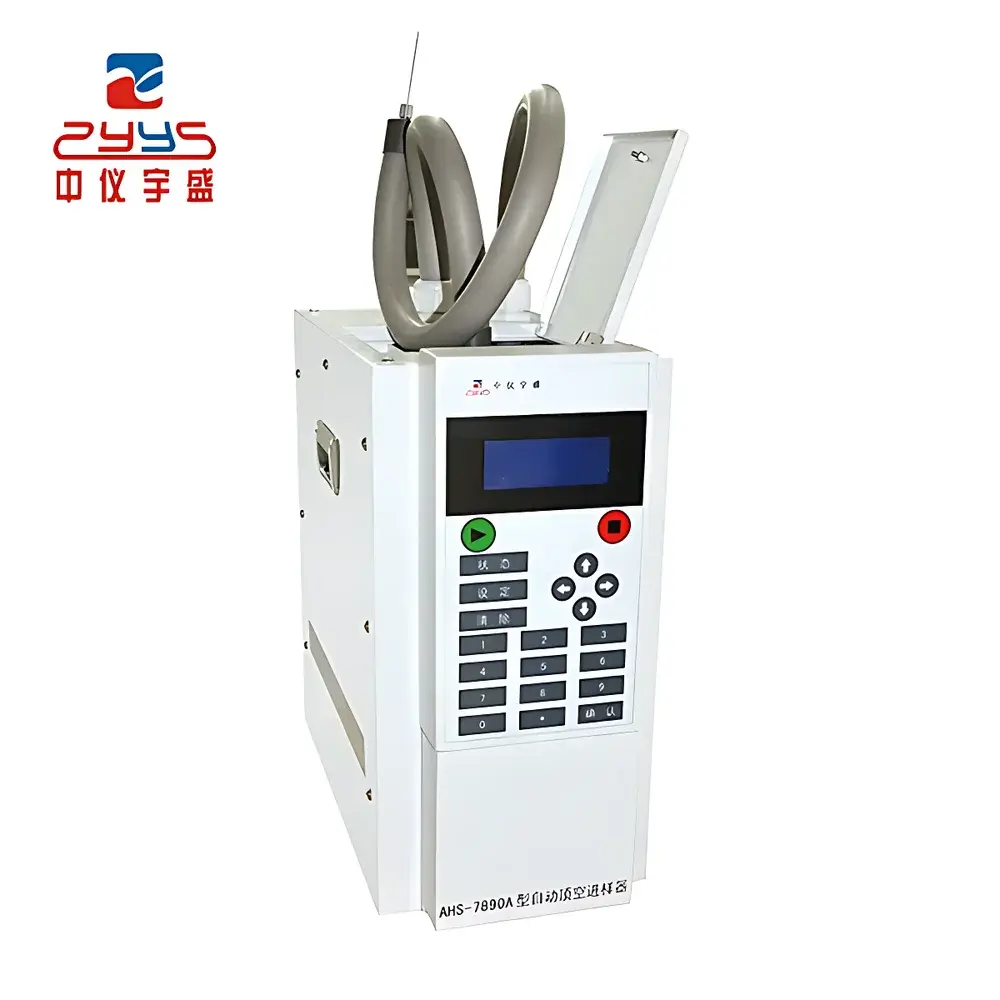
Zhongyi Yusheng AHS-7890A Static Headspace Sampler
| Brand | Zhongyi Yusheng |
|---|---|
| Origin | Beijing, China |
| Manufacturer Type | OEM Manufacturer |
| Instrument Type | Static Headspace Sampler |
| Automation Level | Semi-Automatic |
| Sample Vial Capacity | 12-position carousel |
| Vial Size | 20 mL |
| Injection Mode | Pressure-Balanced Sampling |
| Independent Temperature Zones | 3 (Sample Oven, Valve Box, Transfer Line) |
| Method Storage | 9 pre-programmable methods |
| GC Synchronization | Yes (TTL/relay trigger) |
| Carrier Gas Interface | External pressure regulation, compatible with native GC carrier gas supply |
| Backflush Function | Automated valve and transfer line purge |
| Compatibility | Universal interface for Agilent, Thermo Fisher, Shimadzu, PerkinElmer GC systems |
Overview
The Zhongyi Yusheng AHS-7890A Static Headspace Sampler is an engineered solution for reproducible, trace-level volatile organic compound (VOC) analysis in complex solid, liquid, and semi-solid matrices. Designed specifically for integration with gas chromatography (GC) and GC–MS platforms, the AHS-7890A operates on the principle of static headspace equilibrium: samples are heated in sealed 20 mL vials to establish vapor-phase partitioning of analytes between the matrix and headspace gas; the equilibrated vapor is then transferred via pressure-balanced injection into the GC inlet. This technique eliminates solvent interference, minimizes matrix effects, and enhances detection sensitivity for low-boiling, thermally labile, or highly volatile compounds—including halogenated hydrocarbons, ketones, ethers, aromatic hydrocarbons, aldehydes, nitriles, and residual sterilants such as ethylene oxide. The instrument’s robust thermal architecture and precisely timed pneumatic control ensure high inter-run reproducibility (RSD < 3% for peak area under optimized conditions), making it suitable for regulated environmental, clinical toxicology, pharmaceutical, and food safety applications.
Key Features
- Metal-block heating system with three independently controlled temperature zones: sample oven (ambient to 200 °C), valve box (ambient to 220 °C), and transfer line (ambient to 250 °C), each maintaining ±0.1 °C stability and minimal thermal gradient across the carousel.
- Front-access 12-position sample carousel—ergonomically positioned for unobstructed vial loading/unloading without requiring instrument repositioning or tool access.
- Microprocessor-based controller with intuitive menu-driven interface supporting full method programming: equilibration time, oven ramp rate, pressurization duration, loop fill time, injection time, and post-analysis backflush sequence.
- Pressure-balanced sampling mechanism ensures sharp, narrow chromatographic peaks and superior retention time repeatability compared to syringe-based or vacuum-assisted transfer.
- Automated backflush functionality for both the sampling valve and transfer line—activated after each injection to prevent carryover and cross-contamination between samples.
- External carrier gas regulation module enables seamless operation with existing GC systems without hardware modification; supports both auxiliary and native GC carrier gas sources (He, N2, H2).
- Programmable TTL and relay outputs allow synchronized start/stop triggering with GC acquisition software or external LIMS workflows.
- Universal mechanical and electrical interfaces for direct connection to major GC platforms—including Agilent 7890/8890, Thermo Fisher Trace 1300/1600, Shimadzu GC-2030, and PerkinElmer Clarus series.
Sample Compatibility & Compliance
The AHS-7890A accommodates standard 20 mL crimp-top headspace vials with magnetic or screw caps and PTFE/silicone septa. It supports aqueous, soil, sediment, tissue homogenates, polymer extracts, blood, pharmaceutical tablets, and medical device packaging—provided samples are physically stable at target equilibration temperatures. Its operational design aligns with internationally recognized analytical standards, including but not limited to: ASTM D7622 (VOCs in water), ISO 15681-2 (water quality – phosphorus compounds), USP <467> (residual solvents), and multiple Chinese EPA methods cited in the HJ and GB/T series—particularly HJ 620-2011, HJ 642-2013, HJ 741-2015, HJ 810-2016, and GB/T 5750.8-2023. While the AHS-7890A itself does not bear CE or FDA 510(k) certification, its architecture supports GLP-compliant data integrity when paired with 21 CFR Part 11–enabled GC data systems via timestamped method logs and audit-trail-capable acquisition software.
Software & Data Management
The AHS-7890A operates autonomously via its embedded firmware and requires no dedicated PC software for routine operation. All method parameters—including temperature setpoints, timing sequences, and GC synchronization logic—are stored locally in non-volatile memory (9 methods retained after power cycle). For laboratory informatics integration, the unit provides RS-232 serial output (ASCII protocol) and digital I/O ports to log event timestamps (e.g., “vial #5 injected at 14:22:17”) into external LIMS or ELN systems. When used with chromatography data systems (CDS) such as OpenLab CDS, Chromeleon, or GCsolution, the AHS-7890A’s relay-triggered start signal initiates acquisition synchronously with injection, ensuring accurate retention time alignment and eliminating manual injection time entry errors. Method files exported from CDS can be manually mapped to corresponding AHS-7890A program numbers for consistent cross-platform execution.
Applications
- Environmental testing: Quantification of VOCs in drinking water (GB/T 5750.8), soil, and sediment per HJ 642–2013 and HJ 736–2015.
- Clinical toxicology: Blood ethanol analysis per GA/T 842–2019; detection of volatile metabolites and intoxicants.
- Pharmaceutical QA/QC: Residual ethylene oxide validation in sterilized devices (GB/T 16886.7–2015); solvent residue profiling per ICH Q3C guidelines.
- Food and packaging safety: Migration testing of VOCs from food contact materials (SN/T 4148–2015); flavor compound profiling.
- Forensic chemistry: Analysis of ignitable liquids and accelerants in fire debris.
FAQ
Is the AHS-7890A fully automated or semi-automatic?
The AHS-7890A is classified as semi-automatic: while all thermal, pneumatic, and timing functions are programmable and executed without user intervention during a run, vial loading and cap crimping require manual handling prior to carousel insertion.
Can it be used with mass spectrometry detectors?
Yes—the AHS-7890A is fully compatible with GC–MS systems. Its pressure-balanced injection delivers consistent vapor-phase introduction, critical for quantitative MS analysis and library matching reliability.
What maintenance is required for long-term performance?
Routine maintenance includes quarterly verification of vial seal integrity, biannual cleaning of the transfer line with appropriate solvents (e.g., methanol followed by acetone), and annual calibration of temperature sensors using NIST-traceable reference probes.
Does it support dynamic headspace or purge-and-trap configurations?
No—the AHS-7890A is engineered exclusively for static headspace analysis. It does not include trapping cartridges, desorption ovens, or flow-controlled purge manifolds required for dynamic applications.
How is method transfer validated between laboratories?
Method transfer relies on documented equivalence of thermal profiles (oven ramp rate, equilibration dwell), pressure settings, and GC inlet conditions. Inter-laboratory precision studies should follow ICH Q5C principles, with RSD ≤ 5% across ≥6 replicates per site.
Related Products



