
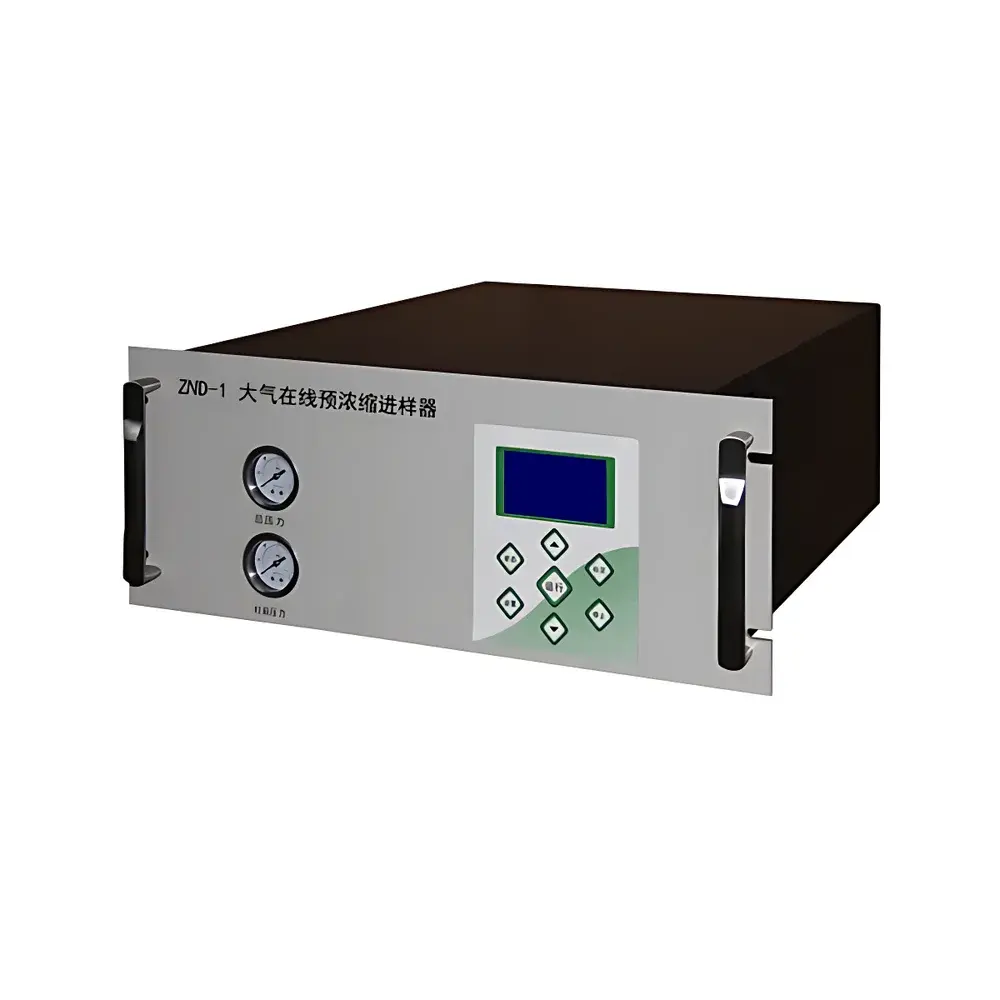
ZHP ZND-1 Dual-Channel Online Atmospheric Preconcentrator
| Brand | ZHP |
|---|---|
| Origin | Beijing, China |
| Manufacturer Type | Direct Manufacturer |
| Model | ZND-1 |
| Automation Level | Fully Automated |
| Valve Inlet Temperature Range | 50–240 °C (customizable up to 330 °C), Control Accuracy: ±1 °C |
| Transfer Line Temperature Range | 40–230 °C, Control Accuracy: ±1 °C |
| Trap Temperature Range | −35 to 400 °C |
| Flash Heating Rate | >50 °C/s |
| Enrichment Time | 0–60 min |
| Injection Time | 0–10 min |
| Interval Time | 0–60 min |
| Sampling Time | 0–60 min |
| Sampling Flow Rate | 16–160 mL/min |
| RSD | ≤2.5% |
| Power Consumption | 450 W |
| Dimensions | 550 × 484 × 222 mm (5U rack-mount chassis) |
| Cooling Method | Semiconductor-based cryogenic trapping |
| Adsorbent Configuration | Dual-trap (A/B), each packed with three selective, deactived sorbents |
| Flow Control | Dual-channel Mass Flow Controller (MFC) |
| Valve Type | High-temp motor-driven 6-port valve (max. 240 °C standard |
| Interface | Universal TTL/RS-232 trigger output for synchronized GC and data system activation |
Overview
The ZHP ZND-1 Dual-Channel Online Atmospheric Preconcentrator is an engineered solution for unattended, quantitative preconcentration of volatile organic compounds (VOCs) from ambient air or stack emissions prior to gas chromatographic analysis. Designed for continuous monitoring applications—including ozone precursor (PAMS-57) surveillance, fence-line emission tracking, and regulatory compliance sampling—the ZND-1 employs dual-cryogenic trapping architecture coupled with precise thermal desorption and inert sample pathway management. Its core principle relies on cryofocusing at −35 °C followed by rapid flash desorption (>50 °C/s) into a heated transfer line, ensuring quantitative transfer of thermally labile and semi-volatile analytes without degradation or breakthrough. The system operates under ISO/IEC 17025-aligned environmental monitoring workflows and supports method validation per EPA TO-14A, TO-15, and ASTM D6196 protocols.
Key Features
- Dual independent cryogenic traps (A/B) with selectable, multi-bed sorbent configurations—optimized for compound classes including alkanes, oxygenates (aldehydes, ketones, esters), nitrogen-containing VOCs, halocarbons, and sulfur compounds (e.g., methanethiol, carbonyl sulfide).
- Semiconductor-based cooling eliminates reliance on liquid nitrogen or mechanical compressors—reducing operational complexity, footprint, and maintenance overhead while maintaining stable −35 °C trap baselines.
- Fully heated sample pathway: inlet valve (50–240 °C, ±1 °C), transfer lines (40–230 °C, ±1 °C), and trap housing—all housed within a thermally insulated enclosure to eliminate cold spots and prevent condensation or adsorption losses.
- High-temperature motorized 6-port valve rated to 240 °C (330 °C optional) ensures reproducible switching and minimal carryover during repeated cycles; valve actuation is synchronized with GC start signals via TTL/RS-232 interface.
- Dual-channel mass flow control enables simultaneous or alternating enrichment from two independent air streams—supporting comparative monitoring (e.g., upwind/downwind), redundancy, or parallel method validation.
- Rack-mount 5U chassis (550 × 484 × 222 mm) designed for integration into fixed-site air quality laboratories or mobile monitoring platforms compliant with EN 14625 and US EPA EQOA requirements.
Sample Compatibility & Compliance
The ZND-1 is validated for trace-level quantification of C2–C12 VOCs across diverse matrices: ambient air, industrial boundary air, indoor air, and diluted stack effluents. It accommodates target analytes specified in major regulatory frameworks—including benzene, toluene, ethylbenzene, xylenes (BTEX), acrylonitrile, acetone, methanol, propylene oxide, 1,2-dichloroethane, vinyl chloride, and methyl mercaptan. All internal surfaces contacting sample gas are constructed from high-inertness, silonized stainless steel tubing with proprietary deactivation treatment, minimizing catalytic decomposition and memory effects. System performance meets or exceeds US EPA Method TO-15 repeatability criteria (RSD ≤2.5% across 10 replicate injections) and supports GLP-compliant audit trails when paired with 21 CFR Part 11-enabled chromatography data systems.
Software & Data Management
The ZND-1 operates via an embedded microcontroller with real-time LCD interface (Chinese-language UI standard; English firmware available upon request). All method parameters—including enrichment time (0–60 min), flash temperature ramp, trap bakeout profiles, and inter-sample interval—are programmable and stored in non-volatile memory. The unit provides standardized hardware triggers (TTL pulse, RS-232 handshake) for automatic GC oven start, detector enable, and data acquisition initiation. When integrated with third-party chromatography data systems (Agilent OpenLab, Thermo Chromeleon, Shimadzu LabSolutions), it supports time-stamped event logging, cycle completion confirmation, and fault-code reporting—enabling full traceability in ISO 17025-accredited laboratories.
Applications
- Continuous ambient VOC monitoring at urban background, traffic, and industrial sites per EU Directive 2008/50/EC and US EPA Photochemical Assessment Monitoring Stations (PAMS) network requirements.
- Fence-line and perimeter emission monitoring for LDAR (Leak Detection and Repair) programs under 40 CFR Part 60 and 63 subparts.
- Method development and validation for EPA TO-14A/TO-15-compliant laboratories performing source apportionment and odor impact assessments.
- Research-grade studies on VOC speciation related to secondary organic aerosol (SOA) formation and atmospheric oxidation kinetics.
- Calibration verification and dynamic spiking studies using certified permeation tubes or diffusion sources.
FAQ
What is the maximum allowable operating temperature for the inlet valve?
The standard ZND-1 inlet valve is rated to 240 °C; a high-temperature option (330 °C) is available upon factory configuration request.
Can the ZND-1 be used with both GC-FID and GC-MS systems?
Yes—the instrument delivers a clean, narrow-band injection pulse compatible with split/splitless inlets and PTV injectors; no hardware modification is required for interfacing with FID, ECD, PID, or MS detectors.
Is remote monitoring or network connectivity supported?
While the base model uses local LCD + hardware triggers, optional Ethernet or Modbus TCP modules can be integrated for SCADA-compatible telemetry and centralized fleet management in multi-unit deployments.
How is carryover minimized between consecutive analyses?
Carryover is mitigated through sequential high-temperature trap bakeout (up to 400 °C), valve purge cycles, and inert surface passivation—validated via blank runs showing <0.5% relative response for all PAMS-57 compounds after high-concentration exposure.
Does the ZND-1 comply with international calibration traceability standards?
Yes—when operated with NIST-traceable gas standards and documented SOPs, the system supports measurement uncertainty budgets aligned with ISO/IEC 17025 clause 7.6 and EURACHEM/CITAC Guide CG4.







