
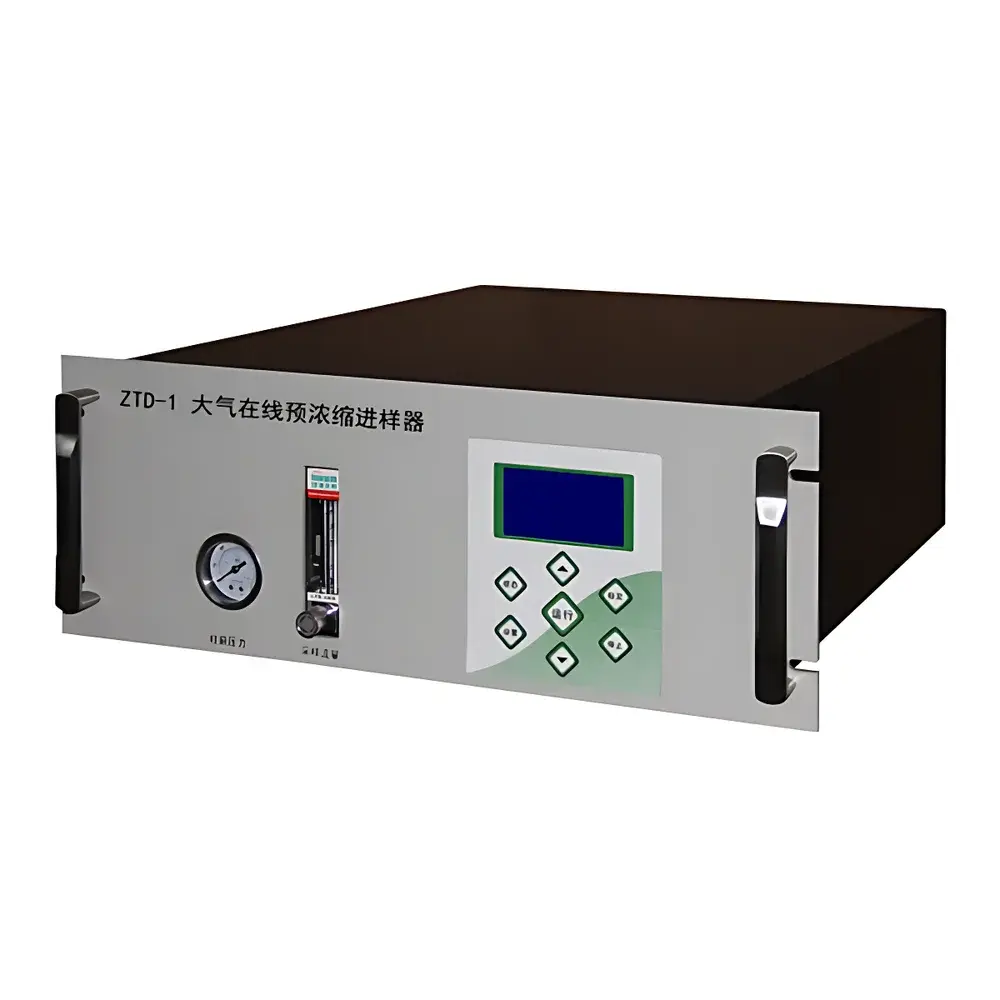
ZHP ZTD-1 Single-Cryogenic Trap Atmospheric Online Concentrator
| Brand | ZHP |
|---|---|
| Origin | Beijing, China |
| Manufacturer Type | Direct Manufacturer |
| Product Origin | Domestic (China) |
| Model | ZTD-1 |
| Automation Level | Fully Automated |
| Valve Injection Zone Temperature Range | 50–240 °C, Control Accuracy: ±1 °C (customizable to 330 °C) |
| Transfer Line Temperature Range | 40–230 °C, Control Accuracy: ±1 °C |
| Trap Temperature Range | −35 to 400 °C |
| Flash Desorption Ramp Rate | >50 °C/s |
| Enrichment Time | 0–60 min |
| Injection Time | 0–10 min |
| Interval Time | 0–60 min |
| Sampling Time | 0–60 min |
| Sampling Flow Rate | 16–160 mL/min |
| RSD | ≤2.5% |
| Power Consumption | 200 W |
| Dimensions | 550 × 484 × 175 mm (4U Rack-Mount Chassis) |
Overview
The ZHP ZTD-1 Single-Cryogenic Trap Atmospheric Online Concentrator is a fully automated thermal desorption system engineered for unattended, real-time preconcentration of volatile organic compounds (VOCs) from ambient air or stack gas streams prior to gas chromatographic analysis. It operates on the principle of cryogenic trapping followed by rapid flash desorption—utilizing a single high-performance trap cooled to −35 °C and heated up to 400 °C—to achieve quantitative recovery of trace-level VOCs across a broad polarity and volatility range. Designed specifically for regulatory-grade environmental monitoring, the ZTD-1 supports continuous, multi-hour sampling cycles with precise temporal resolution, making it suitable for ozone precursor monitoring (e.g., PAMS-57), fence-line emission tracking, and ambient air quality assessment in compliance with EPA TO-17, ISO 16017-1, and EN 14662 methodologies.
Key Features
- Single-stage cryogenic trap with programmable temperature control from −35 °C to 400 °C, enabling efficient capture of C2–C12 hydrocarbons and polar analytes including aldehydes, ketones, nitriles, and sulfur-containing compounds.
- Fully integrated thermal management: independently controlled heating zones for the six-port injection valve (50–240 °C, optional 330 °C) and inert transfer line (40–230 °C), both maintained at ±1 °C accuracy to eliminate cold spots and ensure quantitative analyte transfer.
- High-inertness sample pathway constructed from de-activated fused silica and electropolished stainless-steel tubing, minimizing adsorption, carryover, and memory effects—validated by ≤2.5% relative standard deviation (RSD) over repeated injections.
- Motor-driven high-temperature six-way valve with ceramic rotor seals, rated for continuous operation up to 240 °C (customizable to 330 °C), ensuring long-term stability and reproducibility in demanding field deployments.
- Rack-mount 4U chassis (550 × 484 × 175 mm) optimized for integration into fixed-site monitoring shelters or mobile laboratories; consumes only 200 W nominal power for low-energy operational sustainability.
- Universal synchronization interface supporting TTL/RS-232/relay outputs to trigger GC oven start, data acquisition, and method sequencing on any major chromatography platform—including Agilent, Thermo Fisher, Shimadzu, and国产 GC systems—without proprietary software dependency.
Sample Compatibility & Compliance
The ZTD-1 accommodates gaseous samples directly from ambient air, ducted stack effluents, or canister-based grab samples. Its validated performance spans target analytes specified in U.S. EPA Method TO-17 (e.g., benzene, toluene, ethylbenzene, xylenes, acrylonitrile, acetone, methanol, methyl mercaptan, propylene oxide, m-xylene, 1,2-dichloroethane, vinyl chloride) as well as oxygenated, halogenated, and sulfur-containing VOCs. All thermal zones meet ISO/IEC 17025 traceability requirements for temperature calibration, and system timing parameters (enrichment, flash, purge) are logged with timestamped audit trails compatible with GLP and 21 CFR Part 11–compliant data governance frameworks when paired with compliant chromatography data systems.
Software & Data Management
The ZTD-1 operates via an embedded microcontroller with intuitive Chinese-language LCD interface—designed for field technicians without specialized IT training. All method parameters (sampling flow rate: 16–160 mL/min; enrichment duration: 0–60 min; flash ramp >50 °C/s; injection time: 0–10 min) are programmable and stored in non-volatile memory. Event logs—including valve actuation timestamps, temperature setpoint deviations, and trap cool-down/fill status—are retained onboard for diagnostics and QA/QC review. For centralized deployment, optional Ethernet or RS-485 modules enable remote configuration and status polling via Modbus TCP or ASCII protocols, facilitating integration into SCADA or LIMS environments.
Applications
- Continuous monitoring of ozone precursors (PAMS-57 compound suite) at urban air quality stations and industrial perimeters.
- Compliance-driven VOC emissions reporting under local environmental regulations (e.g., China’s HJ 644–2013, U.S. EPA 40 CFR Part 63 Subpart HHHHHH).
- Source identification and apportionment studies using time-resolved VOC profiles during fugitive emission investigations.
- Method development and validation for ambient air analysis where sensitivity down to sub-pptv levels is required without cryogen consumption.
- Integration with online GC-FID, GC-MS, or GC-PID systems for unattended 24/7 operation in remote or hazardous locations.
FAQ
What is the lowest detectable concentration achievable with the ZTD-1 when coupled to a standard GC-FID?
Detection limits depend on GC detector sensitivity, column efficiency, and sampling volume—but typical method detection limits (MDLs) for benzene and toluene range from 2–5 pptv for 30-minute sampling at 100 mL/min.
Can the ZTD-1 be operated without a dedicated chiller or liquid nitrogen supply?
Yes. The system uses solid-state thermoelectric (Peltier) cooling for the trap, eliminating reliance on external cryogens or mechanical chillers.
Is the trap material compatible with reactive sulfur compounds such as hydrogen sulfide or mercaptans?
The trap packing consists of dual-bed Tenax TA + Carbopack B with gold-plated stainless-steel housing, demonstrating proven inertness and recovery >95% for thiols and sulfides under EPA TO-17 conditions.
How is carryover mitigated between sequential samples?
Post-desorption bake-out at 400 °C for user-defined duration (up to 10 min), combined with ultra-high-purity carrier gas purge, ensures residual analyte removal; blank runs confirm <0.5% carryover for all priority VOCs.
Does the ZTD-1 support dynamic calibration with permeation tubes or gas standards?
Yes. The system includes a calibrated mass flow controller port and pressure-regulated inlet for direct integration with certified gas standards or diffusion-based calibrators—fully compatible with ASTM D6196 and ISO 16017-2 calibration protocols.





