
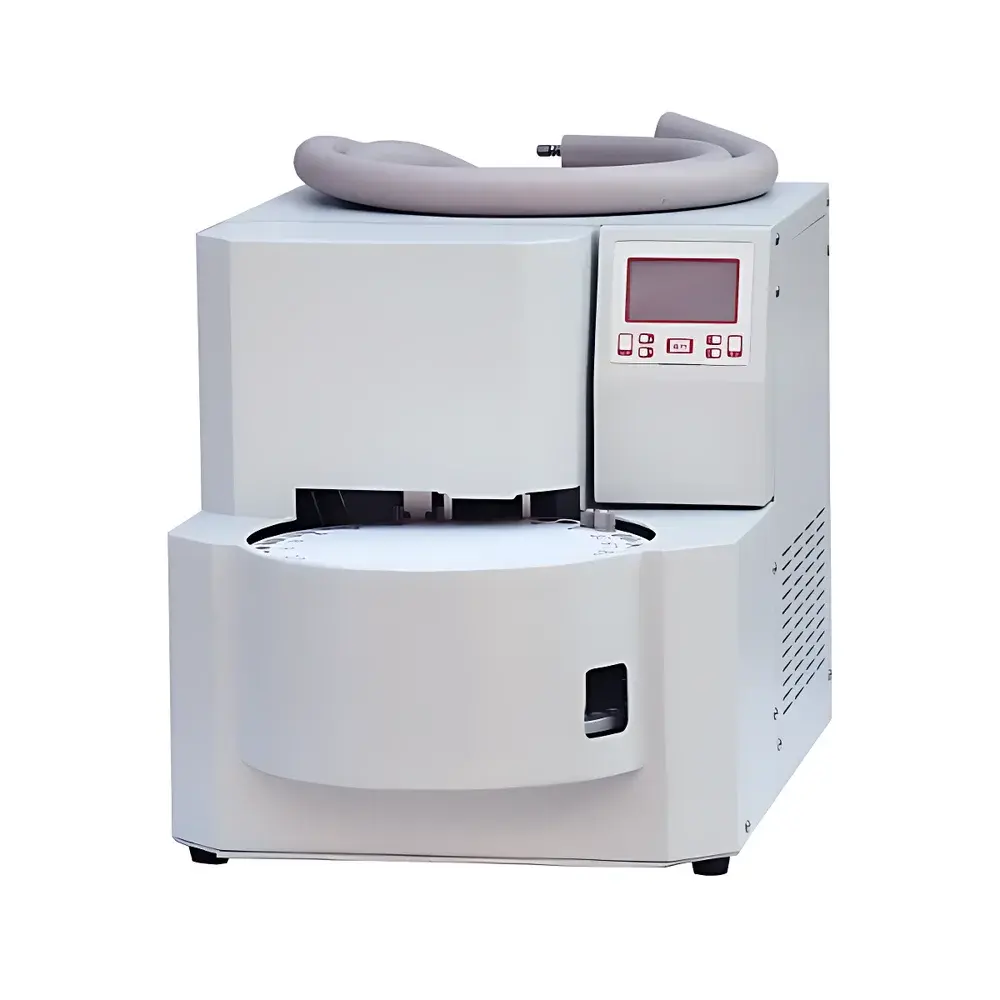
Zhuhui JX-20D Fully Automated Dual-Channel Secondary Thermal Desorber
| Brand | Zhuhui |
|---|---|
| Origin | Beijing, China |
| Manufacturer Type | Direct Manufacturer |
| Instrument Type | Secondary Thermal Desorber |
| Automation Level | Fully Automated |
| Primary Desorption Temperature Range | 40–400 °C |
| Secondary Desorption (Cryofocusing) Temperature Range | −35 to 450 °C |
| Valve & Transfer Line Temperature Range | 40–240 °C, ±1 °C accuracy |
| Cryotrap Temperature Range | −35 to −5 °C |
| Sample Tray Capacity | Dual 20-position (40 total) |
| Cryofocusing Rate | >70 °C/s |
| Peak Width (Secondary Desorption) | <3 s |
| RSD | ≤2.5% (benzene in 0.05 μg methanol) |
| Sample Tube Dimensions | 1/4″ OD × 3.5″ L |
| Simulated Sampling Flow | 0–200 mL/min |
| Power | 500 W peak |
| Dimensions | 600 × 370 × 400 mm |
| Net Weight | ~25 kg |
Overview
The Zhuhui JX-20D Fully Automated Dual-Channel Secondary Thermal Desorber is an engineered solution for high-sensitivity, quantitative analysis of volatile and semi-volatile organic compounds (VOCs/SVOCs) in air, sorbent tube, and environmental matrices. It operates on the principle of two-stage thermal desorption: primary desorption releases analytes from the sorbent tube into a heated transfer line, followed by cryofocusing in a thermoelectrically cooled trap (−35 °C minimum), and rapid secondary desorption (>70 °C/s) directly into the GC inlet. This architecture minimizes band broadening, maximizes analyte transfer efficiency, and delivers sharp, reproducible peaks—critical for trace-level quantification in regulated environmental and indoor air testing.
Key Features
- Dual independent 20-position sample trays (40 total), enabling unattended batch processing with automatic tube indexing, leak verification, and GC synchronization.
- Thermoelectric (Peltier) cryogenic cooling system achieving stable trap temperatures from −35 °C to −5 °C—eliminating reliance on liquid nitrogen or mechanical chillers and reducing operational cost and complexity.
- High-fidelity temperature control across all critical zones: primary desorption oven (40–400 °C), secondary desorption heater (−35 to 450 °C), valve box (40–240 °C), and transfer lines (40–240 °C), all maintained within ±1 °C accuracy via PID-regulated heating and real-time sensor feedback.
- Gas-tight, inert flow path constructed entirely from electropolished, Siltek®/Sulfinert®-treated 316 stainless steel tubing and PTFE-sealed fittings; no silicone-based components to prevent background contamination or analyte degradation.
- Integrated valve-and-line heating architecture with optimized flow-path geometry—including calculated variable-diameter connectors—to minimize dead volume and maximize desorption efficiency (>95% recovery typical for C2–C12 hydrocarbons).
- Pneumatically actuated sampling needle with low-maintenance cylinder drive ensures consistent penetration depth and long-term positional repeatability.
- Built-in simulated sampling function (0–60 min duration, 0–200 mL/min flow) enables method validation, calibration standard preparation, and system performance checks without external flow controllers.
Sample Compatibility & Compliance
The JX-20D accommodates standard 1/4″ OD × 3.5″ OD stainless steel or glass sorbent tubes (e.g., Tenax TA, Carbopack B/C, Carboxen 1000), supporting both single- and multi-bed configurations. Its precise thermal programming and inert flow path ensure compatibility with EPA TO-17, ISO 16017-1, and national standards including GB 50325-2020 (indoor benzene/TVOC), GB/T 18883-2022, HJ 583-2010, HJ 644-2013, and HJ 734-2014. The instrument supports GLP-compliant workflows through deterministic sequence logging, user-accessible audit trails, and full integration with chromatographic data systems (CDS) that comply with FDA 21 CFR Part 11 requirements for electronic records and signatures.
Software & Data Management
Controlled via embedded Linux-based firmware with a responsive touchscreen interface, the JX-20D provides intuitive method setup, real-time status monitoring, and event-driven diagnostics. All method parameters—including desorption times, temperature ramps, valve timing, and simulated sampling profiles—are stored as editable XML templates. Sequence files include timestamps, operator ID, and hardware state logs. Exportable CSV reports document run completion status, leak test results, temperature deviations, and RSD values per batch. The instrument supports RS-232, Ethernet, and dry-contact I/O for bidirectional communication with GCs and CDS platforms (e.g., Agilent OpenLab, Thermo Chromeleon, Shimadzu LabSolutions), enabling synchronized start/stop commands and ready-state handshaking.
Applications
- Regulatory compliance testing for indoor air quality (IAQ), workplace exposure assessment, and ambient air monitoring per national and international VOC protocols.
- Method development and validation for trace-level benzene, toluene, ethylbenzene, xylenes (BTEX), aldehydes, and oxygenated VOCs in environmental and industrial hygiene laboratories.
- Quality control of sorbent tubes and thermal desorption systems through recovery studies and breakthrough testing.
- Research applications requiring high-resolution, low-background analysis of complex VOC mixtures in emissions testing, material off-gassing studies, and forensic air sampling.
- Integration into automated laboratory environments where walk-away operation, minimal consumables, and robust fault handling are essential for 24/7 throughput.
FAQ
What sample tube formats does the JX-20D support?
Standard 1/4″ OD × 3.5″ sorbent tubes—compatible with common packed beds (Tenax, Carbopack, Carboxen) and commercial multi-bed tubes.
Does the instrument meet regulatory requirements for auditable data integrity?
Yes—full method parameter logging, timestamped run records, operator identification, and electronic signature-ready export formats support GLP/GMP and 21 CFR Part 11 compliance when paired with validated CDS software.
How is system leak integrity verified?
Automated pressure decay testing is performed before each sample run; failure triggers audible/visual alerts and halts sequence execution until resolution.
Can the JX-20D be integrated with third-party GCs not listed in the manual?
Yes—dry-contact trigger inputs/outputs and RS-232/Ethernet protocols allow custom integration with any GC featuring external start capability and ready-state signaling.
What maintenance is required for long-term reliability?
Routine tasks include periodic inspection of PTFE seals, cleaning of the sampling needle tip, and verification of thermoelectric cooler performance; no lubrication or valve servicing is needed due to pneumatic actuation and solid-state design.




