
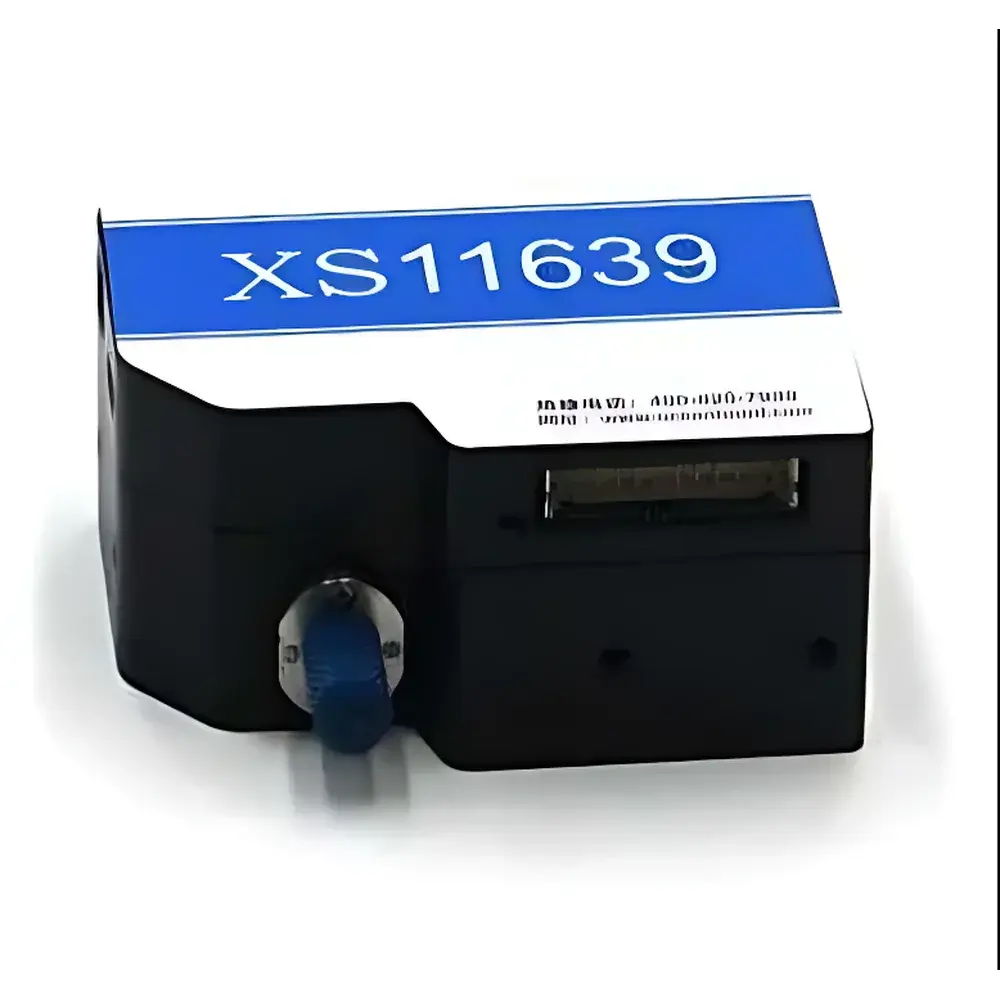
ZHUOLIHANG XS11639-350-1050-25 Fiber-Optic Spectrometer
| Brand | ZHUOLIHANG |
|---|---|
| Origin | Shanghai, China |
| Model | XS11639-350-1050-25 |
| Detector | Hamamatsu S11639 InGaAs-enhanced CCD linear array |
| Spectral Range | 350–1050 nm |
| Pixels | 2048 |
| Slit Width | 25 µm |
| Optical Resolution | ~1.5 nm (FWHM @ 200 µm fiber) |
| Wavelength Accuracy | < ±0.5 nm |
| SNR | 300:1 (full signal, 100 ms integration) |
| Dark Noise | 50 RMS counts (100 ms) |
| Dynamic Range | 1300:1 (@ 100 ms) |
| A/D Resolution | 16-bit |
| Integration Time | 1 ms – 65 s |
| Interface | USB-Micro |
| Dimensions | 75 × 63.5 × 31.5 mm |
| Weight | 185 g |
Overview
The ZHUOLIHANG XS11639-350-1050-25 Fiber-Optic Spectrometer is a compact, high-performance dispersive spectrometer engineered for precision UV-Vis-NIR spectral acquisition in demanding OEM and field-deployable applications. Based on a Czerny-Turner optical architecture with fixed grating and optimized collimation/focusing optics, it delivers consistent wavelength calibration and thermal stability across ambient operating conditions (0–40 °C). The instrument employs the Hamamatsu S11639 infrared-enhanced linear CCD sensor — a back-thinned, thermally stabilized device offering peak quantum efficiency exceeding 75% in the 500–900 nm range and extended responsivity up to 1050 nm. Paired with 16-bit analog-to-digital conversion and low-noise readout electronics, the system achieves a measured signal-to-noise ratio of 300:1 (full well, 100 ms integration) and a dynamic range of 1300:1 under identical conditions. Its robust mechanical design, minimal thermal drift (<0.005 nm/°C typical), and factory-calibrated wavelength scale support reliable quantitative analysis without routine recalibration.
Key Features
- Wide spectral coverage from 350 nm to 1050 nm — spanning deep UV through visible to short-wave near-infrared
- High optical resolution of ~1.5 nm FWHM when coupled with a 200 µm core optical fiber (slit-limited)
- Compact footprint (75 × 63.5 × 31.5 mm) and lightweight construction (185 g) optimized for embedded integration
- Thermally stable optical bench enabling repeatable spectral acquisition across 0–40 °C without active cooling
- Low dark noise performance (50 RMS counts at 100 ms integration), supporting low-light fluorescence and Raman measurements
- USB-Micro interface with vendor-provided SDK (C/C++, Python, LabVIEW) for deterministic data streaming and hardware control
Sample Compatibility & Compliance
The XS11639-350-1050-25 is compatible with standard SMA-905 fiber optic interfaces (200 µm, 400 µm, or 600 µm core fibers), enabling seamless coupling to light sources (e.g., deuterium-halogen lamps, LEDs, lasers), sample probes (reflection, transmission, immersion), and process flow cells. It meets general requirements for laboratory-grade instrumentation per IEC 61326-1 (EMC for measurement equipment) and conforms to RoHS Directive 2011/65/EU. While not certified for medical device use, its wavelength accuracy (<±0.5 nm) and linearity support method validation per ASTM E275, USP <857>, and ISO 17025-compliant laboratories performing qualitative identification and semi-quantitative analysis.
Software & Data Management
The spectrometer ships with cross-platform driver libraries and a configurable GUI application supporting real-time spectrum display, background subtraction, peak detection, and export in CSV, TXT, and JCAMP-DX formats. All spectral acquisitions include embedded metadata (timestamp, integration time, detector temperature estimate, calibration coefficients). The SDK supports audit-trail-enabled operation when integrated into validated systems — including timestamped command logging, user authentication hooks, and binary data integrity checksums — facilitating alignment with FDA 21 CFR Part 11 requirements where implemented within a broader GxP framework. Raw 16-bit frame data is accessible without loss for post-acquisition processing using third-party tools (e.g., MATLAB, Python SciPy).
Applications
- UV-Vis-NIR absorption spectroscopy for pharmaceutical raw material verification and counterfeit drug screening
- Portable gemological analysis — identification of natural vs. synthetic stones via characteristic absorption bands (e.g., ruby Cr3+ peaks at 694 nm, emerald Be3Al2Si6O18 features at 475–600 nm)
- In-field water quality monitoring — quantification of nitrate (200–220 nm), chlorophyll-a (660–680 nm), and dissolved organic carbon (300–400 nm)
- HPLC-UV diode array detection for method transfer and column characterization
- Fluorescence excitation-emission profiling in environmental and biochemical assays
- Reflectance spectroscopy for soil mineralogy and vegetation indices (NDVI, PRI) in geospatial surveying
FAQ
What is the calibrated wavelength accuracy, and how is it verified?
The instrument is factory calibrated using a NIST-traceable Hg-Ar pen-ray lamp (HG-1). Wavelength accuracy is validated across ≥12 emission lines between 365–912 nm; mean absolute error is <0.3 nm, maximum deviation <0.5 nm.
Can this spectrometer be used for Raman spectroscopy?
Yes — its thermal stability, low dark noise, and NIR sensitivity make it suitable for low-frequency Stokes-shifted Raman measurements (e.g., 785 nm excitation), particularly in portable or OEM-configured systems where cost and size are critical constraints.
Is firmware upgrade supported in the field?
Yes — firmware updates are delivered via USB and applied using the provided utility; version history and checksums are documented in release notes.
Does the device support triggering or synchronization with external equipment?
The current revision supports TTL-level software trigger initiation; hardware trigger input (GPIO) is available as an optional configuration upon request.
What is the recommended integration time range for optimal SNR in low-light fluorescence?
For fluorescence applications with weak signals, integration times between 100 ms and 5 s typically balance SNR improvement against dark current accumulation and potential saturation; longer exposures (>10 s) require dark-frame correction.
Are calibration certificates provided with each unit?
A Certificate of Conformance (CoC) listing spectral calibration points and test conditions is included; full ISO/IEC 17025 calibration reports are available as a paid service.





