
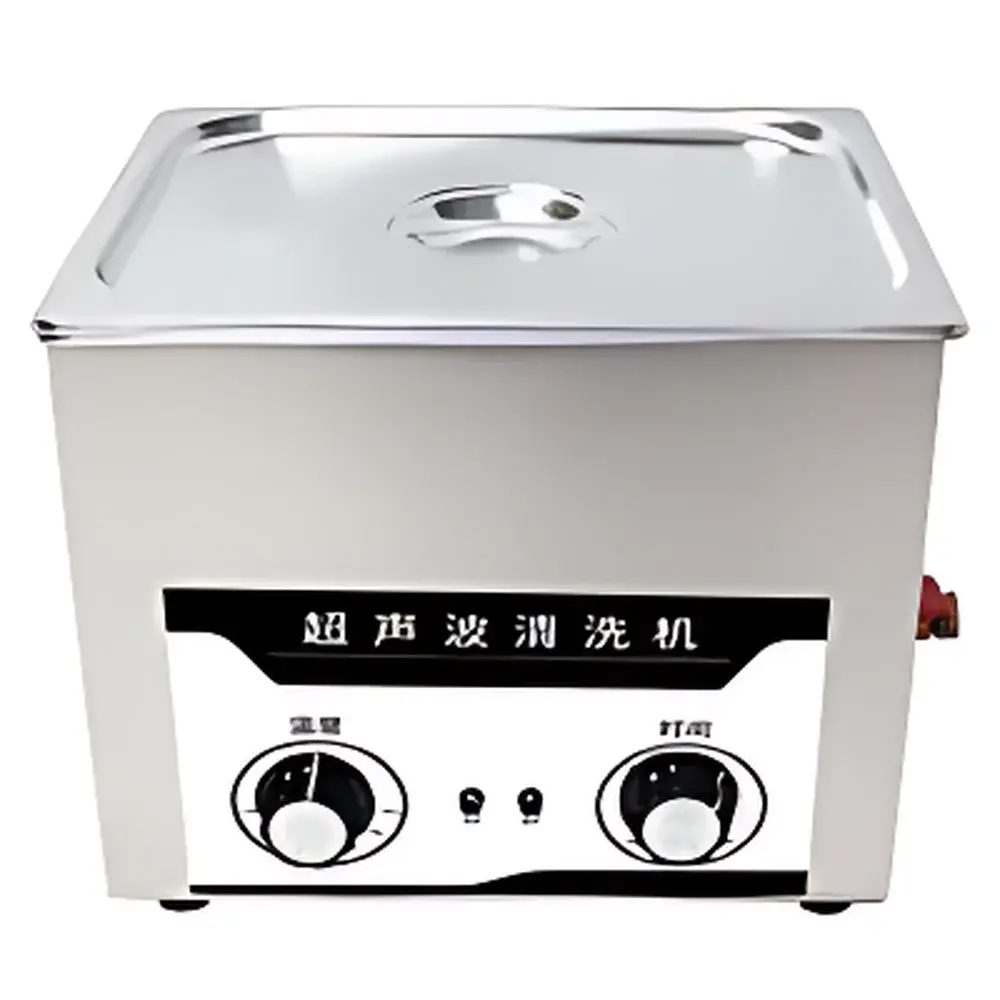
ZiQi ZQ-40H 10L Benchtop Mechanical Knob-Controlled Heated Ultrasonic Cleaner
| Brand | ZiQi |
|---|---|
| Origin | Shanghai, China |
| Manufacturer Type | Direct Manufacturer |
| Product Category | Domestic |
| Model | ZQ-40H (10L Capacity) |
| Instrument Type | General-Purpose |
| Tank Volume | 10 L |
| Ultrasonic Frequency | 40 kHz |
| Ultrasonic Power Output | 240 W |
| Adjustable Power | No |
| Temperature Control Range | Room Temperature to 80 °C |
| Timer Range | 1–30 min |
| Sound-Dampening Lid | Included |
| Drainage Method | Manual Valve |
Overview
The ZiQi ZQ-40H is a benchtop, mechanically controlled heated ultrasonic cleaner engineered for reproducible, high-integrity cleaning and sample preparation in laboratory, R&D, and light industrial environments. It operates on the principle of cavitation—generated by high-frequency (40 kHz) acoustic energy transmitted through an aqueous or compatible solvent medium—to dislodge particulate contaminants, remove organic residues, degas solutions, disrupt cell membranes, and support homogenization or extraction protocols. Unlike digitally controlled systems, the ZQ-40H employs robust mechanical knobs for temperature and timer adjustment—offering simplicity, operational reliability, and immunity to software-related failure modes. Its 10-liter stainless steel tank enables batch processing of larger components, multi-vessel arrays, or bulk samples, while integrated heating (up to 80 °C) enhances cleaning efficacy for waxy, viscous, or thermally responsive soils without requiring external water baths.
Key Features
- High-reliability 40 kHz transducer array with imported piezoelectric elements ensuring consistent cavitation intensity and long-term acoustic stability.
- Seamless, deep-drawn 304 stainless steel tank—no weld seams—eliminating crevice corrosion pathways and improving chemical resistance and leak integrity.
- Dual-layer construction: inner tank and outer chassis both fabricated from premium-grade stainless steel for structural rigidity, thermal retention, and corrosion resilience.
- Mechanical timer dial calibrated for precise 1–30 minute operation; no battery dependency or firmware updates required.
- Independent mechanical thermostat enabling stable temperature setpoints from ambient to 80 °C with ±3 °C typical accuracy under steady-state conditions.
- Integrated high-airflow cooling fan (standard on all ≥10 L models) to accelerate thermal recovery after heating cycles and maintain electronics longevity.
- Acoustically optimized hinged lid with sound-absorbing gasket reduces airborne noise to ≤65 dB(A) at 1 m distance—meeting standard lab acoustic safety thresholds.
- Front-mounted manual drain valve with brass body and EPDM seal for safe, tool-free liquid evacuation between cycles.
Sample Compatibility & Compliance
The ZQ-40H accommodates a broad range of sample formats—including glassware (beakers, flasks, vials), metal parts (surgical instruments, calibration standards), ceramic substrates, printed circuit boards, and biological tissue carriers—provided immersion-compatible solvents (e.g., deionized water, ethanol, isopropanol, alkaline detergents) are used. The unit complies with IEC 61000-6-3 (EMC emission limits) and IEC 61010-1 (safety requirements for electrical equipment for measurement, control, and laboratory use). While not certified for ISO 13485 or FDA 21 CFR Part 11 out-of-the-box, its mechanical controls and deterministic behavior support GLP/GMP-aligned documentation workflows when paired with standardized SOPs and manual logbook entries. All wetted surfaces meet USP Class VI biocompatibility criteria for indirect contact applications.
Software & Data Management
The ZQ-40H operates entirely without embedded software, firmware, or digital interfaces—eliminating cybersecurity exposure, validation overhead, and obsolescence risk associated with proprietary operating systems. Temperature and time settings are recorded manually via operator logs, supporting audit-ready traceability under ISO/IEC 17025 or CAP-accredited quality systems. For laboratories requiring electronic records, integration with external environmental monitoring systems (via optional PT100 probe output) or time-stamped video documentation of cycle initiation/completion is recommended. No data export, cloud connectivity, or remote access capabilities are present—consistent with its design philosophy of functional minimalism and regulatory transparency.
Applications
- Pre-analytical cleaning of HPLC vials, GC autosampler trays, and spectrophotometer cuvettes to eliminate carryover and baseline interference.
- Removal of polishing compounds and oxide layers from optical lenses, semiconductor wafers, and metrology artifacts prior to surface inspection.
- Cell lysis and subcellular fractionation in molecular biology workflows where thermal control (e.g., 37 °C for enzyme preservation) complements sonication intensity.
- Ultrasonic-assisted extraction of plant metabolites, soil-bound contaminants, or polymer additives using heated solvent mixtures.
- Degassing of resin formulations, casting media, or electrodeposition baths to suppress void formation and improve coating uniformity.
- Validation of cleaning efficacy per ASTM D4989 or USP through repeatable, parameter-locked cycles across multiple batches.
FAQ
Is the ultrasonic power output adjustable?
No—the ZQ-40H delivers a fixed 240 W nominal acoustic output at 40 kHz. Power modulation is not supported; intensity is controlled indirectly via solvent choice, temperature, and immersion depth.
Can this unit be used with flammable solvents?
Not without external explosion-proof modifications. The heater and transducers are not intrinsically safe; only aqueous or high-flashpoint solvents (e.g., >60 °C flash point) should be used without engineering controls.
Does it include a stainless steel basket?
A stainless steel mesh basket is available as an optional accessory—not included in the base configuration.
What is the maximum continuous operating time per cycle?
The mechanical timer supports up to 30 minutes per activation; for extended cleaning, manual restart is required.
How is temperature accuracy verified during qualification?
Users should perform independent calibration using a NIST-traceable immersion thermometer placed at the tank center, measured at three points (top/mid/bottom) after 15 minutes of thermal stabilization.



