
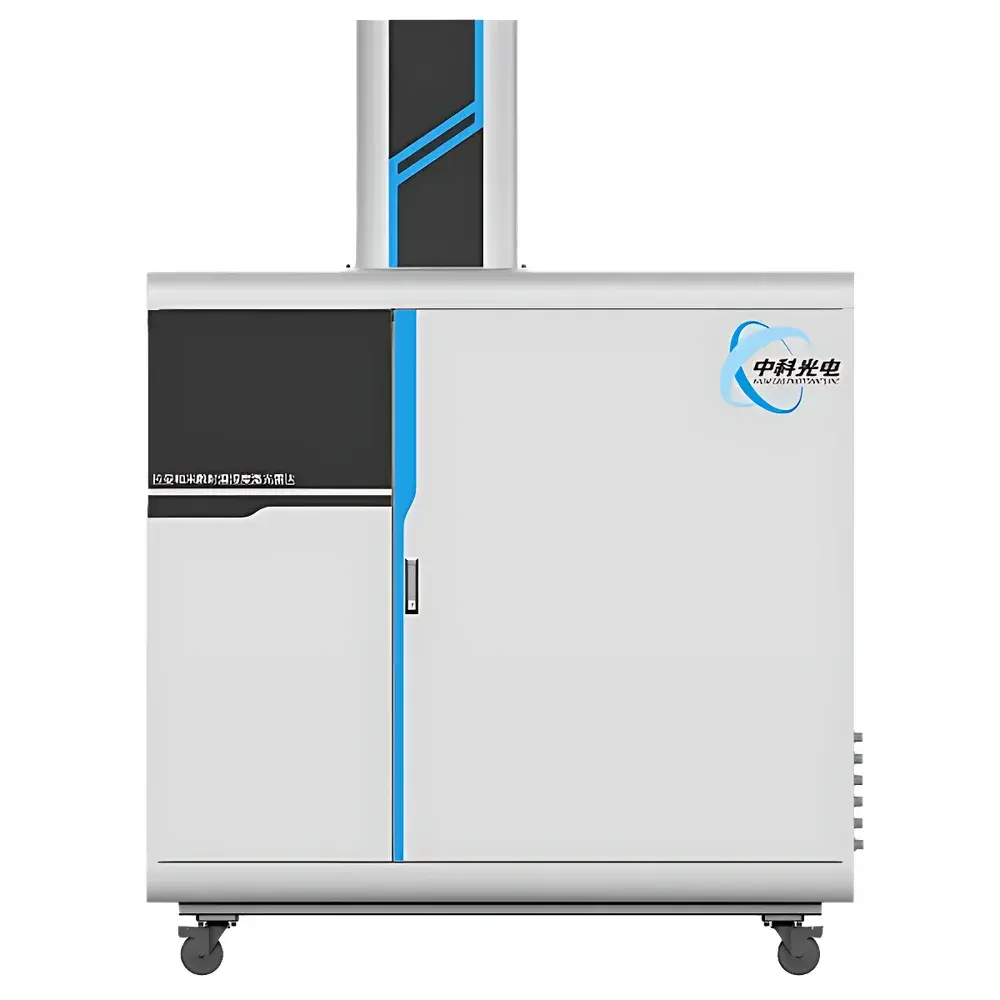
ZKGD-THR-2000 CASP Raman Temperature-Humidity-Aerosol Lidar (Tri-Wavelength, 10/12-Channel)
| Brand | CASP (Zhongke Optoelectronics) |
|---|---|
| Origin | Jiangsu, China |
| Manufacturer Type | Original Equipment Manufacturer (OEM) |
| Product Origin | Domestic (China) |
| Model | Raman Temperature-Humidity-Aerosol Lidar (Tri-Wavelength, 10/12-Channel) |
| Operating Wavelengths | 355 nm, 532 nm, 1064 nm |
| Maximum Detection Altitude | ≥10 km (aerosol backscatter), ≥5 km (temperature profile), ≥3 km (water vapor mixing ratio |
| Pulse Repetition Frequency | ≥100 Hz |
Overview
The ZKGD-THR-2000 is a tri-wavelength, multi-channel Raman lidar system engineered for high-fidelity, simultaneous vertical profiling of atmospheric temperature, water vapor mixing ratio, and aerosol optical properties. It operates on the physical principles of pure rotational Raman scattering from nitrogen (N₂) and oxygen (O₂) molecules at 355 nm and 532 nm, and vibrational Raman scattering from N₂ and H₂O molecules—enabling quantitative retrieval of thermodynamic state variables without reliance on radiosonde or model-assimilated boundary conditions. Unlike elastic-backscatter lidars, this system employs high-power, spectrally stabilized UV–visible–NIR laser sources coupled with high-throughput, thermally compensated monochromators and low-noise photon-counting detection to resolve weak Raman signals across ten or twelve spectral channels. Its architecture supports fully autonomous, unattended operation under both diurnal and nocturnal conditions, delivering continuous, calibrated profiles with temporal resolution down to 1 minute and vertical resolution configurable between 7.5 m and 30 m.
Key Features
- Tri-wavelength excitation (355 nm, 532 nm, 1064 nm) enabling independent retrieval of temperature, humidity, and aerosol extinction/backscatter coefficients via differential Raman signal analysis
- 10- or 12-channel spectral detection architecture with optimized bandpass filtering for N₂ rotational Raman (387 nm, 407 nm), H₂O vibrational Raman (660 nm), and elastic channels (355 nm, 532 nm, 1064 nm)
- Pulse repetition frequency ≥100 Hz ensures high signal-to-noise ratio (SNR) in near-range profiling while maintaining sufficient energy per pulse for stratospheric-level detection
- Automated calibration routines including real-time Rayleigh-atmosphere normalization, dark-current compensation, and detector quantum efficiency tracking
- Robust mechanical design compliant with IP54 environmental rating; operational temperature range: −25 °C to +50 °C; integrated thermal stabilization for optical bench and detectors
- Remote operation capability via secure TLS-encrypted Ethernet interface supporting SCPI command set and MODBUS TCP protocol
Sample Compatibility & Compliance
The ZKGD-THR-2000 is designed for deployment in fixed-site observatories, mobile atmospheric research platforms, and national meteorological network nodes. It complies with international observational standards for upper-air profiling, including WMO/GAW guidelines for aerosol and water vapor lidar intercomparison protocols (e.g., EARLINET, NDACC). Data products—including calibrated attenuated backscatter coefficient (β′), particle depolarization ratio (δ), temperature (T(z)), water vapor mixing ratio (q(z)), and lidar ratio (S(z))—are generated in CF-compliant NetCDF format conforming to the Atmospheric Radiation Measurement (ARM) data model. The system supports traceable calibration against NIST-traceable reference lamps and validated radiometric transfer standards. All firmware and control software adhere to ISO/IEC 17025:2017 requirements for measurement uncertainty quantification and GLP-aligned audit trails.
Software & Data Management
The embedded acquisition and inversion suite runs on a real-time Linux OS (Yocto Project-based) with deterministic scheduling for time-critical photon counting. Raw data are processed using a multi-step algorithm chain: (1) dead-time correction and afterpulsing compensation; (2) atmospheric transmission modeling using MODTRAN-derived transmittance lookup tables; (3) constrained least-squares inversion incorporating Tikhonov regularization for stable temperature/humidity profile retrieval; and (4) aerosol microphysical property estimation via Mie–Raman joint inversion. Exported Level 2 products integrate seamlessly with EUMETSAT’s E-Profile, NOAA’s AERONET-ASDA, and ESA’s ACTRIS metadata schemas. Optional FDA 21 CFR Part 11-compliant version available with electronic signature, role-based access control, and immutable audit logging for regulated environmental monitoring applications.
Applications
- Boundary-layer thermodynamic structure analysis for air quality forecasting and pollution episode attribution
- Validation of numerical weather prediction (NWP) models (e.g., ECMWF IFS, GFS) and reanalysis datasets (ERA5, MERRA-2) in the 0–10 km altitude range
- Quantification of convective initiation potential via vertical gradients of equivalent potential temperature (θₑ) and moist static energy
- Support for aviation meteorology through real-time detection of wind shear precursors, icing layers, and volcanic ash plumes
- Long-term trend analysis of tropospheric humidity and aerosol loading under climate change monitoring programs (e.g., GCOS, GEOSS)
- Field campaign integration with Doppler lidars, microwave radiometers, and unmanned aerial systems (UAS) for synergistic atmospheric process studies
FAQ
What atmospheric parameters does the ZKGD-THR-2000 directly measure?
It directly measures time-resolved photon counts in multiple Raman and elastic channels; derived geophysical products include temperature profiles (K), water vapor mixing ratio (g kg⁻¹), aerosol backscatter coefficient (m⁻¹ sr⁻¹), and particle linear depolarization ratio.
Is the system capable of day-night continuous operation?
Yes—its high spectral rejection ratio (>10⁶) and narrow-band interference filters ensure daytime Raman signal isolation even under full solar illumination; no mechanical shutter or external sun shield is required.
How is calibration maintained during long-term unattended operation?
Automatic daily calibration sequences include internal lamp-based spectral response verification, Rayleigh-fit consistency checks against modeled molecular density, and cross-channel gain drift monitoring using stable atmospheric layers.
Does the system support integration with existing meteorological data infrastructures?
Yes—data export supports BUFR, NetCDF4, and ASCII formats; metadata tagging follows ISO 19115 and CF conventions; API endpoints enable ingestion into OGC SensorThings API and THREDDS Data Server environments.
What level of technical support and software updates are provided post-deployment?
CASP offers 3-year standard warranty with remote diagnostics, biannual firmware updates, and annual algorithm revision packages aligned with latest EARLINET/ACTRIS best practices; extended SLAs include on-site maintenance and metrological recalibration services.
Related Products







