
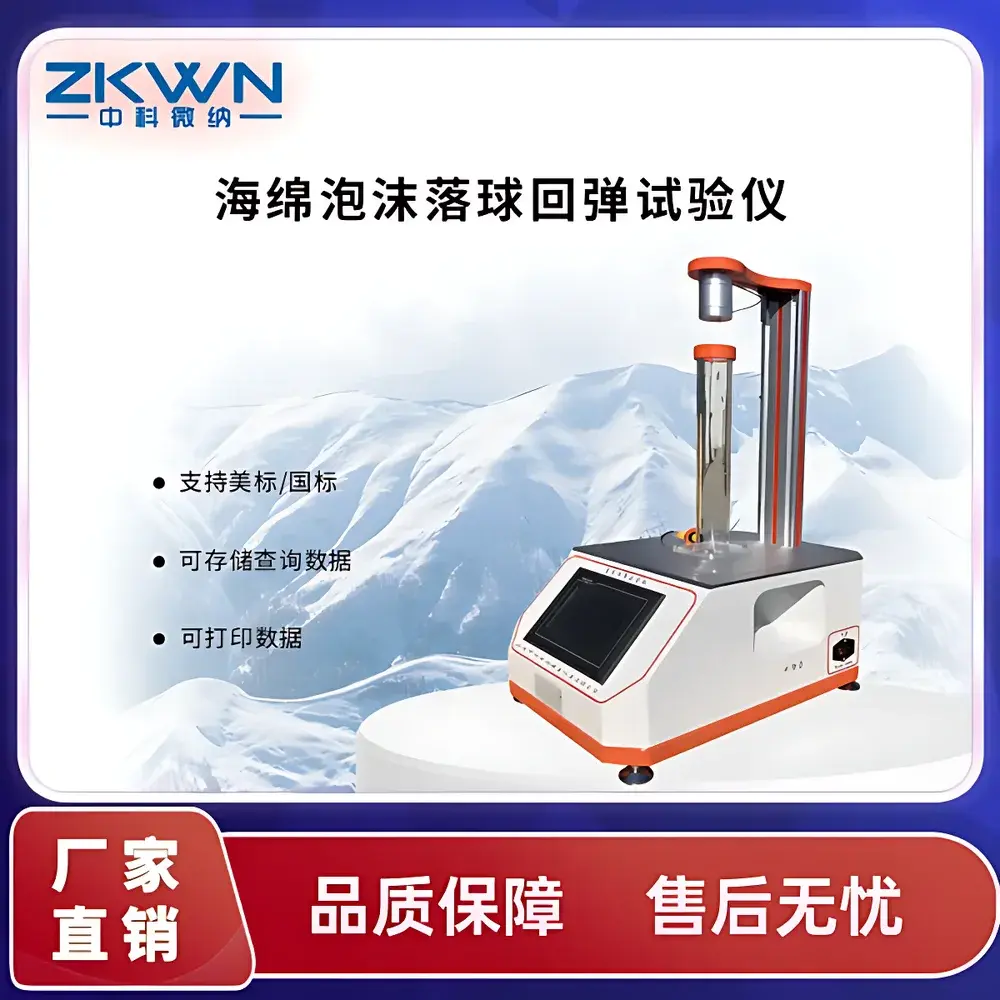
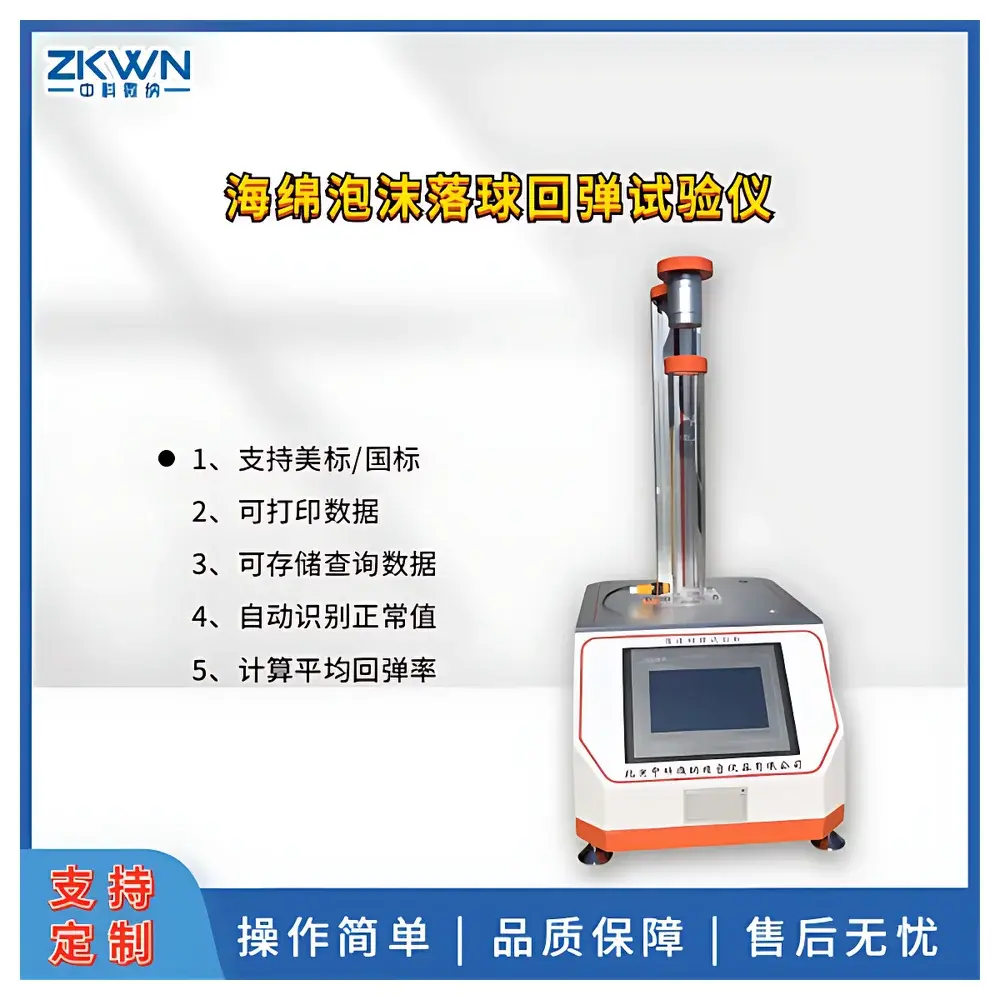
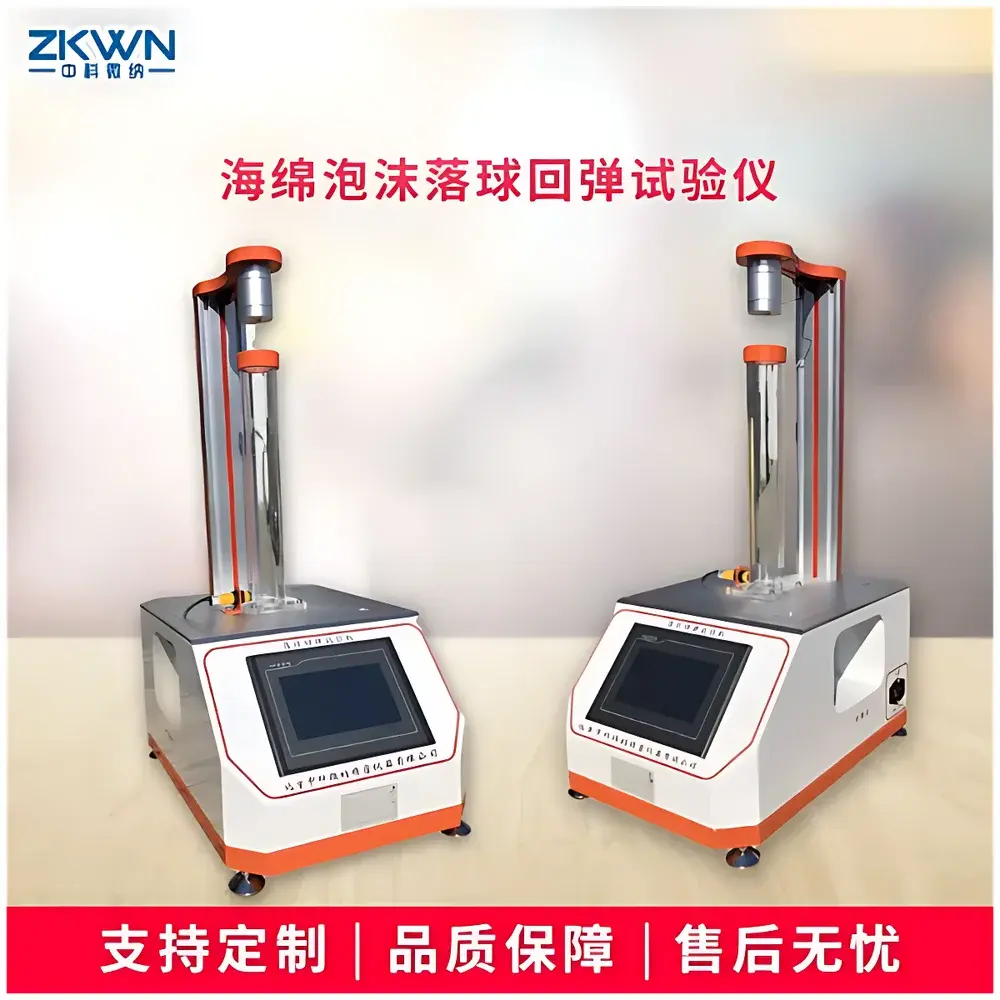
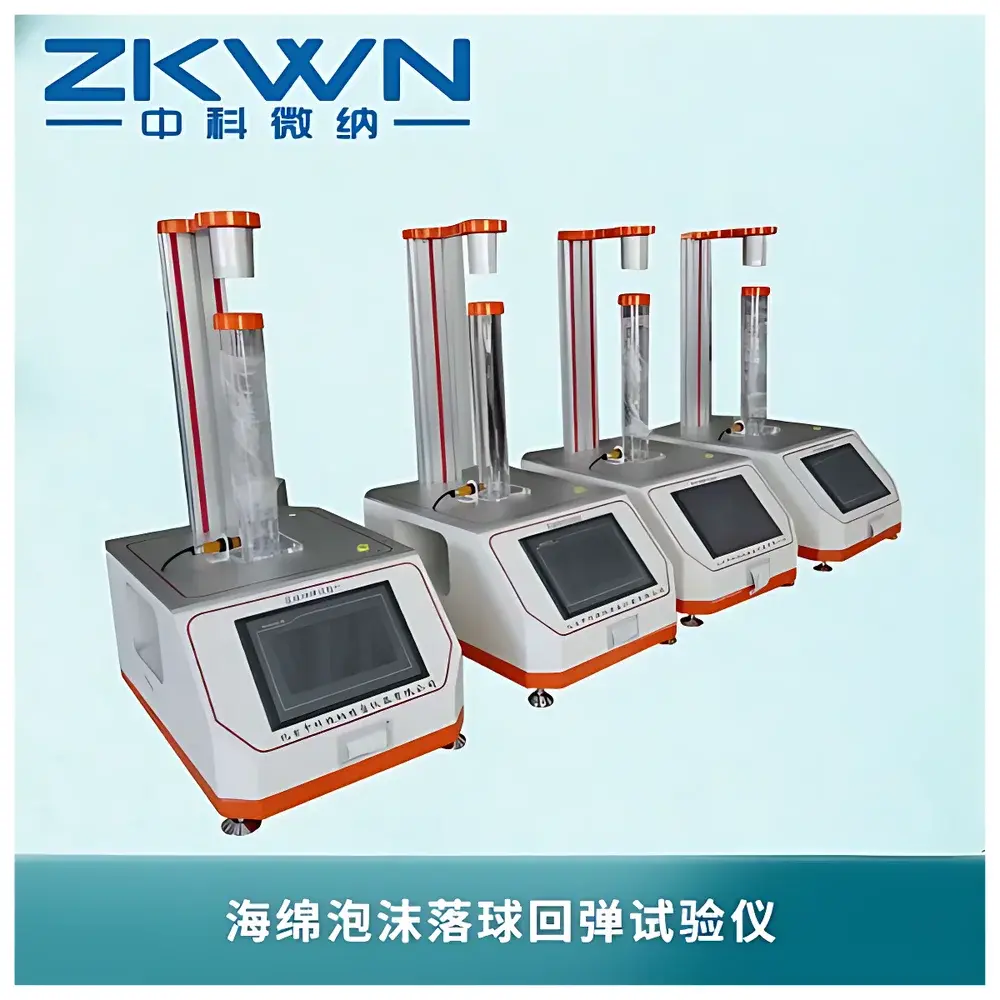
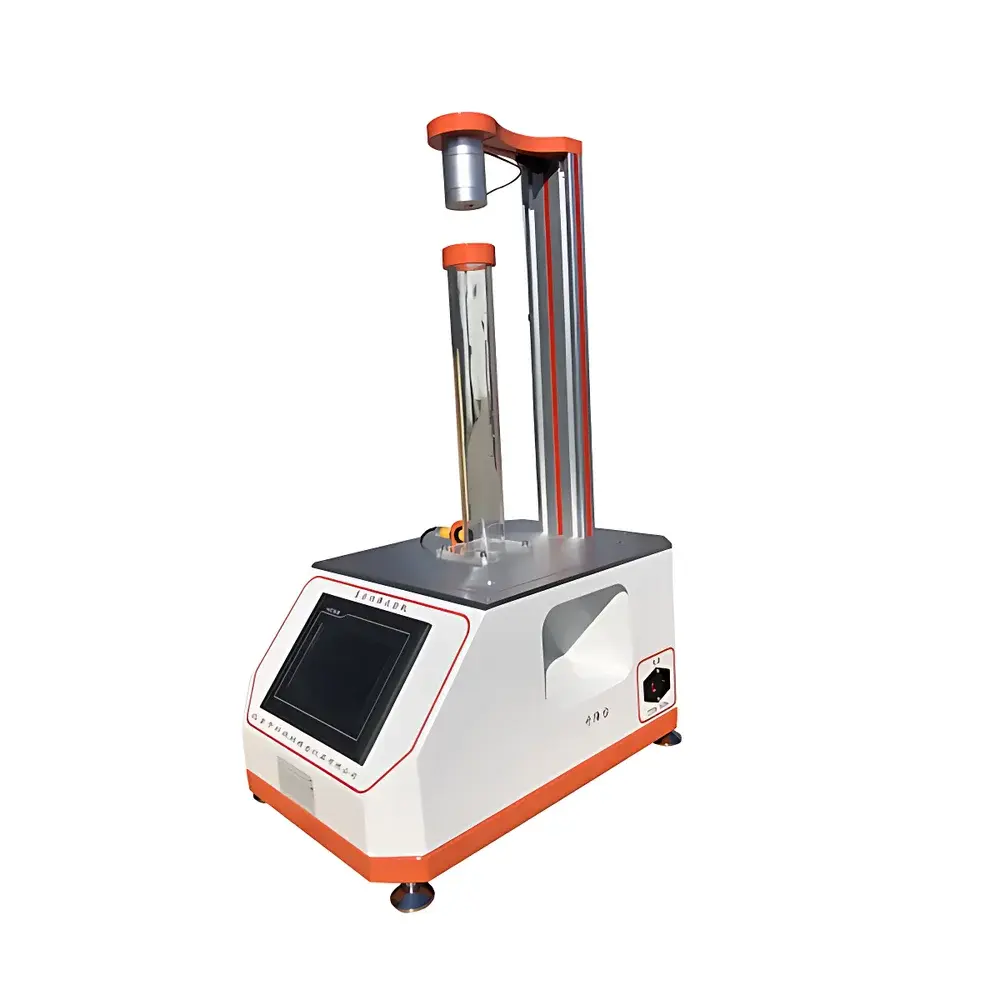
ZKWN ZKPMLQ-500V Foam Resilience Drop Tester
| Brand | ZKWN |
|---|---|
| Origin | Beijing, China |
| Manufacturer Type | Authorized Distributor |
| Country of Origin | China |
| Model | ZKPMLQ-500V |
| Drop Height | 80 mm |
| Max Sample Weight | 75 g |
| Max Sample Dimensions | 50 × 60 × 70 mm |
| Impact Surface Diameter | 56 mm |
| Compliance | GB/T 6670–2008, ISO 8307, ASTM D3574, GB/T 10652–2001 |
Overview
The ZKWN ZKPMLQ-500V Foam Resilience Drop Tester is an engineered instrument designed for the precise determination of resilience (rebound elasticity) in flexible polymeric foam materials—primarily soft polyurethane (PU) foams—using the standardized ball-drop method. It operates on the principle of gravitational free-fall impact: a calibrated steel sphere of defined mass and diameter is released from a fixed vertical height onto a horizontally mounted foam specimen. The rebound height is measured optically or via integrated displacement sensing, and resilience is calculated as the ratio of rebound height to drop height, expressed as a percentage. This method directly correlates with the material’s ability to recover energy after dynamic compression, making it a critical parameter for quality control in cushioning, seating, bedding, and packaging applications.
Key Features
- Electromagnetic release mechanism ensures zero rotational deviation and strict axial alignment of the steel ball during free fall—fully compliant with ISO 8307 and ASTM D3574 requirements for center-aligned, non-rotating impact.
- Integrated 7-inch industrial-grade touchscreen HMI with Chinese/English bilingual interface, powered by Siemens S7-1200 PLC for deterministic real-time control and I/O synchronization.
- Automated three-cycle testing per specimen (3 specimens × 3 drops = 9 total measurements), with embedded logic to identify and exclude outlier rebounds based on user-defined tolerance thresholds (e.g., ±5% deviation from median).
- On-device data storage supports batch-coded sample registration, timestamped test records, and export-ready CSV files—enabling traceability across production lots and QC audits.
- Rigid aluminum-alloy frame with vibration-damped base and precision-machined impact surface (Ø56 mm hardened steel plate) ensures mechanical stability and repeatability under laboratory conditions.
- Dual-mode height verification: automatic optical rebound detection + manual digital caliper readout mode for cross-validation and metrological verification per ISO/IEC 17025 calibration practices.
Sample Compatibility & Compliance
The ZKPMLQ-500V accommodates rectangular foam specimens up to 50 mm (L) × 60 mm (W) × 70 mm (H), with maximum mass limited to 75 g to maintain consistent boundary conditions during impact. Specimens must be conditioned per ASTM D3574 Section 6 (23 °C ± 2 °C, 50% RH ± 5%) prior to testing. The instrument meets the mechanical and procedural requirements of multiple international standards: GB/T 6670–2008 (equivalent to ISO 8307), GB/T 10652–2001 (for high-polymer porous elastic materials), and ASTM D3574 Method A (resilience of flexible cellular materials). While not certified to ISO/IEC 17025 itself, its measurement architecture supports integration into GLP-compliant laboratories when paired with documented calibration procedures, operator training records, and equipment maintenance logs.
Software & Data Management
Data acquisition and reporting are managed through the embedded PLC-HMI firmware—not third-party PC software—ensuring deterministic response timing and eliminating latency-induced measurement drift. Each test session automatically generates a structured record including: specimen ID, test date/time, ambient temperature/humidity (if external sensors are connected), individual rebound heights (mm), calculated resilience (%), pass/fail status per internal threshold, and arithmetic mean resilience for the specimen set. Export functionality supports USB flash drive transfer of raw CSV datasets compatible with LIMS platforms (e.g., LabWare, Thermo Fisher SampleManager) and statistical process control (SPC) tools such as Minitab or JMP. Audit trail capabilities include operator login timestamps and configuration change logs—aligned with FDA 21 CFR Part 11 principles where electronic records are subject to regulatory review.
Applications
- Quality assurance of automotive seat foams (e.g., driver/passenger cushions, headrests) against OEM specifications (e.g., Ford WSS-M99P20-A, GMW16007).
- Batch release testing for mattress core foams per ISO 2439 and EN 1957 compliance protocols.
- R&D evaluation of viscoelastic additives (e.g., silicone surfactants, reactive flame retardants) on dynamic recovery behavior.
- Supplier qualification testing where resilience serves as a proxy for long-term fatigue resistance in packaging inserts.
- Academic research on structure–property relationships in open-cell vs. closed-cell PU architectures under low-energy impact regimes.
FAQ
What steel ball specifications are used in accordance with ISO 8307?
The standard specifies a polished steel sphere of (16.0 ± 0.1) mm diameter and (16.0 ± 0.1) g mass. ZKWN provides NIST-traceable calibration certificates for supplied balls upon request.
Does the instrument support variable drop heights beyond 80 mm?
No—the ZKPMLQ-500V is mechanically and firmware-locked to a fixed 80 mm drop height to ensure full compliance with GB/T 6670–2008 and ISO 8307. Custom-height variants require revalidation per ISO/IEC 17025 and are available under OEM agreement.
How is outlier rejection implemented during triple-drop averaging?
The system computes the median of three rebound heights, then excludes any value deviating by more than ±5% from that median before calculating the final mean. This algorithm mirrors the “normal value” selection logic described in GB/T 10652–2001 Annex B.
Is external environmental monitoring integrated?
The base unit does not include built-in温/humidity sensors, but features RS-485 Modbus RTU ports to connect third-party calibrated probes (e.g., Vaisala HMP110) for automated ambient condition logging alongside test data.
Can test reports be generated in English for international clients?
Yes—language selection is configurable on the HMI. All exported CSV headers, on-screen prompts, and printable reports default to English unless manually switched to Chinese.



