
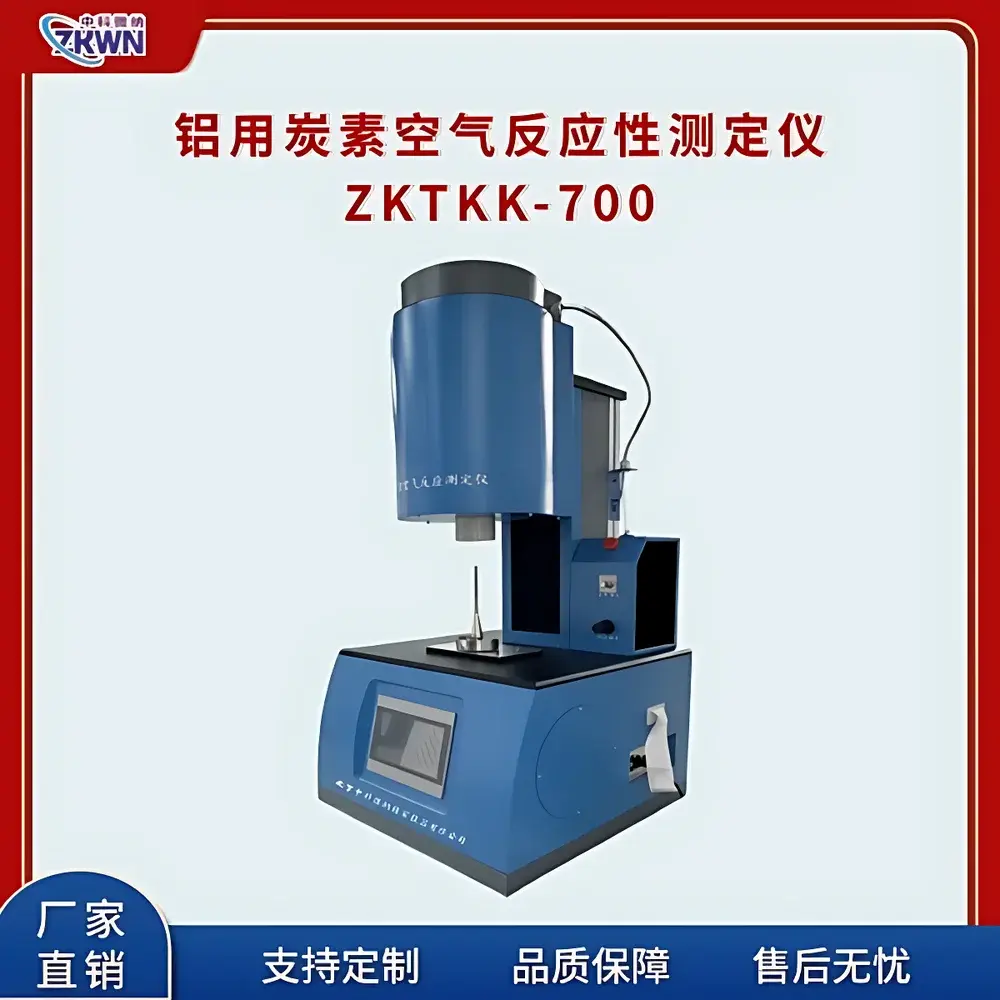
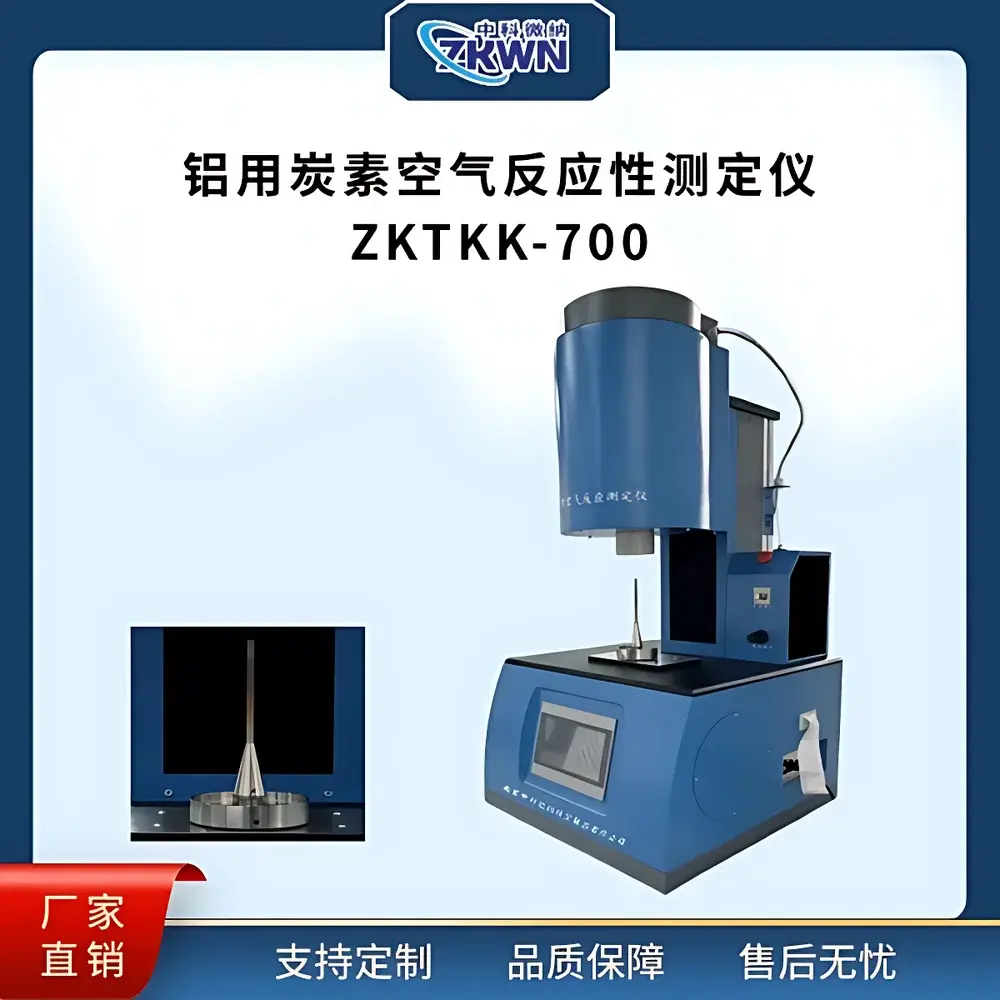
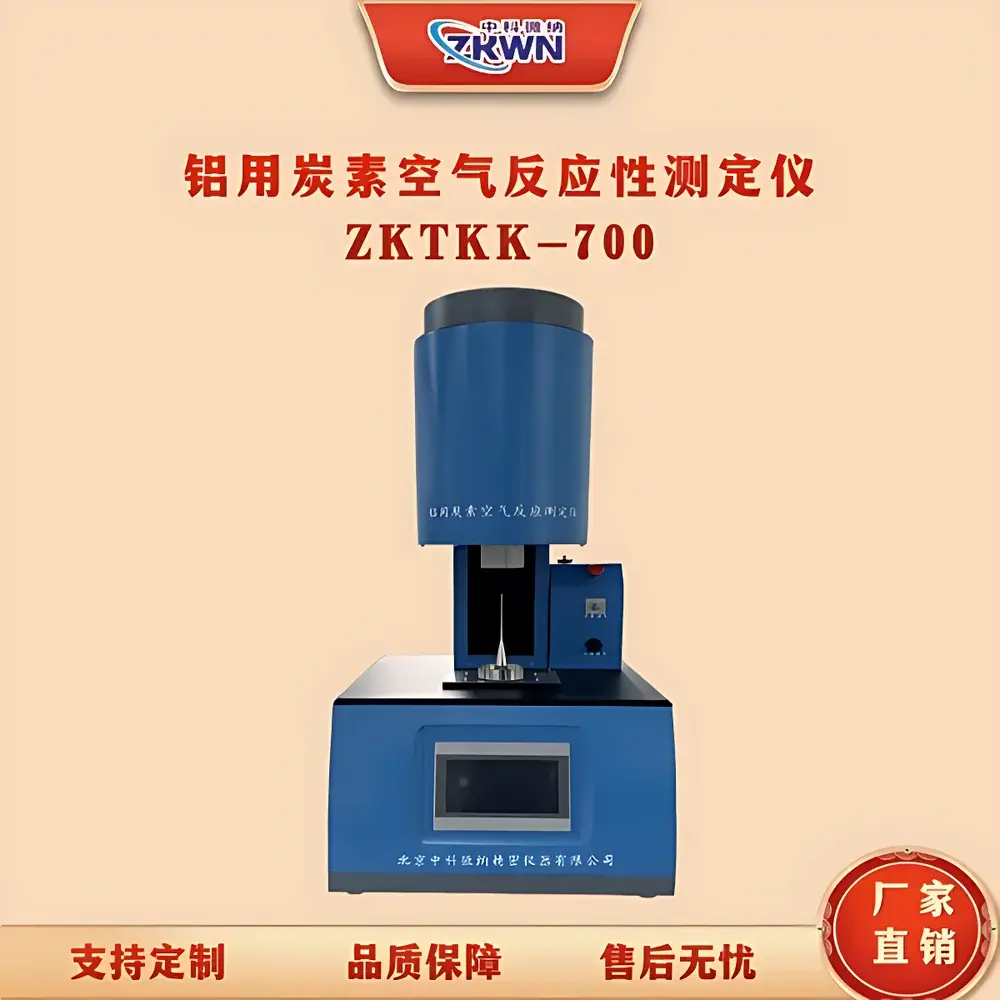
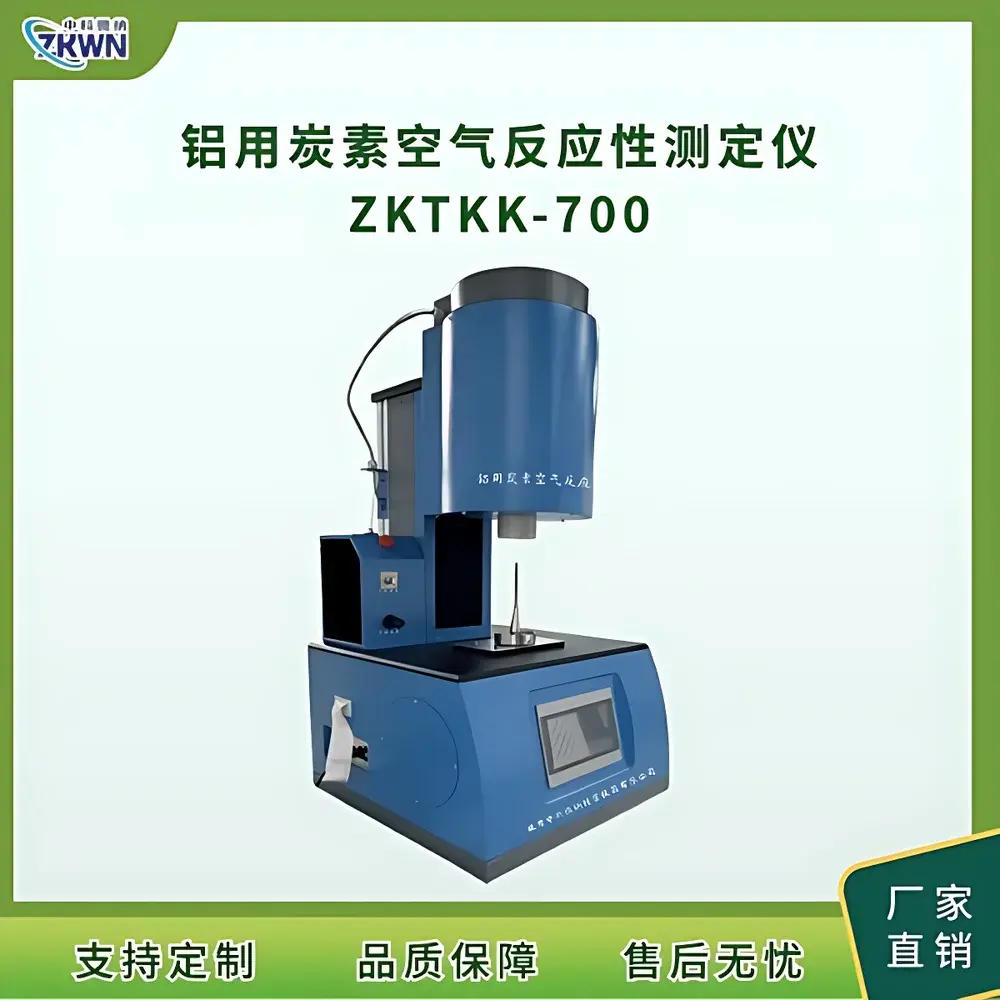
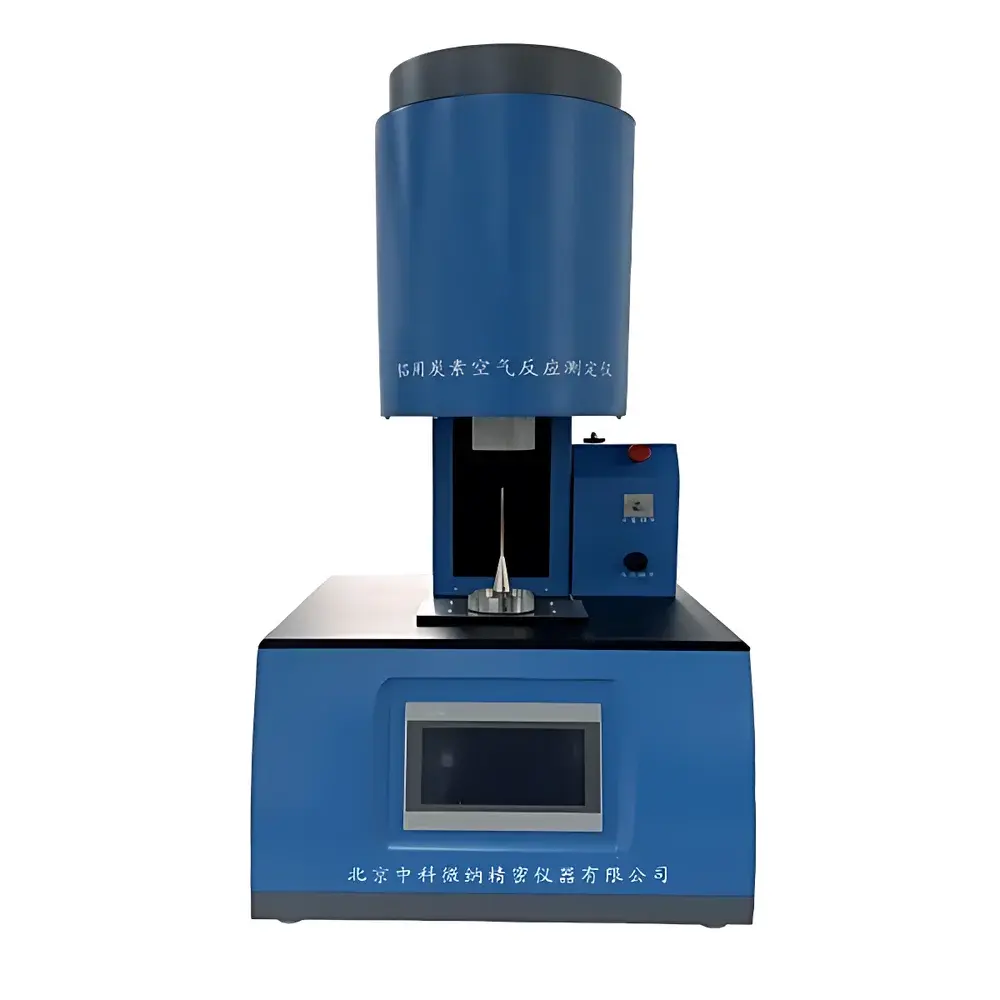
ZKWN ZKTKK-700c High-Temperature Air Reactivity and Thermal Expansion Tester for Carbon Anodes
| Brand | ZKWN |
|---|---|
| Origin | Beijing, China |
| Model | ZKTKK-700c |
| Temperature Range | 200 °C (max. 700 °C) |
| Max. Heating Rate | 80 °C/min |
| Temperature Accuracy | ±1 °C |
| Sample Dimensions | Ø50 mm ±1 mm × 60 mm ±1 mm |
| Measurement Range | 1 mm |
| Resolution | 0.01 mm |
| Atmosphere Control | Air (filtered, pressure-regulated, flow-controlled) |
| Flow Sensor Range | 250 L/h, ±4% FS |
| Pressure Sensor Range | 0–1 MPa, Class ≥1.5 |
| Vibration Frequency | 1 rpm |
| Rated Power | 1.5 kW |
| Voltage/Frequency | 220 V / 50 Hz |
| Device Dimensions | 750 × 700 × 1600 mm |
| Weight | 150 kg |
Overview
The ZKWN ZKTKK-700c High-Temperature Air Reactivity and Thermal Expansion Tester is a specialized thermal analysis instrument engineered for the quantitative evaluation of oxidation behavior and dimensional stability in carbon-based refractory materials—particularly prebaked anodes and side-blocks used in aluminum electrolysis cells. It integrates simultaneous air reactivity assessment with precision linear thermal expansion measurement under controlled oxidative atmosphere, operating up to 700 °C. The system employs a dual-mode experimental protocol: first, thermally induced dimensional change (dilatometry) is recorded via high-resolution linear displacement transduction; second, mass loss kinetics and structural degradation are monitored under precisely metered, filtered, and pressure-stabilized air flow—enabling correlation between thermal expansion, microstructural evolution, and oxidative weight loss. This functional integration supports ASTM D3175, ISO 1171, and GB/T 25907–2010 compliance frameworks for carbon anode qualification.
Key Features
- Robust high-temperature furnace architecture featuring vacuum-formed ceramic fiber insulation and embedded resistance heating elements, ensuring uniform temperature distribution and stable isothermal zones (±1 °C at 700 °C).
- Integrated PID-based temperature control system with K-type thermocouple feedback (0–800 °C range), delivering rapid ramp rates up to 80 °C/min and sustained thermal accuracy within ±1 °C after stabilization.
- Dual-path gas delivery subsystem: air passes through multi-stage filtration (particulate + moisture removal), precision pressure regulation (0–1 MPa, Class ≥1.5 sensor), and mass-flow control (250 L/h, ±4% full-scale accuracy) to maintain stoichiometric consistency across replicate tests.
- High-resolution linear displacement measurement module with 0.01 mm resolution and 1 mm full-scale range, calibrated traceably to NIST-traceable standards.
- Programmable logic controller (PLC) core with dual-interface operation: intuitive 7-inch resistive touch HMI for local setup and real-time monitoring, plus Ethernet-enabled PC software for remote experiment scheduling, data logging, and post-acquisition curve fitting.
- Mechanically synchronized sample vibration mechanism (1 rpm) to simulate operational mechanical stress during thermal-oxidative exposure—critical for replicating in-situ anode degradation modes observed in potline environments.
Sample Compatibility & Compliance
The ZKTKK-700c accepts cylindrical carbon specimens per standard dimensions: Ø50 mm ±1 mm × 60 mm ±1 mm. Its design accommodates both virgin and partially graphitized anode materials, as well as sidewall carbon blocks. All hardware components—including furnace chamber, gas lines, and sensor housings—are constructed from oxidation-resistant alloys compatible with prolonged exposure to hot, humid air at elevated temperatures. The system supports audit-ready data integrity per GLP and GMP principles: software enforces user-level access control, timestamps all parameter changes, and logs raw sensor outputs with millisecond resolution. While not certified to IEC 61508 or UL 61010-1 out-of-box, its electrical architecture complies with CE-conformant safety margins for Class I equipment operating at 220 V / 50 Hz.
Software & Data Management
The proprietary ZKWN TestSuite v3.2 software provides comprehensive experiment lifecycle management. Users define multi-segment thermal profiles (ramp/hold/cool), set gas flow/pressure thresholds, and configure alarm conditions (e.g., deviation >±2 °C, flow drop >10%). Real-time plots display displacement vs. time, temperature vs. time, and derivative dL/dT curves. Post-run analysis includes CTE (coefficient of thermal expansion) calculation over user-defined intervals, oxidation onset temperature identification via inflection-point detection, and mass-loss rate derivation from displacement-coupled calibration models. Export formats include CSV, XLSX, and PDF reports compliant with internal QA documentation requirements. Audit trails record operator ID, timestamp, parameter edits, and calibration events—fully aligning with FDA 21 CFR Part 11 electronic record retention expectations when deployed in regulated manufacturing environments.
Applications
- Quality assurance testing of prebaked anodes prior to potline insertion, verifying adherence to air reactivity limits specified in IAI Anode Quality Guidelines.
- Research into carbon oxidation mechanisms under simulated smelting conditions, including kinetic modeling of CO/CO₂ evolution pathways.
- Evaluation of antioxidant additives (e.g., SiC, TiB₂) by comparative thermal expansion and weight-loss profiling.
- Thermal shock resistance screening via controlled cyclic heating/cooling under air flow, correlating expansion hysteresis with microcrack formation.
- Supplier qualification and incoming material inspection for aluminum producers seeking ISO 9001:2015-compliant process validation records.
FAQ
What standards does the ZKTKK-700c support for anode air reactivity testing?
It enables method development aligned with ASTM D3175 (for volatile matter), ISO 1171 (ash content), and GB/T 25907–2010 (Chinese national standard for carbon anode air reactivity). Full compliance requires lab-specific SOP validation.
Can the system operate under inert atmospheres such as N₂ or Ar?
No—the ZKTKK-700c is specifically engineered for air reactivity assessment and lacks gas-switching valves or purge protocols required for inert or reducing atmospheres.
Is the 0.01 mm displacement resolution maintained across the full 1 mm range?
Yes—linearity error is ≤0.1% FS per manufacturer calibration certificate, verified using certified gauge blocks traceable to national metrology institutes.
Does the software support automated pass/fail判定 based on user-defined specification limits?
Yes—threshold-based pass/fail flags can be assigned to CTE values, oxidation onset temperature, or cumulative expansion at 700 °C, with configurable reporting templates.
What maintenance intervals are recommended for the flow and pressure sensors?
Annual recalibration is advised; filter elements require replacement every 200 operational hours or quarterly—whichever occurs first—to ensure gas purity and measurement fidelity.



