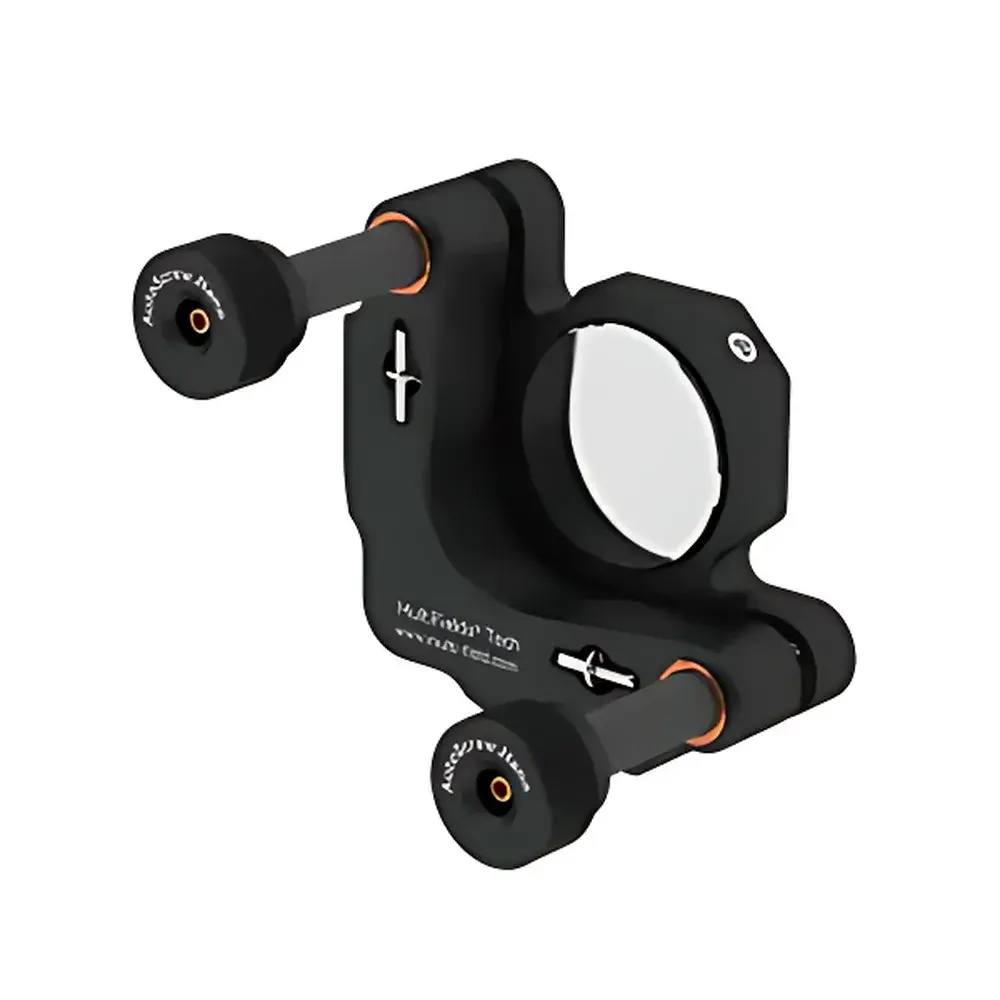
ZOLIX AutoScrew.Nano Piezo-Driven Linear Translation Stage
| Brand | ZOLIX |
|---|---|
| Origin | Beijing, China |
| Manufacturer Type | Original Equipment Manufacturer (OEM) |
| Product Type | Motorized Translation Stage |
| Model | AutoScrew.Nano |
| Motion Principle | Piezoelectric Screw-Driven Linear Actuation |
| Resolution | Sub-nanometer |
| Bandwidth | Up to 10 kHz |
| Maximum Travel | 40 µm |
| Vacuum Compatibility | UHV-Compatible (≤10⁻⁹ mbar) |
| Magnetic Field Compatibility | Non-magnetic Construction |
| Controller Compatibility | Archimedes Series Motion Controllers |
| Integration Ready | BeamStabilizer™ Optical Feedback Systems |
| Dimensions | 2D Mechanical Drawing Available Upon Request |
Overview
The ZOLIX AutoScrew.Nano is a high-precision, piezo-driven linear translation stage engineered for demanding optical alignment and active stabilization applications in research-grade optical laboratories. Unlike conventional stepper- or servo-motor-based stages, the AutoScrew.Nano employs a proprietary piezoelectric screw-actuation mechanism that converts high-frequency electrical signals into precise mechanical displacement via controlled piezoelectric expansion—enabling true sub-nanometer resolution without hysteresis or backlash. Its operational principle relies on closed-loop piezoelectric actuation coupled with integrated strain gauge or capacitive position sensing (depending on configuration), delivering deterministic motion response across its full 40 µm travel range. Designed explicitly for integration into ultra-stable optical trains—including interferometers, cavity ring-down systems, and quantum optics setups—the stage operates reliably under ambient conditions and maintains performance integrity in ultra-high vacuum (UHV) environments down to 10⁻⁹ mbar. Its non-magnetic construction ensures compatibility with magnetic-sensitive experiments such as magneto-optical trapping (MOT), NV-center spectroscopy, and cryogenic SQUID-based detection platforms.
Key Features
- Sub-nanometer open-loop resolution with repeatable positioning accuracy ≤ ±1 nm (typ.) over full stroke
- Dynamic bandwidth of up to 10 kHz—enabling real-time correction of beam path fluctuations induced by acoustic noise or thermal drift
- 40 µm unidirectional travel range optimized for fine-tuning of optical cavity length, mirror tilt compensation, and polarization axis alignment
- UHV-rated materials and bake-out compatible design (up to 150 °C), including ceramic insulators, stainless-steel housing, and silver-plated copper flexures
- Zero magnetic signature: no ferromagnetic components; fully compatible with MRI-adjacent setups and low-field spin resonance experiments
- Standard M4 and SM1 threading for direct mounting of kinematic mirror mounts, lens tubes, and fiber collimators
- Integrated electrical interface compliant with industry-standard LEMO 00 (7-pin) or D-sub 15 connectors for analog voltage control and encoder feedback
Sample Compatibility & Compliance
The AutoScrew.Nano is not a sample-analysis instrument but a precision motion subsystem intended for integration into larger optical assemblies. As such, it imposes no intrinsic sample constraints—its compatibility is defined by mechanical interface standards and environmental tolerances. It conforms to ISO 9001:2015 manufacturing protocols and meets mechanical safety requirements per IEC 61000-6-2 (immunity) and IEC 61000-6-4 (emission). For regulated environments—including GLP-compliant metrology labs and FDA-audited biophotonics facilities—the stage supports traceable calibration documentation and optional factory-certified linearity reports (per ISO 230-2). Its vacuum-compatible architecture aligns with ASTM E595 outgassing specifications (<1.0% TML, <0.1% CVCM), making it suitable for space-qualified optical payloads and synchrotron beamline instrumentation.
Software & Data Management
The AutoScrew.Nano interfaces natively with ZOLIX’s Archimedes Series motion controllers, which provide both analog (±10 V) and digital (USB 2.0, Ethernet TCP/IP) command protocols. Firmware supports standard SCPI command sets and offers programmable waveforms (sine, triangle, step, custom CSV-loaded profiles) for active vibration cancellation and periodic scanning routines. Data logging is synchronized at up to 50 kS/s via onboard FPGA-accelerated acquisition, enabling time-correlated analysis of stage position versus external sensor inputs (e.g., quadrant photodiode error signals). All controller firmware adheres to FDA 21 CFR Part 11 requirements when operated in audit-trail-enabled mode—supporting electronic signatures, user access tiers, and immutable event logs for regulated QC/QA workflows.
Applications
- Active stabilization of free-space optical cavities in gravitational wave detector prototype systems
- Fine adjustment of grating angles in high-resolution monochromators and tunable laser resonators
- Real-time compensation of thermal lensing effects in ultrafast amplifier chains
- Precision spacing control in multi-layer dielectric mirror stacks during in-situ deposition monitoring
- Beam pointing stabilization in satellite-ground quantum key distribution (QKD) ground stations
- Position synchronization with delay-stage systems in pump-probe spectroscopy configurations
FAQ
Is the AutoScrew.Nano compatible with third-party motion controllers beyond the Archimedes Series?
Yes—its analog input accepts standard ±10 V commands, and digital communication follows documented ASCII/SCPI syntax, enabling integration with Thorlabs Kinesis, Newport APT, or LabVIEW-based custom controllers.
Does the stage include built-in position feedback?
Base models feature open-loop operation; closed-loop variants integrate capacitive or resistive position sensors with 0.5 nm typical resolution and are available upon request.
Can multiple AutoScrew.Nano units be synchronized for multi-axis control?
Yes—Archimedes controllers support master-slave daisy-chaining over Ethernet with sub-microsecond inter-unit timing jitter.
What is the recommended maintenance interval under continuous UHV operation?
No scheduled maintenance is required; however, periodic verification of zero-point drift (every 6 months) is advised for metrology-critical deployments.
Are CAD models and footprint drawings available for mechanical integration?
Yes—STEP, IGES, and PDF dimensional drawings (including 2D outline and mounting hole locations) are provided with purchase and accessible via ZOLIX’s secure customer portal.