
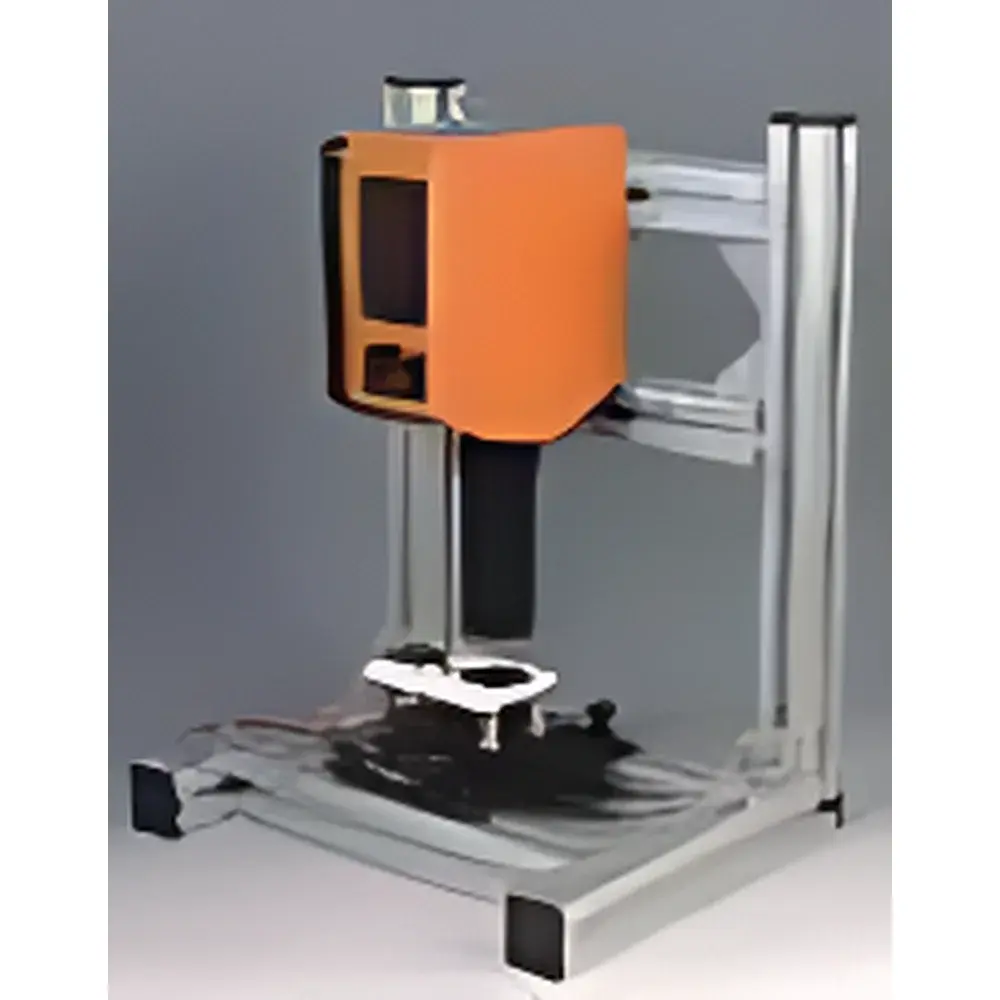
ZOLIX CHAMELEON-100 LED Optical Measurement System
| Brand | ZOLIX |
|---|---|
| Model | CHAMELEON-100 |
| Origin | Beijing, China |
| Manufacturer | ZOLIX (OEM/ODM Capable) |
| Category | Spectroradiometric LED Characterization System |
| Spectral Range | 380–780 nm |
| Spectral Resolution | 2.5 nm |
| Measurement Speed | ≤30 ms per spectrum |
| Photometric Accuracy | Luminous Intensity ±7%, Dominant Wavelength ±1 nm, Chromaticity Coordinates (x,y) ±0.005 (vs. stable reference lamp) |
| Photometric Repeatability | Luminous Intensity ±2%, Dominant Wavelength ±0.3 nm, (x,y) ±0.002 |
| Luminous Intensity Range | 5 mcd – 30,000 mcd |
| Luminous Flux Range | 20 mlm – 200 lm |
| Interface | USB 2.0 |
| Power | USB bus-powered (5 V DC) |
| Dimensions (Spectrometer Only) | 140 × 80 × 180 mm |
| Calibration Traceability | NIST-traceable |
| compliant with CIE S 025/E | 2015 and CIE 127:2007 |
Overview
The ZOLIX CHAMELEON-100 LED Optical Measurement System is a compact, high-speed spectroradiometric platform engineered for precise, repeatable characterization of solid-state lighting (SSL) devices—including discrete LEDs, LED packages, COBs, and small-area light sources. Built around the proprietary SGM100 imaging spectrometer and thermoelectrically stabilized CCD detector, the system implements a direct-optical-path architecture—eliminating fiber-optic coupling entirely. This optical design minimizes photon loss, eliminates modal noise and polarization-dependent transmission artifacts, and ensures superior signal fidelity across the visible spectrum (380–780 nm). The CHAMELEON-100 operates on first-principles radiometric calibration principles, with spectral responsivity traceable to NIST standards and full compliance with CIE S 025/E:2015 (LED measurement requirements) and CIE 127:2007 (measurement of LEDs at a single point). It delivers quantitative photometric, colorimetric, and spectral radiant flux data without requiring external calibration lamps during routine operation—enabling rapid, lab-grade measurements in R&D, incoming inspection, and production line environments.
Key Features
- Direct optical path architecture: No fiber coupling—maximizes throughput and preserves spectral integrity
- Integrated SGM100 imaging spectrometer with 2.5 nm FWHM spectral resolution (pixel-limited)
- Thermally stabilized back-illuminated CCD sensor for low-noise, high-dynamic-range spectral acquisition
- Full suite of CIE-compliant photometric and colorimetric calculations: spectral radiant flux (W/nm), peak wavelength (λp), dominant wavelength (λd), center wavelength (λc), excitation purity (%), CIE 1931 chromaticity coordinates (x, y), correlated color temperature (CCT), and general color rendering index (CRI, Ra)
- Sub-30 ms spectral acquisition time enables high-throughput batch testing and real-time process monitoring
- USB 2.0 interface with bus-powered operation—no external power supply or driver required
- Compact form factor (140 × 80 × 180 mm for spectrometer head) facilitates integration into automated test fixtures and benchtop setups
Sample Compatibility & Compliance
The CHAMELEON-100 is optimized for measuring LEDs under controlled DC or pulsed drive conditions. It supports standard integrating sphere configurations (e.g., 2″, 4″, or 10″ spheres with baffle and port correction) for total luminous flux (lm), radiant flux (W), and spectral power distribution (SPD) measurements. For directional intensity characterization, it interfaces with goniophotometric adapters meeting IES LM-79-19 Annex B requirements. All photometric algorithms conform to CIE 127:2007’s “Measurement of LEDs at a Single Point” definition, ensuring consistency with industry reporting norms. Radiometric calibration is performed using NIST-traceable tungsten-halogen and deuterium reference sources, and system-level uncertainty budgets are documented per ISO/IEC 17025 guidelines. The platform satisfies foundational requirements for GLP-compliant LED qualification workflows and supports audit-ready calibration logs.
Software & Data Management
The system ships with ZOLIX SpectraView Pro—a Windows-based application supporting real-time spectral display, multi-parameter export (CSV, XML, CIE 15:2018-compliant .cie files), and batch report generation. Software includes built-in CIE 1931 and 1976 u’v’ chromaticity diagrams with MacAdam ellipse overlays, CCT iso-temperature lines, and CRI calculation per CIE 224:2017. Raw spectral data are stored with full metadata (integration time, lamp ID, operator, timestamp, calibration ID). Audit trail functionality records all parameter changes and export actions. Data exports comply with FDA 21 CFR Part 11 requirements when deployed with validated IT infrastructure (electronic signatures, user access control, and immutable audit logs enabled via optional enterprise configuration).
Applications
- LED binning and sorting based on λd, CCT, and CRI tolerances
- Phosphor-converted LED development: spectral stability assessment under thermal stress and drive-current variation
- QC verification of commercial LED modules against IES LM-80 and ENERGY STAR specifications
- Research into human-centric lighting (HCL): melanopic EDI, circadian stimulus (CS), and spectral gamut analysis
- Calibration transfer between production-line testers and metrology labs
- Validation of optical simulation outputs (e.g., LightTools, TracePro) against empirical SPD data
FAQ
What spectral calibration standards are supported?
The CHAMELEON-100 supports factory calibration using NIST-traceable tungsten-halogen (radiance) and deuterium (irradiance) sources. Users may perform field recalibration using certified reference lamps compliant with CIE 127:2007 Annex A.
Is the system compatible with third-party integrating spheres?
Yes—standard 2″, 4″, and 10″ spheres with SMA905 or FC/PC input ports and appropriate baffle geometry can be directly coupled via the provided collimating lens assembly.
Does the software support automated pass/fail judgment against user-defined tolerances?
Yes. SpectraView Pro allows configurable limit tables per parameter (e.g., λd ±0.5 nm, CCT ±100 K, CRI ≥80), with visual flagging and CSV summary reports for SPC analysis.
Can the system measure pulsed LEDs?
Yes—external trigger synchronization via TTL input enables gated spectral acquisition synchronized to pulse width, frequency, and duty cycle.
What is the recommended recalibration interval?
ZOLIX recommends annual recalibration under normal lab use; however, drift validation using a stable reference LED should be performed daily or per shift in production environments per ISO/IEC 17025 Clause 5.9.




