
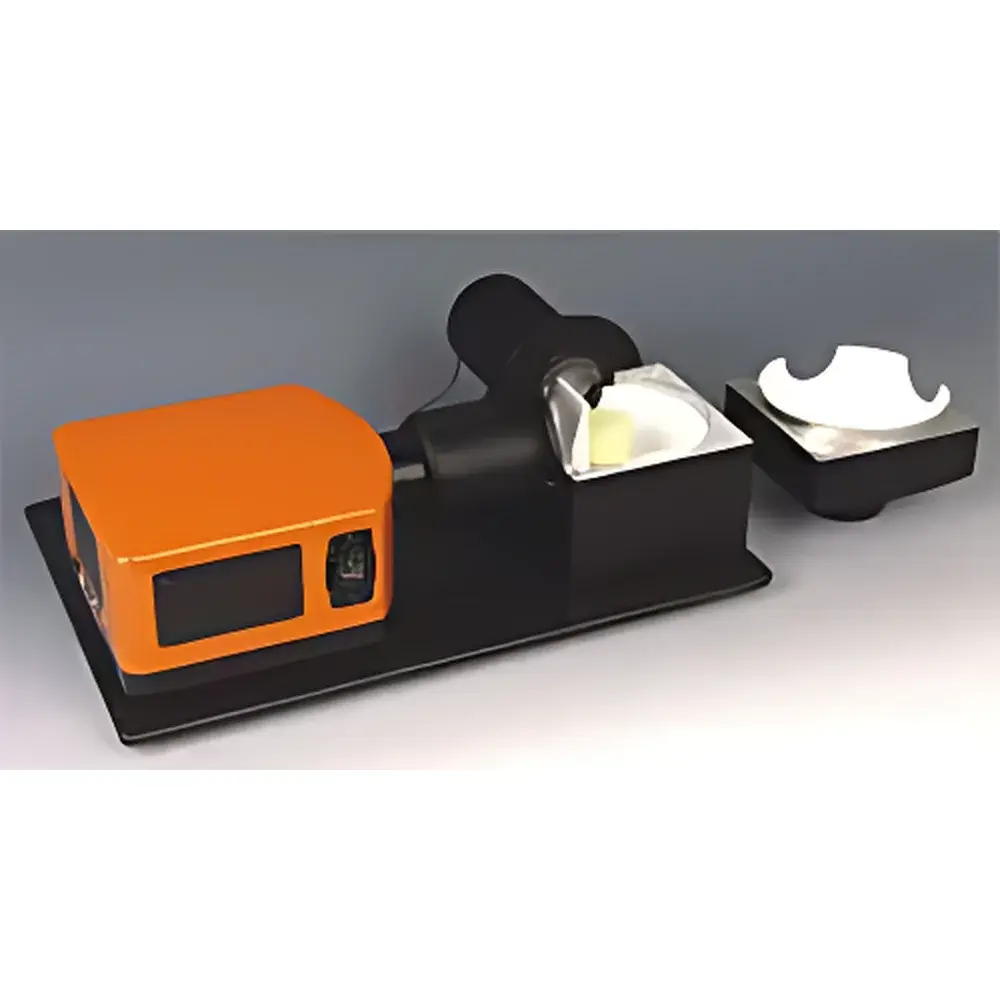
ZOLIX Chameleon-QY Fluorescence Quantum Yield Measurement System
| Brand | ZOLIX |
|---|---|
| Origin | Beijing, China |
| Manufacturer Type | Original Equipment Manufacturer (OEM) |
| Product Origin | Domestic (China) |
| Model | Chameleon-QY |
| Pricing | Upon Request |
| Excitation Source | 460 nm Blue LED |
| Detection System | SGM100 Spectrograph with TCD1304DG Linear CCD Array |
| Integration Sphere | 110 mm Diameter, >96% Reflectance (380–1400 nm) |
| Spectral Range | 400–780 nm |
| Spectral Resolution | 1.62 nm |
| Wavelength Accuracy | ±0.5 nm |
| Integration Time | 7.2 ms – 64 s |
| Optical Design | Asymmetric Crossed Czerny-Turner (C-T) |
| Focal Length | 100 mm |
| f-number | f/2.95 |
| Slit Width | 100 µm |
| Pixel Count | 3648 |
| Pixel Size | 8 µm × 200 µm |
| PRNU | ≤10% |
| Communication Interface | USB 2.0 |
| Power Supply | 5 VDC @ 350 mA (USB-powered or external adapter) |
| Spectrograph Dimensions | 203 × 160 × 90 mm |
| Spectrograph Weight | 4 kg |
| Integrating Sphere Dimensions | 130 × 130 × 165 mm |
Overview
The ZOLIX Chameleon-QY Fluorescence Quantum Yield Measurement System is a turnkey optical instrumentation platform engineered for precise, reproducible determination of absolute photoluminescence quantum yield (PLQY) of phosphor materials under standardized excitation conditions. It operates on the integrating sphere-based comparative method compliant with ASTM E1593 and ISO 11627, where sample emission is measured relative to a reference standard of known quantum efficiency under identical geometric and spectral acquisition conditions. The system employs a stabilized 460 nm blue LED as the primary excitation source—selected to match industry-standard GaN-based LED pump wavelengths used in solid-state lighting applications. Fluorescent samples are positioned centrally within a high-reflectance (≥96% from 380–1400 nm) 110 mm diameter integrating sphere, ensuring near-Lambertian collection of all emitted photons. Collected light is coupled via fiber optic interface into the SGM100 spectrograph—a thermally stable, EMI-hardened, aluminum-machined Czerny-Turner spectrometer featuring an asymmetric crossed optical layout, 100 mm focal length, and f/2.95 throughput. The detector is a TCD1304DG linear CCD array (3648 pixels, 8 µm × 200 µm) with calibrated spectral response across 400–780 nm and wavelength accuracy of ±0.5 nm. Internal stray-light suppression is achieved through precision-aligned light traps and optimized baffling, minimizing spectral distortion and enabling high-fidelity quantification of weak emission bands adjacent to strong excitation tails.
Key Features
- Integrated hardware-software architecture optimized for PLQY measurement per ASTM E1593, ISO 11627, and IEC 62612 Annex G protocols
- Thermally invariant spectrograph housing machined from monolithic aluminum—minimizing thermal drift and mechanical misalignment during extended acquisitions
- EMI-shielded electronics and grounded optical bench design ensuring robust operation in shared laboratory environments with RF-emitting equipment
- High-reflectance PTFE-coated integrating sphere (≥96% reflectivity from 380–1400 nm) with precisely centered sample port and calibrated baffle geometry
- Real-time spectral correction for detector responsivity, grating efficiency, and sphere throughput using NIST-traceable calibration files
- Automated dual-measurement sequence: simultaneous acquisition of excitation spectrum (with sample), blank spectrum (sphere only), and reference standard spectrum
Sample Compatibility & Compliance
The Chameleon-QY accommodates powdered phosphors, dispersed suspensions, thin-film coatings on quartz substrates, and encapsulated LED packages—provided sample volume or thickness permits uniform illumination and negligible self-absorption. Sample positioning is facilitated by a removable, alignment-verified holder with integrated leveling screws. The system supports GLP-compliant data recording: all raw spectra, integration times, lamp intensity logs, and environmental metadata (timestamp, operator ID, ambient temperature) are embedded in HDF5-formatted output files. Audit trails comply with FDA 21 CFR Part 11 requirements when deployed with optional secure user authentication and electronic signature modules. Instrument validation documentation—including factory-installed wavelength and radiometric calibrations traceable to NIST SRM 2036 and 2037—is supplied with each unit.
Software & Data Management
ZOLIX QYStudio software provides a dedicated workflow environment for quantum yield computation, spectral deconvolution, and colorimetric analysis. Core functions include automatic baseline subtraction using iterative morphological filtering, full-width-at-half-maximum (FWHM) calculation with Gaussian/Lorentzian fitting, CIE 1931 chromaticity coordinate mapping, correlated color temperature (CCT) derivation, and quantum yield calculation via the comparative integral method: ηQY = (Isample/Iref) × (Aref/Asample) × ηref, where A denotes absorbed photon fraction derived from reflectance-corrected excitation spectra. All processing steps are scriptable via Python API (PyZOLIX), enabling integration into automated QC pipelines. Export formats include CSV, ASCII, and vendor-neutral JCAMP-DX for third-party spectral libraries. Raw data retention follows ISO/IEC 17025 clause 7.5.2; backups are configurable to network-attached storage with SHA-256 checksum verification.
Applications
- Quantitative evaluation of rare-earth-doped phosphors (e.g., YAG:Ce³⁺, β-SiAlON:Eu²⁺) for white LED and micro-LED backlighting
- Batch-to-batch consistency testing in phosphor manufacturing under ISO 9001 quality management systems
- Photostability assessment via time-resolved PLQY monitoring under accelerated aging (JEDEC JESD22-A108)
- Development of down-conversion nanomaterials (quantum dots, perovskite nanocrystals) requiring sub-1% quantum yield resolution
- Supporting R&D for laser-pumped phosphor converters in high-luminance projection and automotive headlamp systems
FAQ
What excitation sources are supported beyond the default 460 nm LED?
The system features interchangeable LED modules (365 nm, 395 nm, 455 nm, 520 nm) and optional fiber-coupled laser diode inputs (e.g., 405 nm CW diode) with integrated power stabilization and TTL triggering.
Can the system measure quantum yield of transparent thin films?
Yes—using the transmission-mode accessory kit, which replaces the standard sphere port with collimated beam input/output optics and enables absorbance-corrected PLQY calculation for semi-transparent samples.
Is spectral calibration traceable to national standards?
Each unit ships with dual-point wavelength calibration (Hg/Ar emission lines) and radiometric calibration against NIST-traceable standards; annual recalibration services are available through ZOLIX certified labs.
How is stray light minimized in the spectrograph?
Stray light suppression is achieved through internal light traps, multi-stage baffling, optimized coating of non-optical surfaces, and a zero-order blocking filter integrated upstream of the CCD.
Does the software support automated pass/fail reporting for QC workflows?
Yes—QYStudio includes configurable tolerance thresholds, statistical process control (SPC) charts, and PDF report generation with embedded spectra, metadata, and compliance statements for ISO/IEC 17025 audits.




