
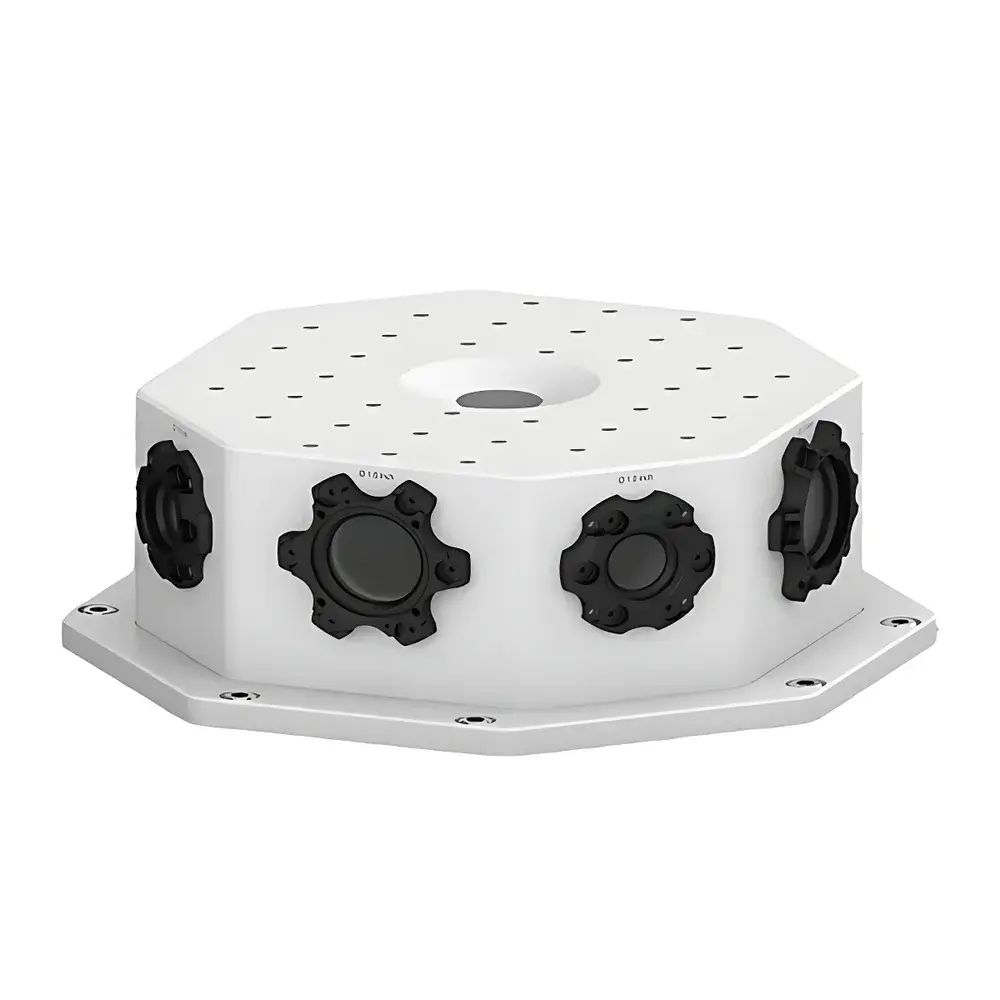
ZOLIX ColdTable+ Cryogenic Low-Vibration Optical Testing Platform
| Brand | ZOLIX |
|---|---|
| Origin | Beijing, China |
| Manufacturer Type | Direct Manufacturer |
| Country of Origin | China |
| Model | ColdTable+ |
| Price Range | USD $42,000 – $280,000 |
| Vibration Level | < 5 nm P-P (3-axis) @ base temperature (ColdTable+.Quiet) / < 24 nm P-P (3-axis) @ base temperature (ColdTable+) |
| Base Temperature | ≤ 2.8 K (ColdTable+) / ≤ 3.8 K (ColdTable+.Quiet) |
| Cooling Time | ≤ 180 min (300 K → 4 K) |
| Temperature Range | 2.8 K – 320 K (ColdTable+) / 3.8 K – 320 K (ColdTable+.Quiet) |
| Refrigeration Power | 220 mW @ 4.2 K (ColdTable+) / 40 mW @ 4.2 K (ColdTable+.Quiet) |
| Vacuum Level | ≤ 1×10⁻⁸ mbar |
| Optical Apertures | 1 top + 8 side windows |
| Cold Stage Diameter | Ø100 mm (4 K zone) |
| Control Interface | LabVIEW & Python APIs |
| Electrical Interfaces | 24 DC lines (user) + 24 DC lines (piezo control) |
| RF Connectors | 4 × 2.92 mm hermetic, up to 40 GHz |
| Fiber Ports | 4 single-mode hermetic feedthroughs |
| Piezo Motion Options | 25 mm & 35 mm cryogenic linear/tilt/rotary/scanning stages |
| Low-Temperature Objectives | Huygens series (NA 0.90, 0.60, 0.36 |
| Thermal Stability | ±2 mK @ 4.5 K, ±20 mK @ 300 K |
| Power Supply | 8 kW @ 380 V (ColdTable+) / 1.5 kW @ 220 V (ColdTable+.Quiet) |
| Dimensions (Platform) | 800 × 1000 × 800 mm |
| Mass (Platform) | 150 kg |
Overview
The ZOLIX ColdTable+ is a fully integrated, closed-cycle cryogenic optical testing platform engineered for high-fidelity quantum optics, nanophotonics, and low-temperature spectroscopy experiments. It combines a high-efficiency Gifford-McMahon (GM) cryocooler with a multi-stage passive vibration isolation architecture—including air-spring optical tables and tuned damping elements—to achieve sub-5 nm peak-to-peak (P-P) mechanical stability in all three orthogonal axes at base temperature. Unlike liquid-helium-dependent systems, the ColdTable+ operates without cryogen consumption, delivering continuous, stable operation across a wide thermal range (2.8 K to 320 K) while maintaining ultra-high vacuum compatibility (<1×10⁻⁸ mbar). Its core design adheres to fundamental requirements for quantum coherent measurements: thermal homogeneity across the Ø100 mm 4 K cold stage, minimal thermal drift (<2 mK at 4.5 K), and electromagnetic quietness essential for charge-sensitive or spin-resolved detection.
Key Features
- Cryogenic performance: Achieves ≤2.8 K base temperature with 220 mW cooling power at 4.2 K (ColdTable+) or ≤3.8 K with 40 mW at 4.2 K (ColdTable+.Quiet variant), enabling studies of superconducting qubits, quantum dots, and 2D material exciton physics.
- Ultra-low vibration architecture: Dual configurations—standard ColdTable+ (<24 nm P-P) and ColdTable+.Quiet (<5 nm P-P)—employ precision-machined air-bearing optical tables, active pressure regulation, and acoustic shielding to decouple compressor and ambient noise sources.
- Modular optical access: Nine hermetically sealed optical ports (1 top + 8 side) support multi-angle excitation and collection; all windows feature broadband AR coatings optimized per spectral band (430–1600 nm).
- Integrated motion control: Optional cryogenic piezo stages (25 mm and 35 mm travel ranges) provide sub-nanometer resolution positioning under vacuum and at cryogenic temperatures, compatible with closed-loop feedback via external controllers.
- Electrical and RF integration: Twenty-four user-accessible DC feedthroughs, four 2.92 mm RF hermetic connectors rated to 40 GHz, and four single-mode fiber feedthroughs enable simultaneous optical, microwave, and electronic characterization.
- Software-defined operation: Unified control software supports automated temperature ramping, PID parameter tuning, and synchronized data logging; LabVIEW and Python APIs facilitate integration into custom experimental sequences and compliance-ready workflows.
Sample Compatibility & Compliance
The ColdTable+ accommodates diverse sample geometries and measurement modalities through its standardized M3-threaded mounting grid (10 mm × 10 mm pitch) and configurable sample holders—DC-only, RF/DC hybrid, or custom-designed carriers. All internal components are constructed from non-magnetic, ultra-high-vacuum (UHV)-compatible materials (e.g., oxygen-free copper, stainless steel 316L, and ceramic insulators), ensuring compatibility with magnetic field experiments up to 12 T when integrated with external magnets. The system conforms to ISO 20483 (vibration testing of precision equipment) and meets mechanical stability benchmarks referenced in ASTM E2927-21 for cryogenic optical metrology. Its vacuum integrity and traceable temperature calibration pathways support GLP/GMP-aligned validation protocols; optional 21 CFR Part 11-compliant audit trail modules are available for regulated R&D environments.
Software & Data Management
The platform’s embedded controller runs real-time Linux-based firmware with deterministic I/O latency (<100 µs loop time). Temperature setpoints, ramp rates, and piezo actuation profiles are programmable via a web-accessible GUI or script-driven interfaces. All sensor readings—including primary stage thermometry (Cernox®), secondary sample-stage monitoring, and compressor status—are timestamped with microsecond resolution and exported in HDF5 or CSV format. Data provenance is preserved through automatic metadata tagging (e.g., vacuum pressure, cooling power, elapsed time, user ID). For long-duration experiments, the system supports scheduled auto-recovery after power interruption and includes built-in diagnostics for thermal gradient mapping and vibration spectral analysis (FFT output up to 1 kHz).
Applications
- Quantum information science: Characterization of superconducting transmon qubits, spin-photon interfaces in diamond NV centers, and cavity optomechanics requiring sub-10 nm positional stability.
- Nanoscale spectroscopy: Confocal photoluminescence, Raman, and cathodoluminescence mapping of monolayer TMDs, perovskites, and topological insulators at cryogenic temperatures.
- Low-temperature microscopy: Integration with confocal or near-field scanning optical microscopes (NSOM) using Huygens-series objectives (NA 0.90, 0.60, 0.36), each validated for operation from 4 K to 350 K and UHV compatibility.
- THz and microwave photonics: On-chip device testing under simultaneous DC bias, RF excitation (up to 40 GHz), and optical probing—enabled by hermetic RF and fiber feedthroughs.
- Fundamental condensed matter physics: Transport measurements of correlated electron systems, quantum Hall devices, and Majorana nanowires requiring milli-Kelvin thermal stability and electromagnetic isolation.
FAQ
What distinguishes ColdTable+ from conventional cryostats?
It eliminates liquid cryogens while achieving comparable base temperatures and superior vibration isolation through integrated GM cooling and multi-stage passive damping—designed specifically for optical coherence-critical applications.
Can the system operate continuously for extended periods (e.g., >72 hours)?
Yes. With proper maintenance and stable utility supply (water cooling for ColdTable+, ambient airflow for ColdTable+.Quiet), the platform supports uninterrupted operation for weeks, as verified under ISO 9001-certified reliability testing.
Is third-party objective lens integration supported?
Yes. Standard RMS threading (W20.32×0.706) and Ø22 mm barrel compatibility allow integration of commercial low-temperature objectives; ZOLIX provides mechanical and thermal interface specifications upon request.
How is temperature uniformity ensured across the cold stage?
The Ø100 mm 4 K zone uses OFHC copper with embedded heater/thermometer pairs and finite-element-optimized thermal shunting to maintain ΔT < ±15 mK over the central 50 mm diameter at 4.5 K.
Does the system support remote operation and monitoring?
All control functions—including vacuum monitoring, temperature profiling, and piezo positioning—are accessible via secure HTTPS API; SSH and VNC options are available for advanced diagnostic access.



