
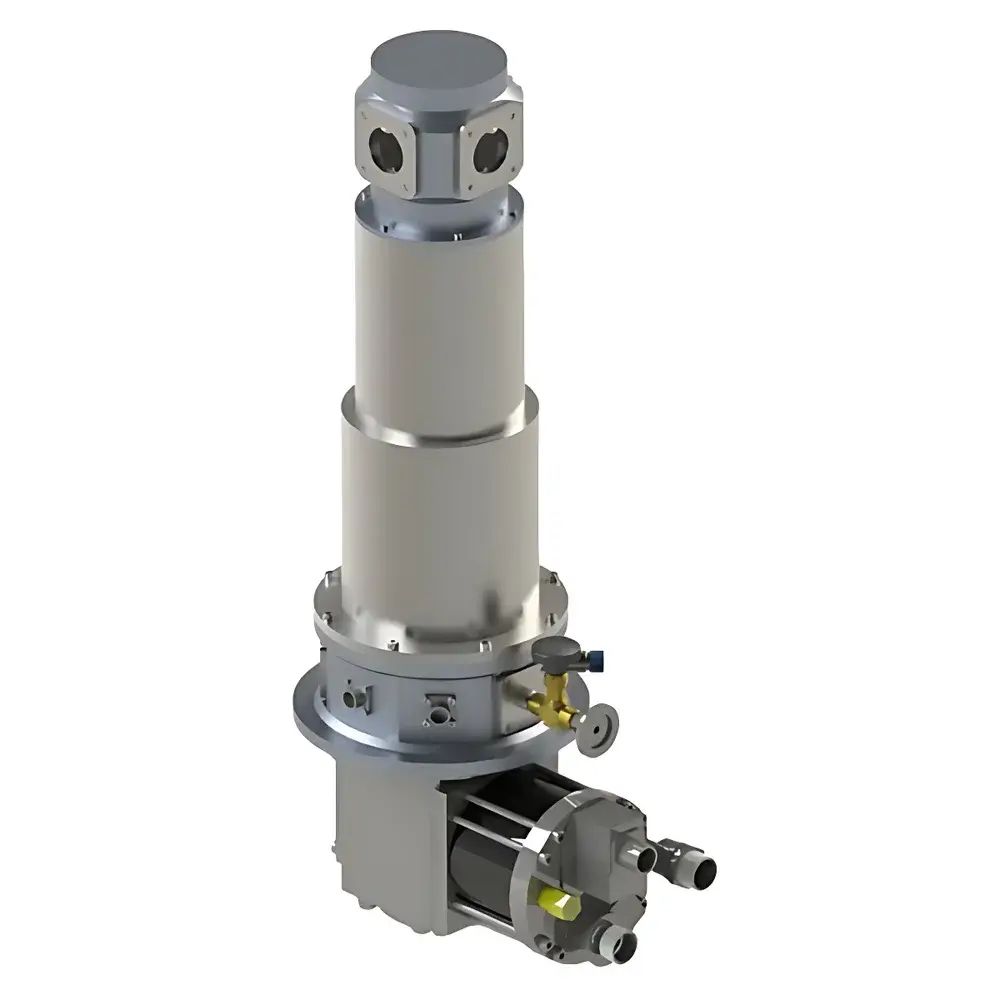
ZOLIX Cryo-Optic 4K Closed-Cycle Optical Cryostat
| Brand | ZOLIX |
|---|---|
| Origin | Beijing, China |
| Manufacturer Type | Direct Manufacturer |
| Country of Origin | China |
| Instrument Type | Vertical Cryostat |
| Base Temperature | <3.5 K |
| Cooling Time (2nd Stage, Empty Load) | <60 min to 4.2 K |
| Operating Temperature Range | 1.4 K – 300 K |
| Vacuum Chamber Pressure | <1×10⁻³ Pa |
| Standard Optical Windows | 4 × quartz, Ø25 mm |
| Optional Window Materials | CaF₂, sapphire, ZnSe |
| Sample Environment Options | High-vacuum, He-gas (In-sealed), customizable sample space |
| Vibration Level | Low-noise mechanical design |
| Electrical Feedthroughs | 6-pin standard + optional 1–19-pin SMA/BNC/TRB connectors |
| Temperature Control Resolution | ±1 mK (with optional sensors) |
| Integrated Temperature Controller | Dual-channel input, 1 active control loop, lower limit 300 mK |
| Compatible Cryocooler | Two-stage pulse tube cooler (PTC) with 1.3 W @ 4.2 K cooling power |
| Helium Compressor Model | KDC6000V |
| Water Cooling Requirement | 7–10 L/min @ 5–25 °C inlet, ΔT ≤ 19 °C |
| Total System Power Consumption | 6.5 kW (steady-state, 50 Hz) |
| Molecular Pump | DN100 CF flange, 110 L/s (air), base pressure 6×10⁻⁷ Pa |
| Pre-pump | RV4 rotary vane pump (standard) |
| Weight (cryostat + cold head) | 20 kg |
| (compressor + chiller) | 118 kg |
Overview
The ZOLIX Cryo-Optic 4K Closed-Cycle Optical Cryostat is an engineered solution for high-fidelity low-temperature optical spectroscopy and quantum material characterization. Based on a two-stage pulse tube cryocooler architecture, it achieves stable base temperatures below 3.5 K without liquid cryogens—eliminating operational complexity, helium boil-off, and logistical constraints associated with wet systems. Its core design integrates ultra-low vibration mechanical isolation, high-vacuum compatibility (<1×10⁻³ Pa), and optically optimized sample access via four standard quartz windows (Ø25 mm), enabling transmission, reflection, and photoluminescence measurements across UV–NIR spectral ranges. The system supports programmable temperature ramping from 1.4 K to 300 K with sub-millikelvin resolution when paired with calibrated Cernox or RuO₂ sensors. It is expressly designed for integration with steady-state and time-resolved fluorescence spectrometers—including ZOLIX’s own FLS series—enabling automated, script-driven acquisition of temperature-dependent spectral datasets under reproducible thermal conditions.
Key Features
- Two-stage pulse tube cryocooler delivering ≥1.3 W cooling power at 4.2 K, with first-stage capacity of 50 W at 43 K
- Base temperature <3.5 K (typical 4.2 K under standard vacuum conditions); cooldown to 4.2 K in <60 minutes (second stage, empty load)
- Optimized mechanical decoupling and rigid stainless-steel cold finger construction to minimize microphonic coupling and thermal drift
- Modular optical interface: Four standard quartz viewports (25 mm diameter); optional CaF₂ (UV-transmitting), sapphire (high-strength, broadband), or ZnSe (mid-IR) windows available
- Customizable sample platforms: Standard gold-plated copper sample holder; fully configurable optical and electrical sample stages including thin-film clamps, powder cups, and multi-contact electrical cards (1–19 pin configurations)
- Integrated temperature control system with dual-sensor input, independent channel monitoring, and active regulation down to 300 mK
- Hermetic helium gas option with indium-sealed chamber for enhanced thermal uniformity and reduced radiative loading on sensitive samples
Sample Compatibility & Compliance
The Cryo-Optic 4K cryostat accommodates diverse solid-state sample geometries—including single crystals, epitaxial thin films, nanowires, powders, and organic semiconductors—within a configurable internal volume. Electrical characterization is supported via low-leakage feedthroughs (<100 fA), compatible with DC transport, Hall effect, and impedance spectroscopy setups. All vacuum components conform to ISO-KF and CF flange standards (DN100 molecular pump port). The system meets GLP-aligned operational documentation requirements and supports audit-ready temperature logging when used with compliant data acquisition software. While not certified to IEC 61000 or UL 61010 by default, its electrical subsystems adhere to CE-compliant safety margins for laboratory environments (IP20 enclosure rating, reinforced grounding, overpressure/overtemperature interlocks).
Software & Data Management
The cryostat interfaces with ZOLIX’s proprietary CryoControl Suite via RS-232 or Ethernet, enabling synchronized temperature ramping, real-time sensor readout, and event-triggered acquisition protocols. Export formats include CSV and HDF5, ensuring compatibility with Igor Pro, MATLAB, Python (NumPy/Pandas), and OriginLab workflows. Audit trails—including timestamped setpoint changes, sensor calibrations, and error logs—are retained locally and exportable for regulatory review. When integrated with fluorescence spectrometers, the software supports batch-mode spectral acquisition across user-defined temperature sequences, with automatic normalization to reference thermometry and metadata embedding per spectrum (e.g., pressure, stage position, laser power).
Applications
- Temperature-dependent photoluminescence (PL) and electroluminescence (EL) mapping of quantum dots, perovskites, and 2D materials
- High-resolution absorption and reflectance spectroscopy of superconducting thin films and topological insulators
- Low-temperature Raman and FTIR studies requiring minimal thermal broadening
- Single-photon source characterization and spin coherence time (T₂) measurements in NV centers or rare-earth-doped hosts
- In situ electrical transport combined with optical excitation (optoelectronic correlation studies)
- Calibration of cryogenic detectors (e.g., SNSPDs, transition-edge sensors) under controlled thermal gradients
FAQ
What vacuum level is required for optimal optical performance?
A base pressure better than 1×10⁻³ Pa is recommended for standard operation; for reduced radiative loading or gas-phase experiments, integration with a turbomolecular pump (110 L/s, 6×10⁻⁷ Pa base) is advised.
Can the cryostat be operated continuously for extended periods?
Yes—the pulse tube cooler and helium compressor are rated for >10,000 hours MTBF; the water chiller and molecular pump have respective maintenance intervals of 30,000 hours and 15,000 hours under nominal lab conditions.
Is remote operation and scripting supported?
Full SCPI command support is provided via TCP/IP or serial interface, allowing integration into LabVIEW, Python-based automation frameworks, and custom experiment sequencers.
What electrical noise specifications apply to the feedthroughs?
Standard 6-pin feedthroughs exhibit <10 nV/√Hz voltage noise and <100 fA current leakage at 4 K; low-noise variants with guarded shielding and filtered pins are available upon request.
Does the system comply with FDA 21 CFR Part 11 for regulated labs?
While the hardware itself does not carry Part 11 certification, the CryoControl Suite can be configured with electronic signatures, audit trails, and role-based access controls to meet ALCOA+ data integrity principles when deployed within validated workflows.



