
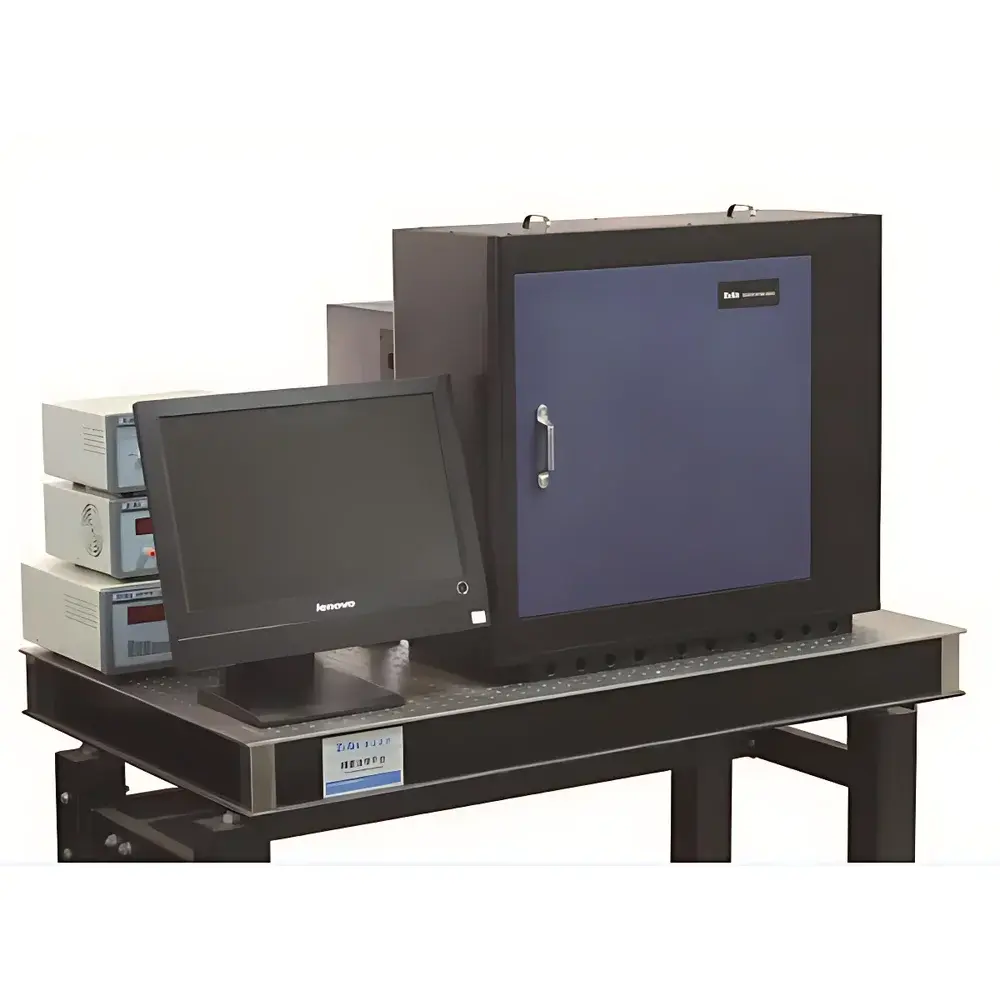
ZOLIX CS10 Integrated Quantum Efficiency Measurement System for Photovoltaic Devices
| Brand | ZOLIX |
|---|---|
| Model | CS10 |
| Origin | Beijing, China |
| Manufacturer | ZOLIX (Producer) |
| Origin Category | Domestic |
| Measurement Mode | DC |
| Spectral Range | 300–1100 nm (extendable to 1700 nm) |
| Sample Size Range | 1 mm × 1 mm to 100 mm × 100 mm |
| Measurable Parameters | Spectral Responsivity (A/W), External Quantum Efficiency (EQE), Photon-to-Electron Conversion Efficiency, Integrated Short-Circuit Current Density (J<sub>sc</sub>), Beam-Induced Current (BIC) |
| Compatible Sample Types | Inorganic thin-film PV cells, dye-sensitized solar cells (DSSCs), quantum dot solar cells, organic photovoltaics (OPVs), polymer solar cells, perovskite solar cells |
| Bias Light Sources | 75 W tungsten-halogen lamp or 150 W xenon lamp |
| Software | Dedicated EQE acquisition and analysis suite with bias light parameter control |
Overview
The ZOLIX CS10 Integrated Quantum Efficiency Measurement System is a modular, research-grade instrumentation platform engineered for high-precision external quantum efficiency (EQE) and spectral responsivity characterization of next-generation photovoltaic devices. It operates on the principle of monochromatic photocurrent measurement under controlled illumination conditions, employing lock-in amplification (for AC mode) or precision low-noise DC current sensing (for DC mode) to resolve sub-picoamp photocurrent signals across the UV–NIR spectrum. Designed specifically for lab-scale R&D in academia and industrial PV development centers, the CS10 enables traceable, repeatable EQE mapping from 300 nm to 1100 nm—with optional extension to 1700 nm via interchangeable grating and detector modules—supporting rigorous evaluation of emerging absorber materials including perovskites, organic semiconductors, quantum dots, and dye-sensitized architectures.
Key Features
- Modular optical architecture with motorized monochromator, calibrated silicon photodiode reference channel, and configurable sample stage accommodating substrates from 1 × 1 mm to 100 × 100 mm
- Dual operational modes: DC photocurrent measurement (for steady-state EQE) and AC-modulated measurement (3.8 Hz typical, with phase-sensitive detection)
- Integrated bias light subsystem featuring dual independent filter wheels, each holding six positions, enabling precise attenuation control (OD 0.1–1.0) using certified neutral density filters (NDFI2501–NDFI2510)
- Interchangeable bias light sources: 75 W tungsten-halogen lamp (broadband visible–NIR) and 150 W xenon arc lamp (enhanced UV output), both equipped with collimating optics and thermal management
- Low-drift, high-resolution current preamplifier with selectable gain (10⁶–10¹¹ V/A) and shielded cabling compliant with IEC 61000-4-3 EMI immunity standards
- Thermally stabilized optical bench with kinematic mounts and vibration-damped base plate to ensure long-term signal stability during multi-hour scans
Sample Compatibility & Compliance
The CS10 system supports direct electrical contact via spring-loaded microprobes or vacuum chuck mounting, eliminating soldering requirements for fragile or solution-processed devices. It meets ISO/IEC 17025 technical competence criteria for photovoltaic metrology when operated with NIST-traceable calibration standards (e.g., calibrated Si reference diode SRM 2500). All bias light intensities are quantified in photon flux units (photons·cm⁻²·s⁻¹) and can be referenced to standard AM1.5G irradiance (100 mW/cm²) using built-in spectral mismatch correction algorithms. The system’s mechanical and electrical design complies with CE marking directives (2014/30/EU EMC, 2014/35/EU LVD) and conforms to safety practices outlined in IEC 61215-2 (MQT 13) for PV device testing environments.
Software & Data Management
The proprietary ZOLIX EQE Control Suite provides a validated, audit-ready interface for instrument control, data acquisition, and post-processing. It includes automated wavelength stepping, real-time current normalization against reference diode response, and built-in Jsc integration over user-defined spectral ranges (e.g., 350–800 nm for perovskite cells). The software enforces electronic signature workflows, time-stamped audit trails, and export options compliant with ASTM E2848-22 (Standard Practice for Reporting Photovoltaic Non-Concentrator Cell and Module Performance Test Results). Raw data files are stored in HDF5 format with embedded metadata (wavelength, bias intensity, filter ID, ambient temperature, relative humidity), ensuring full traceability for GLP/GMP-aligned laboratories. Optional 21 CFR Part 11 compliance package available upon request.
Applications
- Quantitative EQE comparison of perovskite film morphology variants (e.g., solvent annealing vs. antisolvent dripping)
- Charge extraction dynamics analysis in DSSCs via bias-dependent EQE shift assessment (0–0.3 sun bias range)
- Spectral loss analysis in tandem cell stacks through subcell-resolved EQE deconvolution
- Stability benchmarking: time-series EQE mapping under ISOS-L-1 illumination protocols
- Interface recombination quantification using voltage-biased EQE measurements (Vbias = −0.5 V to +0.5 V)
- Calibration transfer between primary reference cells and production-line QE testers
FAQ
What is the minimum detectable photocurrent in DC mode?
The system achieves a typical noise floor of ≤50 fA RMS (10 s integration, 1 Hz bandwidth) with optimized grounding and shielding.
Can the CS10 measure internal quantum efficiency (IQE)?
Yes—when coupled with a calibrated reflectance/absorptance accessory (e.g., integrating sphere module), IQE calculation is supported via user-defined optical loss correction.
Is the software compatible with third-party data analysis tools?
All exported datasets include columnar ASCII and HDF5 formats with documented schema, enabling direct import into Python (NumPy/Pandas), MATLAB, or OriginLab.
Does the system support automated J-V + EQE co-measurement?
Not natively; however, the ZOLIX CS10 can be synchronized with external source-measure units (SMUs) via TTL triggers and GPIB/LAN interfaces for coordinated testing sequences.
What calibration standards are recommended for routine verification?
NIST SRM 2500 (Si reference diode) and NIST SRM 2035 (spectral irradiance standard) are recommended for annual verification; ZOLIX provides certified calibration reports upon request.





