
ZOLIX Custom Fiber-Optic Raman Probe System
| Brand | ZOLIX |
|---|---|
| Origin | Beijing, China |
| Manufacturer Type | OEM Manufacturer |
| Laser Wavelengths | 405/514/532/633/670/671/785/808 nm |
| Raman Shift Range | 100–4000 cm⁻¹ (laser-dependent) |
| Spectral Resolution | <10 cm⁻¹ (guaranteed) |
| Probe Working Distance | 3 mm / 7 mm (standard), customizable up to 18 mm |
| Operating Temperature | 0–325 °C (customizable) |
| Max Pressure Rating | 6000 psi |
| Probe Material | Hard-anodized aluminum & 316 stainless steel |
| Fiber Core/Clad | 100/100 µm (standard), custom options available |
| Detector | Back-illuminated deep-depletion CCD (2000 × 256 pixels, 15 µm pitch, -60 °C cooling, read noise <4.5 e⁻) |
| Optical Interface | SMA/MPO/10 mm cylindrical |
| Filter OD | >6 (long-pass, laser-line rejection) |
| System Weight | 5.0–5.8 kg |
Overview
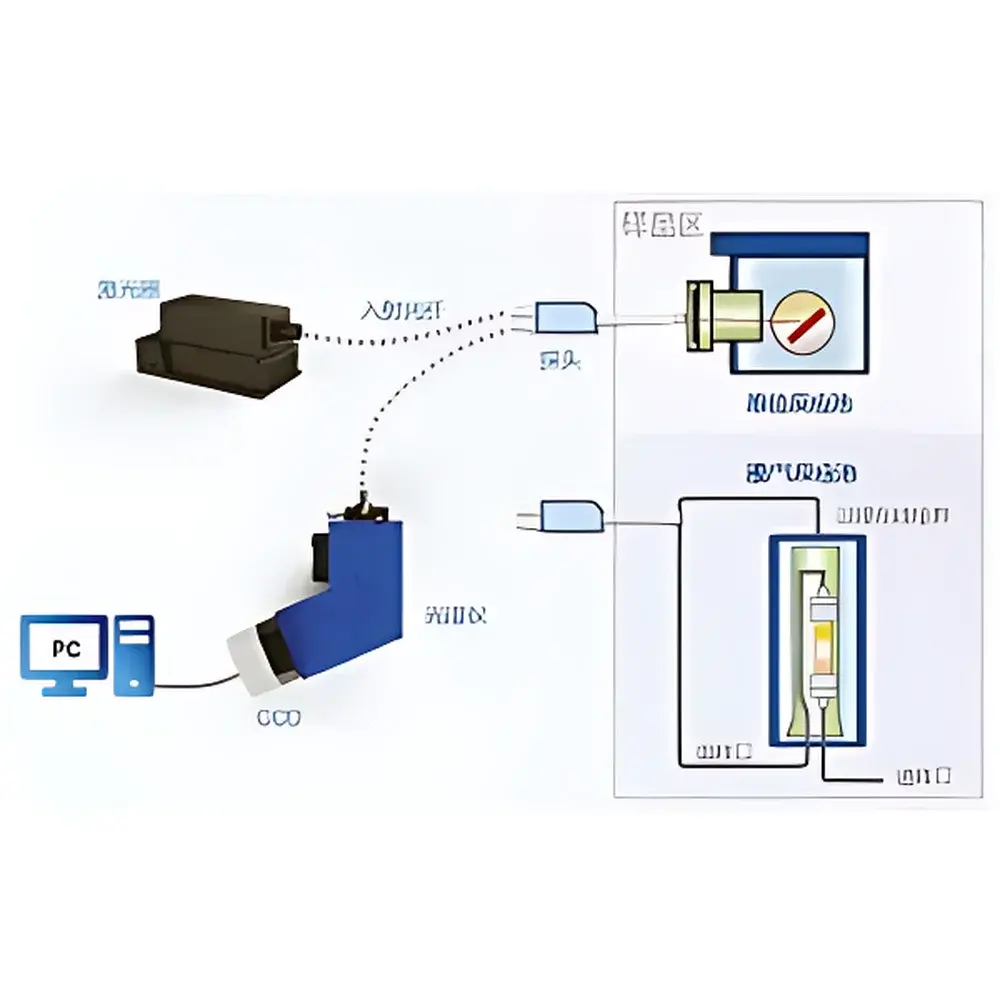
The ZOLIX Custom Fiber-Optic Raman Probe System is an engineered solution for in situ and online molecular characterization under extreme process conditions. Based on spontaneous Raman scattering—where monochromatic laser light interacts with molecular vibrational modes to generate inelastic shifts—the system delivers chemically specific, non-destructive spectral fingerprints across the 100–4000 cm⁻¹ Raman shift range. Unlike conventional benchtop micro-Raman systems constrained to ambient laboratory environments, this platform integrates robust fiber-coupled optics, thermally stable probe housings, and high-rejection optical filtering to enable direct intrusive measurement inside reactors, pipelines, autoclaves, and sealed electrochemical cells. Its design adheres to fundamental spectroscopic principles: excitation wavelength selection (405–808 nm) balances fluorescence suppression, photon energy, and detector quantum efficiency; VPH transmission gratings ensure high throughput and low stray light; and deep-cooled back-illuminated CCD detection guarantees signal-to-noise integrity for weak Raman signals in real-time acquisition.
Key Features
- Fiber-optic architecture enabling physical decoupling of laser source, spectrometer, and measurement zone—critical for hazardous, high-temperature, or high-pressure applications
- Probe variants rated for continuous operation from 0 °C to 325 °C and up to 6000 psi, with sealing options using perfluoroelastomer (FFKM) O-rings compatible with aggressive chemical environments (e.g., HF, HCl, molten salts)
- Modular laser compatibility: supports discrete-wavelength diode and DPSS lasers including 532 nm (100 mW) and 785 nm (350 mW), with optional integration of 405 nm, 633 nm, and 808 nm sources
- High-throughput VPH grating spectrometers (Omni-iSpecT series) featuring F/1.8–F/2.3 optics, 85–100 mm focal length, and adjustable entrance slits (10 µm–6 mm) for resolution/sensitivity trade-off optimization
- Back-illuminated deep-depletion CCD detectors with 2000 × 256 pixel format, 15 µm pixel size, and thermoelectric cooling to –60 °C—delivering sub-5 e⁻ read noise and broad 200–1100 nm responsivity
- Customizable probe geometry: standard 2.25″ × 0.96″ × 0.58″ rectangular or 1.3″ diameter × 4.5″ cylindrical form factors; 3/8″ probe shank with 2–3″ insertion length; numerical aperture 0.22
Sample Compatibility & Compliance
The system accommodates solid, liquid, and gaseous samples via direct immersion, flow-cell coupling, or window-based standoff configurations. Probe tip optical windows (e.g., sapphire, fused silica) maintain spectral transmission while isolating corrosive or radioactive media. It has been validated in nuclear fuel cycle monitoring (e.g., real-time PuO₂ fluorination off-gas analysis per Actinide Research Quarterly, 2019), glass corrosion studies in borosilicate solutions (Analytical Chemistry, 2018), and MOF crystallization kinetics in microreactors (Phys. Chem. Chem. Phys., 2022). Hardware construction complies with ISO 9001 manufacturing protocols. While not pre-certified for IEC 61000-6-2/4 or ATEX, mechanical and sealing specifications align with ASME B16.5 Class 1500 flange interface conventions and ASTM E2500 risk-based verification frameworks. Data acquisition workflows support audit-trail generation for GLP/GMP-aligned environments when paired with validated third-party software.
Software & Data Management
The system operates with ZOLIX’s proprietary SpectraSolve™ control suite (Windows 10/11, 64-bit), providing instrument parameter synchronization, dark/bias correction, cosmic ray removal, and real-time spectral averaging. Raw data exports in HDF5 and ASCII formats preserve metadata (laser power, integration time, grating position, temperature log). Spectral preprocessing includes polynomial baseline subtraction, Savitzky-Golay smoothing, and peak deconvolution using constrained Gaussian-Lorentzian models. For quantitative modeling, the software supports partial least squares (PLS) and multivariate curve resolution–alternating least squares (MCR-ALS) calibration import/export per ASTM E1655 guidelines. All spectral acquisitions are timestamped and linked to external process variables (e.g., thermocouple readings, pressure transducer outputs) via analog/digital I/O modules. Optional FDA 21 CFR Part 11 compliance packages include electronic signature enforcement, role-based access control, and immutable audit logs.
Applications
- Real-time gas-phase reaction monitoring in fluorination, chlorination, and catalytic cracking processes—particularly where HF, Cl₂, or HCl necessitate inert probe materials and hermetic sealing
- In-reactor crystallization tracking of metal–organic frameworks (MOFs), battery electrode intermediates, and pharmaceutical polymorphs under solvothermal conditions
- Corrosion and leaching kinetics assessment of nuclear waste glasses, ceramics, and cementitious barriers in simulated geological repository environments
- Online quality assurance in continuous pharmaceutical manufacturing—e.g., API polymorphic form verification during wet granulation or fluid-bed drying
- High-temperature electrochemical cell diagnostics, including SEI layer evolution on Li-ion anodes and redox speciation in molten carbonate fuel cells
FAQ
Can the probe be used in explosive atmospheres?
The base probe is not intrinsically safe or ATEX-certified; however, its all-metal housing, absence of internal electronics, and fiber-optic signal transmission allow deployment in Zone 1/2 environments when paired with externally located certified laser and spectrometer units.
What is the minimum detectable Raman shift with the 785 nm configuration?
The guaranteed low-wavenumber cutoff is 350 cm⁻¹ for the 785 nm module (Omni-iSpecT785A1); with optimized filtering and background subtraction, usable signal extends down to ~200 cm⁻¹ in controlled conditions.
Is remote calibration supported?
Yes—NIST-traceable polystyrene and silicon reference standards can be integrated into the probe path via motorized filter wheels; automated wavelength and intensity calibration routines are embedded in SpectraSolve™.
How is thermal drift compensated during long-duration measurements?
The spectrometer incorporates passive athermalization via matched CTE optical mounts, and the CCD’s stabilized –60 °C operating point minimizes dark current drift; real-time spectral registration uses internal Rayleigh scatter referencing.
Can the system interface with PLCs or DCS platforms?
Analog voltage (0–10 V) and digital TTL outputs are provided for trigger synchronization and alarm signaling; Modbus TCP and OPC UA gateways are available as add-on modules for industrial control system integration.






