
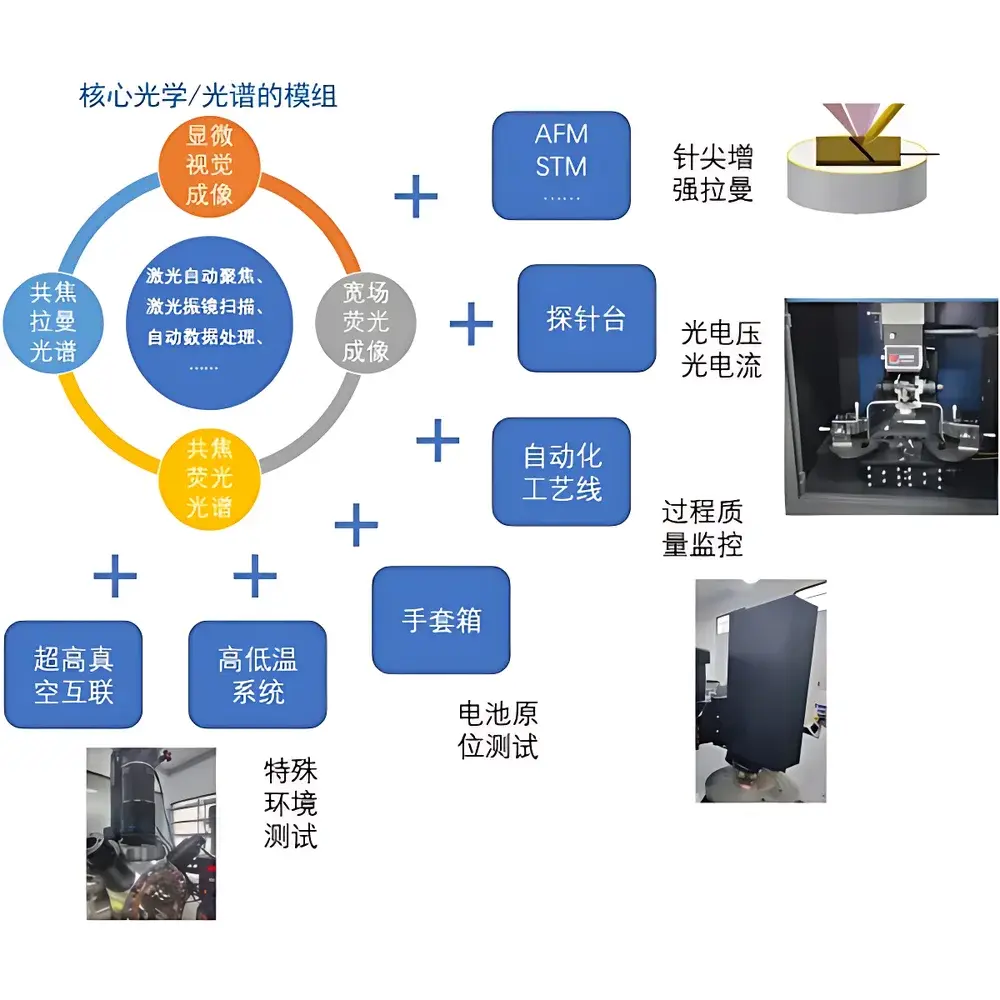
ZOLIX Customized In-situ Optical & Spectroscopic Microscopy System
| Brand | ZOLIX |
|---|---|
| Origin | Beijing, China |
| Manufacturer Type | Original Equipment Manufacturer (OEM) |
| Product Category | Domestic |
| Model | Custom In-situ Spectroscopic Microscopy System |
| Pricing | Available Upon Request |
Overview
The ZOLIX Customized In-situ Optical & Spectroscopic Microscopy System is an engineered platform designed for real-time, spatially resolved optical and spectral characterization under operational or environmentally controlled conditions. Built upon a modular optomechanical architecture, the system integrates high-stability microscope optics with spectrometers, light sources (including tunable lasers and broadband lamps), and synchronized detection subsystems. Its core measurement principle combines diffraction-limited visible/NIR microscopy with point- or area-resolved spectroscopic acquisition—enabling simultaneous morphological imaging and spectral fingerprinting (e.g., Raman, photoluminescence, reflectance, or absorbance) at micron-scale resolution. Unlike conventional benchtop microspectrometers, this system is purpose-built for integration into dynamic experimental environments: vacuum chambers, electrochemical cells, thermal stages, mechanical strain rigs, or semiconductor process tools—wherein optical access, mechanical clearance, and interface compatibility are critical constraints.
Key Features
- Modular optical backbone: Interchangeable objectives (10×–100×, NA 0.25–0.95), filter cubes, and beam paths support multi-modal operation (brightfield, fluorescence, darkfield, polarization contrast).
- Laser auto-focus subsystem: Integrated non-contact laser triangulation sensor enables sub-micron axial repeatability (< ±0.3 µm) without physical contact to the sample or stage—critical for in-situ measurements on soft, reactive, or temperature-sensitive specimens.
- Zero-obstruction objective design: No mechanical components reside beneath the objective nosepiece, ensuring unimpeded access for auxiliary probes (e.g., electrical contacts, gas nozzles, or micro-manipulators) and compatibility with inverted or custom-stage configurations.
- Standardized hardware interfaces: IEEE-488 (GPIB), USB 3.0, Ethernet (TCP/IP), and TTL-triggered I/O ports enable deterministic synchronization with external controllers (e.g., motion stages, potentiostats, or environmental chambers).
- Open software API: C++/Python SDKs provide low-level access to hardware control, spectral acquisition timing, and metadata tagging—facilitating compliance with automated experiment workflows and laboratory information management systems (LIMS).
Sample Compatibility & Compliance
The system accommodates samples ranging from polished wafers and thin-film stacks to biological tissue sections, battery electrodes, catalytic substrates, and polymer composites. Sample mounting is fully adaptable via standard SM1/SMA-threaded adapters or custom kinematic mounts. All optical components meet ISO 10110 surface quality specifications; spectral calibration is traceable to NIST-traceable reference standards (e.g., HG/Ne lamps, certified reflectance tiles). The platform supports alignment and validation per ASTM E2847 (Standard Practice for Calibration of Spectrometers Used in Raman Spectroscopy) and ISO/IEC 17025 requirements for testing laboratories. When deployed in regulated environments, the software architecture supports audit trails, user role-based permissions, and electronic signatures—aligning with FDA 21 CFR Part 11 and GLP/GMP documentation expectations.
Software & Data Management
ZOLIX Control Suite v4.x provides unified orchestration of imaging, spectral acquisition, and hardware synchronization. It features real-time spectral preview, region-of-interest (ROI) mapping, time-series stacking, and batch processing with customizable export formats (HDF5, TIFF+CSV, JCAMP-DX). Raw spectral data includes embedded metadata: timestamp, objective ID, grating position, slit width, integration time, laser power, and environmental sensor readings (if interfaced). Data provenance is preserved through hierarchical file naming, checksum validation, and optional integration with enterprise storage via SFTP or RESTful APIs. For advanced analysis, native plugins support peak deconvolution (Voigt fitting), multivariate curve resolution (MCR), and PCA-based clustering—without requiring third-party licensing.
Applications
- In-situ electrochemical Raman monitoring of Li-ion battery cathode phase transitions during charge/discharge cycling.
- Real-time photoluminescence mapping of perovskite thin-film degradation under controlled humidity and UV exposure.
- Microscale stress-strain correlation in MEMS devices using polarized reflectance spectroscopy coupled with nanoindenter feedback.
- High-temperature oxidation kinetics of turbine alloys observed via time-resolved emission spectroscopy within a tube furnace viewport.
- Correlative optical/spectral histopathology—overlaying H&E-stained morphology with autofluorescence spectral signatures for digital tissue classification.
FAQ
Can the system be integrated into a UHV chamber with limited optical access?
Yes—the compact objective module (diameter ≤ 60 mm) and fiber-coupled spectrometer options allow installation through standard CF-63 or KF-40 viewports; custom flange adapters and magnetic feedthrough-compatible cabling are available.
Is laser auto-focus compatible with transparent or highly reflective samples?
The triangulation sensor operates at 650 nm with adjustable gain and dynamic range; it has been validated on fused silica, sapphire, gold-coated mirrors, and aqueous droplets without saturation or tracking loss.
Do you provide validation documentation for GxP-regulated labs?
Upon request, ZOLIX supplies IQ/OQ protocols, calibration certificates, and software verification reports aligned with ASTM E2500 and Annex 11 principles.
What spectrometer resolution options are supported?
Standard configurations include 0.1 nm (75 mm focal length) and 0.02 nm (300 mm focal length) Czerny-Turner spectrometers; CCD, EMCCD, and InGaAs array detectors are selectable based on wavelength range and sensitivity requirements.
Is remote operation and monitoring supported?
Yes—via secure VNC or browser-based web interface (HTTPS/TLS); all control functions, live image feeds, and spectral streams are accessible with configurable firewall rules and two-factor authentication.





