
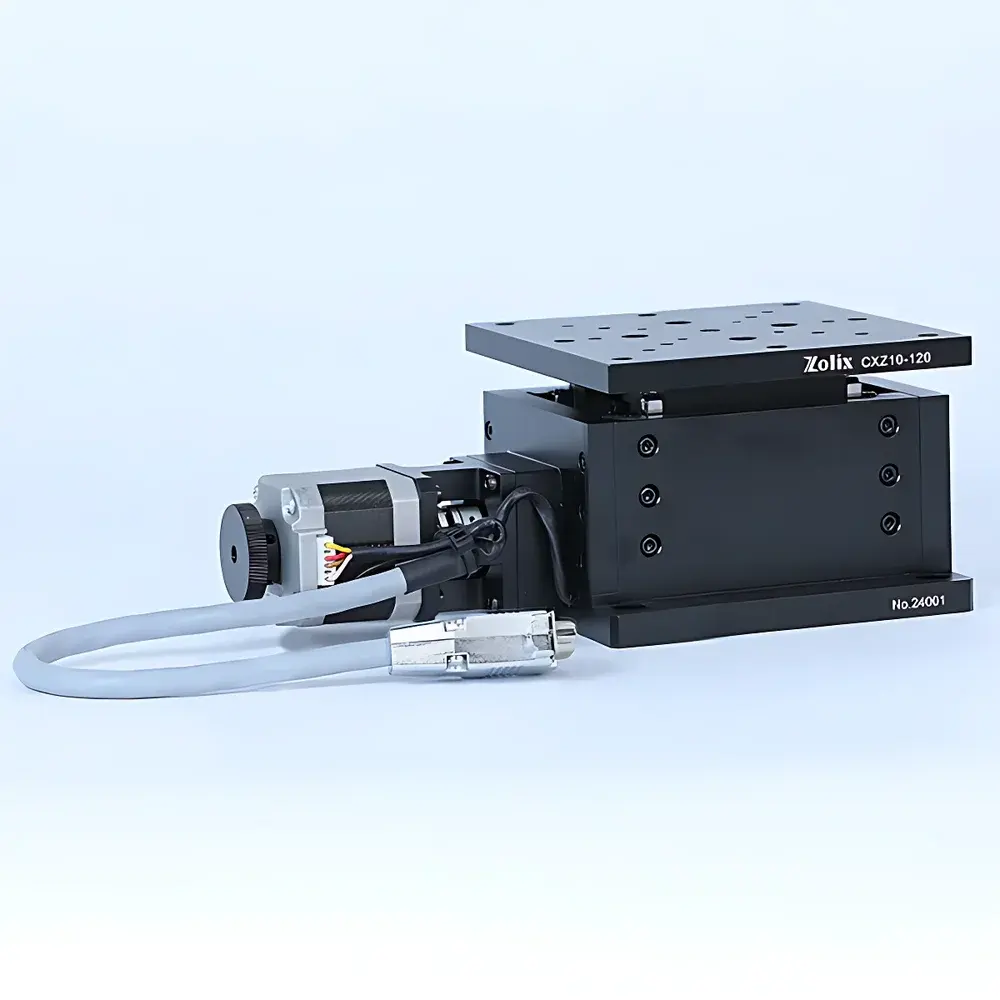
ZOLIX CXZ10-120 Motorized Vertical Translation Stage
| Brand | ZOLIX |
|---|---|
| Origin | Beijing, China |
| Manufacturer Type | Direct Manufacturer |
| Product Category | Domestic (China-made) |
| Model | CXZ10-120 |
| Pricing | Upon Request |
| Product Type | Motorized Translation Stage |
| Drive Mechanism | Ball Screw |
| Guidance System | Crossed Roller Bearings |
| Actuation | Bipolar Stepper Motor |
| Material | Anodized Hard Aluminum Alloy |
| Surface Finish | Black Anodized |
| Structural Design | Wedge-Type Load-Bearing Architecture |
| Typical Use Case | High-Cycle Precision Vertical Positioning in Space-Constrained Systems |
Overview
The ZOLIX CXZ10-120 Motorized Vertical Translation Stage is an engineered solution for precise, repeatable vertical displacement in optical alignment, micro-positioning, and compact automation applications. Designed using fundamental principles of mechanical metrology and kinematic constraint theory, the stage operates on a wedge-based lifting mechanism coupled with a preloaded ball screw drive system—ensuring minimal axial backlash and high positional fidelity over extended operational cycles. Its core architecture leverages crossed roller bearings to provide low-friction, high-rigidity linear guidance, while the hard-anodized aluminum alloy body delivers dimensional stability under thermal fluctuation and mechanical stress. Unlike belt- or lead-screw-driven alternatives, the CXZ10-120’s direct-coupled stepper motor and hardened ground ball screw combination enables sub-micron repeatability (typical ≤ ±1.5 µm) and consistent load-bearing performance up to 5 kg (static), making it suitable for integration into laser cavity alignment systems, fiber coupling stations, spectrometer sample changers, and semiconductor inspection platforms where footprint, weight, and cycle endurance are critical design constraints.
Key Features
- Wedge-type structural design for enhanced static and dynamic load capacity—optimized for vertical orientation with minimal deflection under off-axis loading
- Crossed roller bearing guideways ensuring smooth motion, high stiffness (>2.5 N/µm in vertical direction), and long-term wear resistance across >10⁶ operational cycles
- Precision-ground ball screw (lead: 2 mm) with anti-backlash nut assembly, delivering resolution down to 0.5 µm per motor step (with 1.8° bipolar stepper and standard 1000-pulse/rev controller)
- Black anodized 6061-T6 aluminum housing—corrosion-resistant, non-magnetic, and thermally stable (CTE ≈ 23.6 × 10⁻⁶ /°C)
- Integrated stepper motor with IP52-rated connector interface (15-pin D-sub), supporting standard pulse/direction signaling compliant with STEP/DIR industrial motion protocols
- Compact envelope: 100 mm × 100 mm base footprint, 120 mm travel range, total height < 95 mm at retracted position—engineered for OEM integration into multi-axis goniometers and modular optical breadboards
Sample Compatibility & Compliance
The CXZ10-120 is mechanically compatible with standard M4 and M6 mounting patterns used across Thorlabs, Newport, and Standa optical stages. Its rigid platform supports payloads including collimators, photodetectors, MEMS mirrors, and miniature spectrometers without requiring auxiliary bracing. While not certified to ISO 9001 or CE as a standalone instrument (intended for integration rather than end-user deployment), all materials and surface treatments comply with RoHS Directive 2011/65/EU. Mechanical tolerances adhere to ISO 2768-mK general tolerancing standards; bearing preload and screw alignment are verified per ISO 10110-7 for optical component mounts. For GLP/GMP-aligned installations, traceable calibration reports (including bidirectional repeatability and hysteresis testing per ISO 230-2 Annex B) can be provided upon request.
Software & Data Management
The stage operates via standard TTL-level STEP/DIR signals and does not require proprietary firmware. It is natively supported by common motion control environments including LabVIEW (NI Motion API), MATLAB (Instrument Control Toolbox), Python (PySerial + custom pulse generators), and commercial platforms such as Zaber’s ASCII protocol-compatible controllers. Optional encoder feedback modules (e.g., Renishaw RESOLUTE™ analog quadrature) may be retrofitted for closed-loop operation, enabling compliance with FDA 21 CFR Part 11 requirements when paired with audit-trail-enabled host software. All electrical timing diagrams—including enable delay, pulse width minimum (≥1.5 µs), and direction setup/hold times—are documented in the ZOLIX CXZ Series Technical Reference Manual v3.2.
Applications
- Laser beam height adjustment in ultrafast oscillator cavities requiring < ±2 µm vertical repeatability over 8-hour thermal soak
- Fiber-to-chip coupling alignment in photonic integrated circuit (PIC) test stations with automated focus-scan routines
- Multi-wavelength filter wheel positioning in compact Raman spectrometers where Z-axis clearance is limited to < 100 mm
- In-line wafer inspection stages performing rapid vertical indexing between focal planes in AOI (Automated Optical Inspection) systems
- Modular vacuum-compatible variants (upon customization) for UHV spectroscopy end-stations operating at 10⁻⁷ mbar
FAQ
What is the maximum recommended payload for continuous operation?
For optimal lifetime and repeatability, the rated dynamic load is 3 kg at full 120 mm extension; static load capacity is 5 kg at mid-stroke.
Is the CXZ10-120 compatible with third-party motion controllers?
Yes—it accepts industry-standard STEP/DIR inputs and is verified with controllers from Galil, Parker Compumotor, and National Instruments.
Can this stage be operated in vacuum environments?
The standard version is not vacuum-rated; however, ZOLIX offers customized versions with vacuum-compatible lubricants, vented housings, and stainless-steel fasteners for pressures down to 10⁻⁶ mbar.
What is the typical bidirectional repeatability specification?
Measured per ISO 230-2: ±1.2 µm (3σ) over 1000 cycles at 25 °C ambient, using a calibrated Heidenhain ND287 interferometer.
Does ZOLIX provide SDKs or driver libraries for integration?
Yes—C/C++, Python, and LabVIEW drivers are available under NDA upon purchase confirmation, including example scripts for synchronized multi-axis sequencing.






