
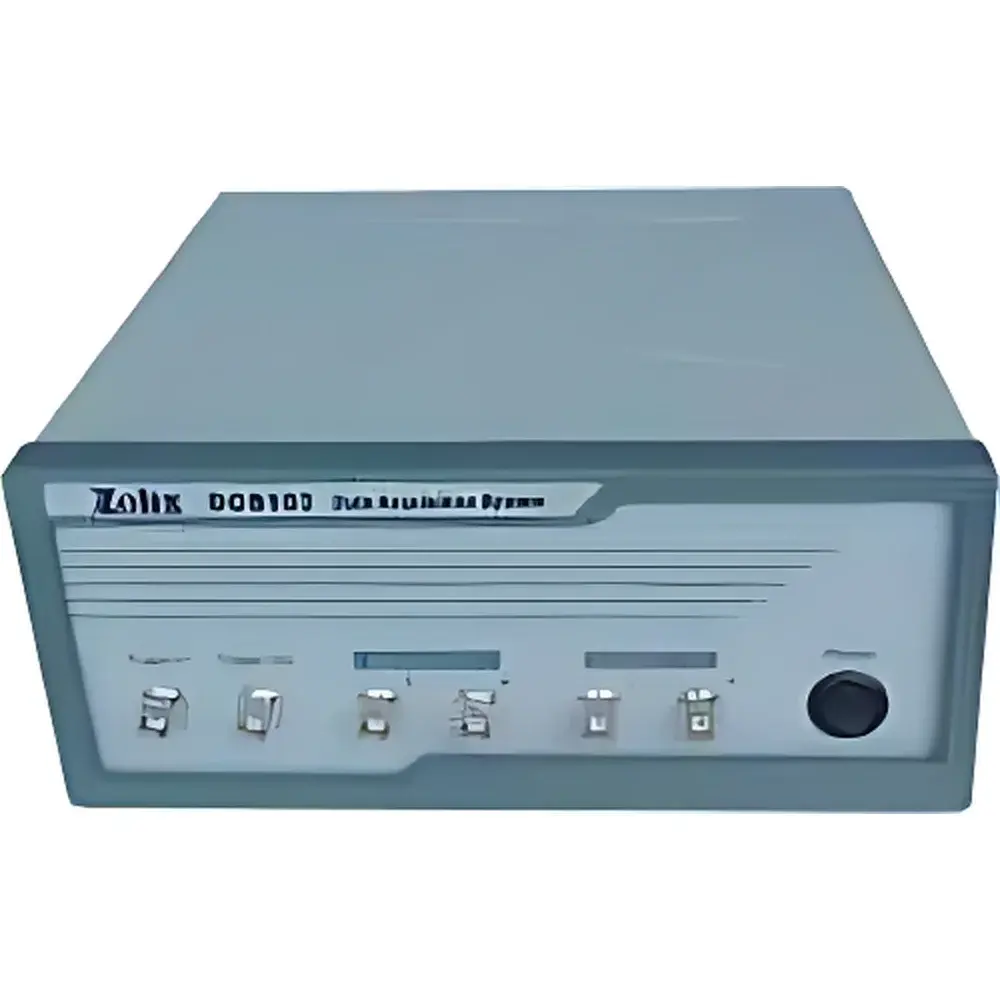
ZOLIX DCS103 Dual-Channel Current/Voltage Data Acquisition System
| Brand | ZOLIX |
|---|---|
| Origin | Beijing, China |
| Manufacturer Type | Original Equipment Manufacturer (OEM) |
| Product Category | Domestic |
| Model | DCS103 |
| Pricing | Upon Request |
| Input Channels | 2 × I/V (selectable current/voltage mode) |
| Current Range | ±5 pA (LSB) to ±40 µA (LSB) |
| Voltage Range | ±0.5 µV (LSB) to ±4 V (LSB) |
| A/D Resolution | ±15 bits |
| D/A Output | 2 × 0–10 V, 12-bit resolution |
| Trigger Input | TTL, ≥0.5 µs pulse width, ≤2 MHz frequency |
| Trigger Output Modes | (1) Sampling-end sync pulse (25 µs, 5 V) |
| Max Sampling Rate | 17,947 samples/sec (55.7184 µs/sample) |
| Interfaces | RS232, USB 2.0 |
| Dimensions | 240 × 240 × 120 mm |
| Weight | 3 kg |
Overview
The ZOLIX DCS103 Dual-Channel Current/Voltage Data Acquisition System is a precision-engineered instrumentation-grade signal interface designed for high-fidelity analog signal capture in spectroscopic and photonics laboratories. Built upon low-noise transimpedance amplifier architecture and a ±15-bit successive-approximation register (SAR) analog-to-digital converter, the DCS103 delivers exceptional dynamic range and linearity across nine programmable gain stages—enabling reliable quantification of both ultra-low photocurrents (down to 5 pA LSB) and higher-level DC voltage signals (up to ±4 V). Its dual-channel symmetry supports independent configuration per channel—each selectable as either current-input (I/V conversion) or voltage-input mode—making it suitable for differential measurements, ratiometric photodetector readout, or synchronized acquisition from complementary optical detectors. As an integral component of ZOLIX’s Omni-λ series monochromators and spectrographs, the DCS103 bridges the gap between analog detector output and digital data processing, maintaining signal integrity under demanding experimental conditions including lock-in compatible modulation schemes and time-resolved spectral acquisition.
Key Features
- Dual identical analog input channels with independent gain, offset, and mode (current/voltage) selection per channel
- Programmable transimpedance gain spanning nine decades (256× stepwise scaling), optimized for photomultiplier tube (PMT), silicon photodiode, and CCD readout applications
- ±15-bit A/D resolution ensures 90 dB effective number of bits (ENOB) at mid-scale
- Two 12-bit D/A output channels (0–10 V, unipolar) for real-time control of external devices such as motorized filter wheels, shutter drivers, or laser current sources
- Hardware-synchronized triggering system with configurable input sensitivity and dual-mode output: sampling-locked TTL strobe or standalone square-wave generation (40 Hz–10 kHz, 0.1 ms resolution)
- Real-time sampling engine capable of sustained 17.947 kS/s acquisition on both channels simultaneously, with deterministic latency and sub-microsecond timing resolution
- Rugged aluminum chassis (240 × 240 × 120 mm, 3 kg) designed for benchtop integration and EMI-resistant operation in shared lab environments
Sample Compatibility & Compliance
The DCS103 interfaces natively with ZOLIX Omni-λ monochromators, spectrometers, and modular optical benches via standardized BNC and SMB connectors. It supports industry-standard detector types including vacuum PMTs, solid-state photodiodes (Si, InGaAs), and thermopile sensors operating in DC or pulsed modes. All analog front-end circuitry complies with IEC 61000-4-2 (ESD immunity) and IEC 61000-4-3 (radiated RF immunity) requirements. Firmware and host communication protocols adhere to NIST-traceable calibration practices; raw ADC codes are directly mappable to physical units using factory-provided gain/offset coefficients stored in non-volatile memory. While not certified for clinical or process-critical GMP environments, the device meets general-purpose laboratory equipment requirements under ISO/IEC 17025–accredited testing workflows when used with documented calibration intervals.
Software & Data Management
The DCS103 is fully supported by ZOLIX SpectraMaster™ Control Suite (Windows 10/11, 64-bit), providing graphical configuration of sampling parameters, real-time waveform visualization, multi-channel overlay, and export to CSV, HDF5, or MATLAB .mat formats. The SDK includes C/C++, Python (PySerial + NumPy), and LabVIEW VIs for custom automation—enabling integration into automated spectroscopy platforms compliant with ASTM E1317 (spectrophotometer performance verification) or ISO 17025 audit trails. All acquisition sessions log timestamped metadata—including gain settings, trigger source, and firmware revision—supporting GLP-aligned record retention. USB 2.0 and RS232 interfaces ensure backward compatibility with legacy DAQ systems while maintaining deterministic packet timing essential for time-correlated single-photon counting (TCSPC) auxiliary synchronization.
Applications
- High-sensitivity fluorescence and Raman spectroscopy signal digitization with PMT or APD detectors
- Time-resolved absorbance kinetics using dual-beam ratio acquisition to compensate for source drift
- Calibration traceability for radiometric and photometric standards labs (e.g., spectral responsivity mapping)
- Control-loop interfacing in closed-loop monochromator wavelength stabilization systems
- Multi-detector array readout in custom-built hyperspectral imaging setups
- Educational labs requiring teachable signal conditioning fundamentals: transimpedance design, Nyquist sampling, and noise floor characterization
FAQ
Can the DCS103 operate independently without connection to a ZOLIX spectrometer?
Yes—the DCS103 functions as a standalone dual-channel data acquisition unit with full software configurability for generic voltage/current measurement tasks.
Is the ±15-bit A/D resolution differential or pseudo-differential?
It is true differential input architecture with programmable common-mode voltage range, enabling rejection of ground-loop-induced interference in unshielded lab environments.
Does the device support external clock synchronization for multi-unit triggering?
No native external clock input is provided; however, the TTL trigger input accepts externally generated start/stop signals compatible with function generators or FPGA-based timing controllers.
What is the typical RMS noise floor in the lowest current range (±5 pA LSB)?
Measured input-referred noise is ≤1.2 fA/√Hz at 1 kHz bandwidth when configured with 1 GΩ transimpedance gain and 100 Hz low-pass filtering.
Are calibration certificates available for metrological traceability?
ZOLIX provides optional NIST-traceable calibration reports (per ANSI/NCSL Z540-1) upon request, covering gain accuracy, offset stability, and D/A linearity across all ranges.





