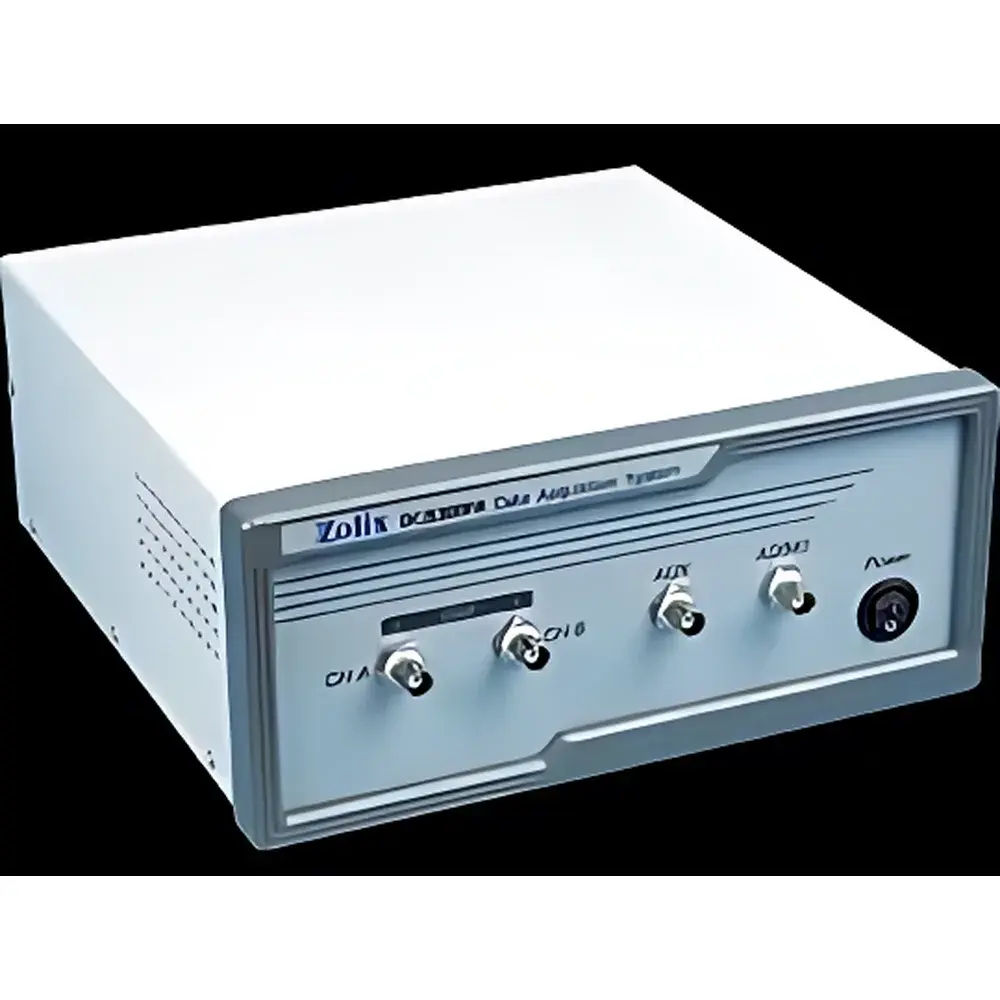
ZOLIX DCS300PA Dual-Channel Data Acquisition Unit with Integrated Low-Noise Pre-Amplifiers
| Brand | ZOLIX |
|---|---|
| Origin | Beijing, China |
| Manufacturer Type | Original Equipment Manufacturer (OEM) |
| Product Category | Domestic |
| Model | DCS300PA |
| Price Range | USD 1–4,999 |
| Input Voltage Range (V) | ±1 mV to ±10 V |
| Input Current Range (I) | ±1 mA to ±10 mA |
| Auxiliary Input | DC 0–10 V |
| Voltage Gain | 10⁰–10⁴ |
| Current Gain | 10³–10⁷ |
| Integration Time | 10 µs–10 s |
| RAM Buffer Depth | ≤2,000 samples |
| Temperature Input | AD950 sensor, −30 °C to +100 °C |
| A/D Resolution | 16-bit |
| D/A Outputs | 2 channels, 0–10 V, 12-bit resolution |
| Trigger Input | TTL rising-edge |
| Trigger Output | TTL-compatible, for shutter/solenoid control |
| Digital I/O | 5 inputs, 2 TTL outputs |
| Interface | USB 2.0 |
| Certification | CE |
| Power Supply | AC 100–240 V, 50/60 Hz → DC 24 V / 0.3 A |
| Dimensions (L×W×H) | 260 × 260 × 120 mm |
| Weight | 3.3 kg |
Overview
The ZOLIX DCS300PA Dual-Channel Data Acquisition Unit with Integrated Low-Noise Pre-Amplifiers is a precision-engineered signal conditioning and digitization platform designed for laboratory and industrial applications requiring high-fidelity capture of low-amplitude analog signals. Unlike generic data loggers, the DCS300PA implements a dual-channel transimpedance and voltage amplification architecture—optimized for photodetector outputs, thermocouple derivatives, piezoelectric sensors, and other microvolt- or microamp-level sources. Its core measurement principle relies on programmable gain instrumentation amplification followed by synchronous 16-bit analog-to-digital conversion with configurable integration timing (10 µs–10 s), enabling lock-in–compatible signal averaging without external hardware. As a direct evolution of the DCS103 platform, the DCS300PA retains full backward compatibility with legacy software drivers while introducing calibrated, multi-decade gain switching (voltage: 1×–10,000×; current: 1,000×–10,000,000×), significantly extending dynamic range and minimizing quantization error in weak-signal regimes.
Key Features
- Dual independent analog input channels supporting both voltage (±1 mV to ±10 V) and current (±1 mA to ±10 mA) modes, each with user-selectable gain stages and anti-aliasing filtering
- Integrated low-noise pre-amplifier stage with <15 nV/√Hz input voltage noise and <0.1 pA/√Hz input current noise at mid-gain settings
- Programmable integration time from 10 microseconds to 10 seconds—enabling time-resolved transient capture and noise-reduction via boxcar averaging
- 16-bit A/D converter with ≥92 dB SNR and monotonic response across full scale, compliant with IEEE 1057 standards for digitizer performance verification
- Dedicated auxiliary DC voltage input (0–10 V) for reference signal monitoring or external sensor biasing
- Two 12-bit D/A output channels (0–10 V range) for closed-loop control of actuators, laser diode drivers, or temperature controllers
- Hardware-triggered acquisition via TTL rising-edge input and synchronized TTL trigger output for coordination with pulsed light sources or mechanical shutters
- Five digital inputs and two TTL outputs supporting event logging, interlock safety circuits, and peripheral device handshaking
- USB 2.0 interface with vendor-provided SDK (C/C++, Python, LabVIEW) and SCPI-compliant command set for automated test system integration
Sample Compatibility & Compliance
The DCS300PA interfaces seamlessly with a broad spectrum of scientific sensors—including photodiodes, photomultiplier tubes (PMTs), lock-in amplifier reference outputs, RTDs, and AD950-class silicon temperature probes—without requiring external signal conditioning. Its input impedance (>10 GΩ in voltage mode, <50 Ω in current mode) ensures minimal loading effects across source impedances from 1 MΩ. All analog signal paths are galvanically isolated from digital ground to suppress common-mode interference in electromagnetically noisy environments. The unit carries CE marking per Directive 2014/30/EU (EMC) and 2014/35/EU (LVD), and its firmware supports audit-trail-enabled operation when used in GLP/GMP-regulated workflows. While not FDA 21 CFR Part 11–certified out-of-the-box, its deterministic timestamping, non-volatile configuration storage, and write-protected firmware update mechanism provide foundational traceability for validation protocols.
Software & Data Management
ZOLIX provides the DCS300PA Control Suite—a cross-platform application (Windows/macOS/Linux) supporting real-time waveform visualization, multi-channel oscilloscope-style triggering, and batch export to CSV, HDF5, or MATLAB .mat formats. The embedded 2,000-sample RAM buffer enables high-speed burst acquisition without host PC latency bottlenecks. For system integrators, the unit exposes a full SCPI command set over USB virtual COM port, enabling scripting in Python (via PySerial), MATLAB Instrument Control Toolbox, or National Instruments TestStand. All acquired data includes embedded metadata: timestamp (UTC-sync capable), gain setting, integration time, channel calibration coefficients, and firmware revision—ensuring full experimental provenance per ISO/IEC 17025 clause 7.5.3.
Applications
- Time-resolved fluorescence decay measurements using gated PMT detection
- Low-light spectroscopy systems where signal-to-noise ratio is constrained by detector dark current
- Thermal stability testing of optoelectronic components with simultaneous temperature and photocurrent logging
- Electrochemical impedance spectroscopy (EIS) front-end signal digitization at sub-millivolt excitation levels
- Atomic force microscopy (AFM) cantilever deflection readout in contact/resonant modes
- Calibration laboratories performing transfer standards verification for microampere-level current sources
- Physics education labs demonstrating signal averaging, noise statistics, and dynamic range trade-offs
FAQ
Is the DCS300PA compatible with third-party DAQ software such as LabVIEW or MATLAB?
Yes—the device implements a standard USB CDC ACM interface with SCPI command support and ships with native drivers and API wrappers for LabVIEW, MATLAB, Python, and C/C++.
Can the integration time be synchronized across both analog channels?
Yes—hardware-level channel synchronization ensures identical integration windows and sampling clocks for both inputs, critical for differential or ratiometric measurements.
Does the unit support external clock input for master-slave DAQ configurations?
No—timing is internally generated; however, the TTL trigger output can serve as a sync pulse for coordinating multiple DCS300PA units or external instruments.
What is the maximum sustainable sampling rate in RAM mode?
At minimum integration time (10 µs), the effective sustained rate is ~100 kS/s per channel; the 2,000-sample buffer limits continuous duration to 20 ms unless streamed to host memory.
Are calibration certificates available for metrological traceability?
ZOLIX offers optional NIST-traceable calibration reports (ISO/IEC 17025 accredited lab) upon request, covering gain linearity, offset drift, and A/D transfer function verification.