
ZOLIX Diffractive Optical Elements (DOEs)
| Brand | ZOLIX |
|---|---|
| Origin | Beijing, China |
| Manufacturer Type | OEM/ODM Producer |
| Product Category | Domestic |
| Model Range | Custom-Configurable DOEs for Laser Beam Shaping and Multi-Wavelength Focusing |
| Pricing | Available Upon Technical Consultation |
Overview
ZOLIX Diffractive Optical Elements (DOEs) are precision-engineered microstructured optical components designed to manipulate laser beam phase profiles with high fidelity. Based on scalar diffraction theory and rigorous design optimization using iterative Fourier transform algorithms (IFTA), these elements enable deterministic control over intensity distribution, focal positioning, and wavefront correction—functions unattainable with conventional refractive optics alone. Each DOE is fabricated via high-resolution photolithography and reactive ion etching (RIE) on optically homogeneous substrates, ensuring sub-wavelength surface accuracy (< λ/20 RMS) and minimal zero-order leakage (< 0.5%). The product family includes three functionally distinct classes: dual-wavelength focusing lenses, top-hat beam shapers, and diffractive aberration-corrected focusing mirrors—each tailored for industrial, scientific, and medical laser systems operating across UV to far-IR spectral bands (266 nm – 10.6 µm).
Key Features
- Multi-Wavelength Co-Focusing: Dual-band anti-reflection coated ZnSe lenses (e.g., DW-201-A-Y-A) simultaneously focus CO2 (10.6 µm) and HeNe (633 nm) beams to a common focal point with < ±25 µm axial tolerance, eliminating mechanical alignment drift in hybrid metrology setups.
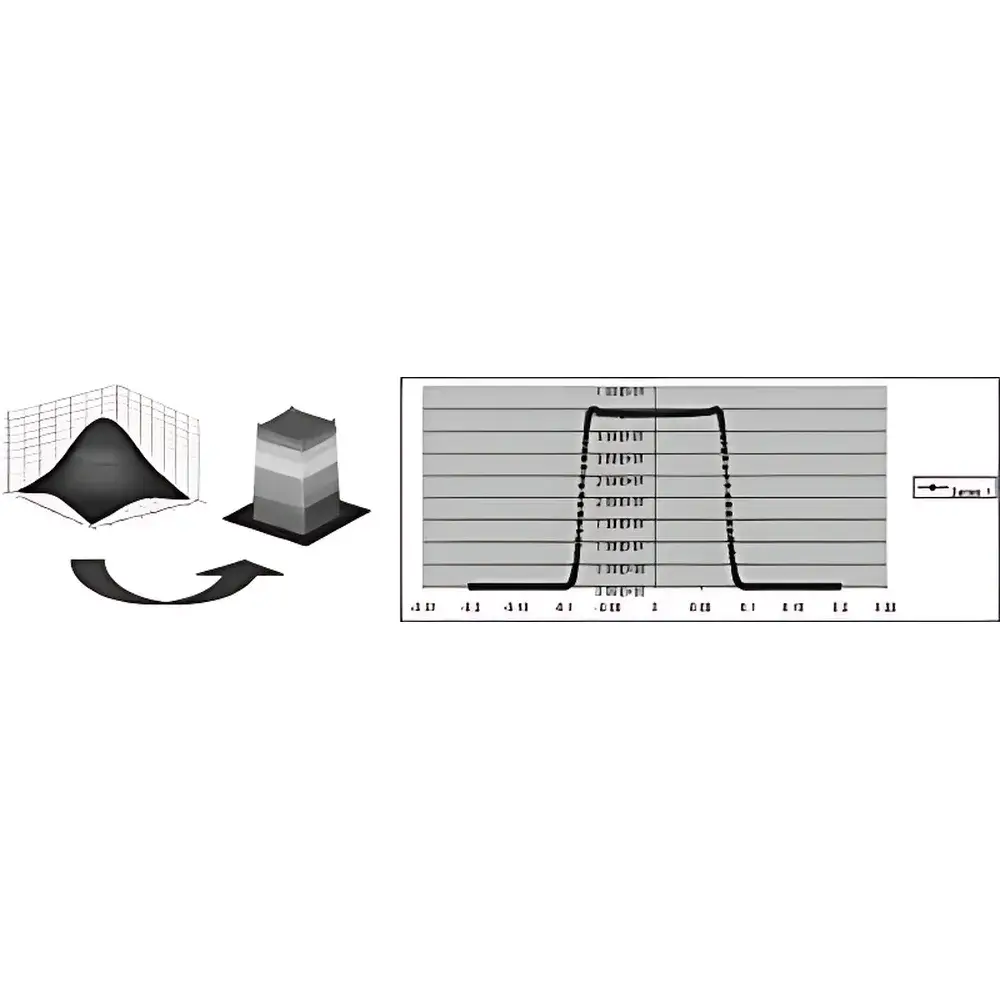
- Top-Hat Beam Uniformity: Engineered for >75% intensity uniformity (±20% flatness) over defined output apertures—from 15 µm round spots to 100 × 100 mm square fields—with sharp edge transition (≤10% intensity roll-off over ≤10 µm lateral distance).
- Diffractive Aberration Correction: Hybrid refractive-diffractive designs (e.g., SE-series) integrate kinoform phase profiles onto plano-convex substrates to compensate spherical aberration across full input aperture, achieving diffraction-limited spot sizes (Strehl ratio > 0.85) at working distances from 20 mm to infinity.
- Material & Coating Flexibility: Substrates include fused silica (UV–NIR), ZnSe (MIR), and CaF2 (deep UV); broadband or laser-line AR coatings meet ISO 10110-7 scratch-dig standards and withstand peak power densities up to 1 GW/cm² (10 ns pulse, 10 Hz).
- Custom Design Integration: All DOEs support OEM integration via standardized mounting interfaces (e.g., SM1-threaded cells, kinematic mounts) and are supplied with measured MTF, PSF, and far-field irradiance maps traceable to NIST-calibrated interferometers.
Sample Compatibility & Compliance
ZOLIX DOEs are compatible with continuous-wave and pulsed laser sources including Nd:YAG (266/355/532/1064 nm), Ti:sapphire (700–1000 nm), excimer (193/248/308 nm), CO2 (10.6 µm), and diode lasers (375–980 nm). Each component undergoes full environmental qualification per MIL-STD-810G for thermal shock (−40°C to +70°C, 5 cycles), humidity (95% RH, 48 h), and vibration (10–2000 Hz, 7.5 g RMS). Documentation packages include RoHS-compliant material declarations, ISO 9001:2015 manufacturing certificates, and optional FDA 21 CFR Part 11–compliant calibration records for regulated medical device applications.
Software & Data Management
ZOLIX provides proprietary DOE design software (Z-DOE Designer v3.2) supporting import of measured beam profiles (via .mat or .csv), automatic generation of binary-phase kinoforms, and simulation of near- and far-field irradiance distributions using angular spectrum propagation. Export formats include Gerber (for mask fabrication), STL (for direct-write lithography), and Zemax-compatible .DAT files. All delivered DOEs include encrypted digital twin datasets—containing as-fabricated surface topology (measured via white-light interferometry), calibrated efficiency curves, and spectral transmission spectra—accessible via secure client portal with audit-trail logging compliant with GLP/GMP data integrity requirements.
Applications
- Laser micromachining: Uniform ablation thresholds in PCB drilling, thin-film scribing, and semiconductor dicing
- Medical laser systems: Homogeneous energy delivery in dermatology (vascular lesion treatment) and ophthalmology (femtosecond LASIK)
- Optical trapping & manipulation: Flat-top illumination for multi-particle holographic tweezers
- Spectroscopy & metrology: Co-aligned reference and probe beams in dual-comb interferometry
- Display technology: Pixel-level beam shaping for laser phosphor projection and AR waveguide illumination
- Defense & sensing: Multi-spectral LIDAR transceivers requiring simultaneous eye-safe (1550 nm) and targeting (1064 nm) channel collimation
FAQ
What is the typical damage threshold for ZOLIX DOEs under nanosecond pulsed operation?
For ZnSe-based elements at 1064 nm, 10 ns pulses, the certified LIDT is 500 mJ/cm² (tested per ISO 21254-2); fused silica variants achieve 1.2 J/cm² under identical conditions.
Can ZOLIX provide DOEs optimized for non-Gaussian input beams?
Yes—designs accept user-defined input intensity and phase profiles (e.g., super-Gaussian, Bessel, or measured M2-degraded beams) to maintain output uniformity within specified tolerances.
Is custom spectral bandwidth support available beyond standard models?
Yes—custom coating stacks and substrate combinations accommodate multi-line operation (e.g., 532/1064/1550 nm triple-band) or ultra-broadband (400–2000 nm) applications with <0.3% RMS transmission variation.
Do you supply measurement reports with each DOE shipment?
Every unit ships with a Certificate of Conformance including interferometric surface map, far-field intensity scan, absolute diffraction efficiency at design wavelength(s), and environmental test summary.
Are ZOLIX DOEs suitable for vacuum or UHV environments?
Yes—ZnSe and fused silica substrates exhibit outgassing rates <1×10⁻¹⁰ Pa·m³/s·cm² (per ASTM E595), and all adhesives/coatings are vacuum-compatible; optional gold overcoat available for enhanced thermal stability.




