
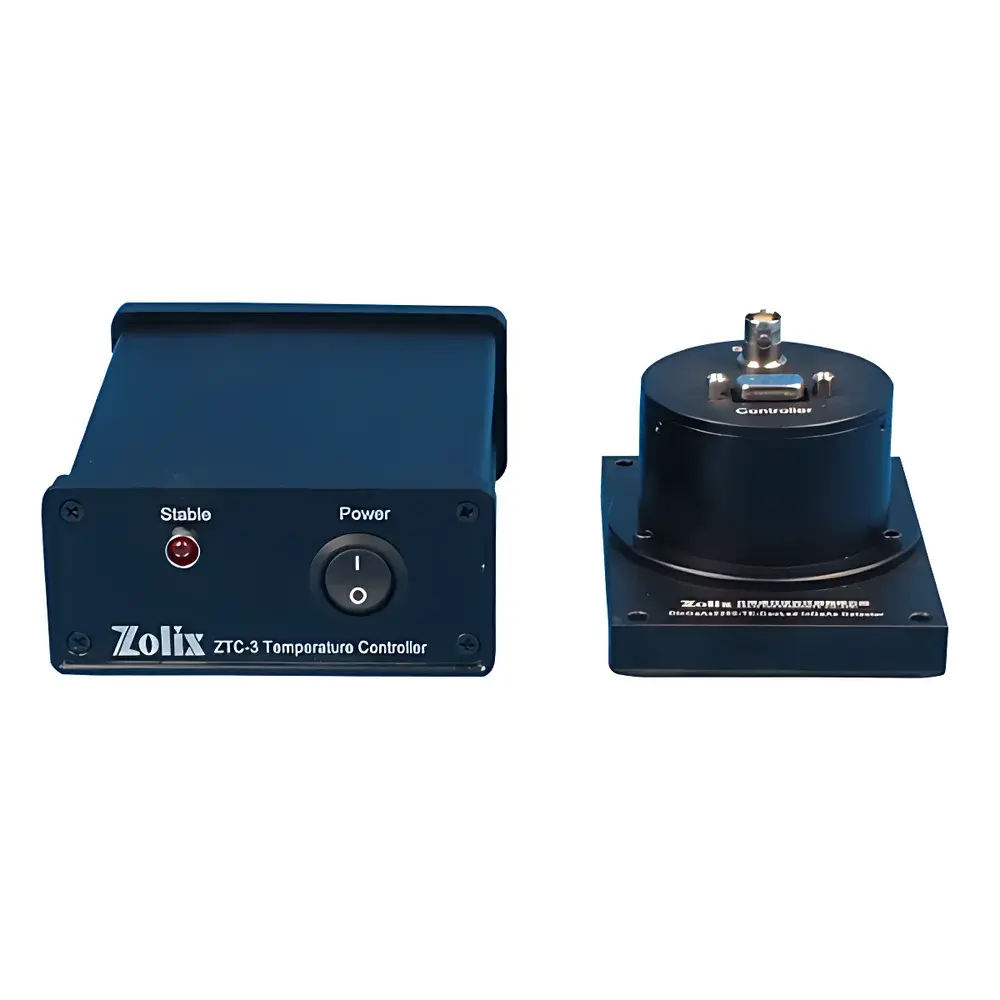
ZOLIX DInAs3800-TE Thermoelectrically Cooled Indium Arsenide Photodetector
| Brand | ZOLIX |
|---|---|
| Model | DInAs3800-TE |
| Active Area Diameter | 2 mm |
| Spectral Range | 1–3.8 µm |
| Peak Responsivity | 1.5 A/W @ λₚₑₐₖ |
| Specific Detectivity (D*) | 9.1 × 10¹² cm·Hz¹ᐟ²/W @ λₚₑₐₖ, 1 kHz |
| Noise-Equivalent Power (NEP) | 4.4 pW/Hz¹ᐟ² @ λₚₑₐₖ, 1 kHz |
| Operating Temperature | −40 °C |
| Temperature Stability | ±0.5 °C |
| Output Mode | Current (Positive Polarity) |
| Required Temperature Controller | ZTC (Two-Stage TE Cooler, Fixed Cooling Power) |
| Recommended Preamp | ZAMP |
| Integrated Amplification Compatibility | DCS300PA Data Acquisition System (Dual-Channel, Built-in I-V Conversion) |
Overview
The ZOLIX DInAs3800-TE is a thermoelectrically cooled indium arsenide (InAs) photodetector engineered for high-sensitivity mid-wave infrared (MWIR) detection in spectroscopic and analytical instrumentation. Operating on the principle of photoconductive or photovoltaic conversion—depending on bias configuration—the detector delivers stable, low-noise current output across a spectral range of 1–3.8 µm, with peak responsivity at ~3.2 µm. Its 2-mm-diameter active area enables efficient coupling with optical fibers, monochromators, FTIR beam paths, and laser-based absorption setups. The integrated two-stage thermoelectric (TE) cooler maintains the InAs element at a stabilized −40 °C, significantly suppressing dark current and thermal noise—critical for high signal-to-noise ratio (SNR) measurements in low-flux applications such as gas-phase molecular spectroscopy, trace hydrocarbon analysis, and non-dispersive infrared (NDIR) sensing.
Key Features
- Thermoelectrically cooled InAs sensing element with factory-optimized anti-reflection coating for broadband MWIR transmission
- Precise temperature regulation via dedicated ZTC controller, achieving ±0.5 °C stability at −40 °C operating point
- High specific detectivity (D* = 9.1 × 10¹² cm·Hz¹ᐟ²/W) and low NEP (4.4 pW/Hz¹ᐟ²) at 1 kHz modulation frequency—enabling sub-nW-level radiant power resolution
- Current-output architecture (positive polarity) compatible with standard lock-in amplifiers, oscilloscopes, and data acquisition systems equipped with transimpedance input stages
- Direct integration capability with ZOLIX DCS300PA dual-channel data acquisition system, which incorporates onboard programmable gain transimpedance amplifiers—eliminating need for external preamplification
- Rugged hermetic TO-8 package with K-mount flange, optimized for vacuum-compatible and vibration-resistant laboratory environments
Sample Compatibility & Compliance
The DInAs3800-TE is designed for use with continuous-wave (CW) and modulated IR sources including quantum cascade lasers (QCLs), tunable diode lasers (TDLs), and globar emitters in Fourier-transform infrared (FTIR) spectrometers. It supports both free-space and fiber-coupled configurations (FC/PC or SMA-905 interfaces via optional adapters). The detector complies with RoHS Directive 2011/65/EU and meets mechanical and electrical safety requirements per IEC 61010-1:2010 for laboratory measurement equipment. While not certified to ISO/IEC 17025 or GLP/GMP out-of-the-box, its stable thermal control, calibrated responsivity traceability (NIST-traceable reference detectors available upon request), and audit-ready signal chain design support compliance workflows under ASTM E1421 (Standard Practice for Describing and Measuring Performance of FTIR Spectrometers) and USP (Spectrophotometric Absorbance Measurements).
Software & Data Management
No proprietary software is bundled with the DInAs3800-TE; it functions as a hardware-level analog sensor requiring external signal conditioning and digitization. When paired with the DCS300PA acquisition system, users leverage ZOLIX’s LabVIEW-based DCS Control Suite v3.x, which provides real-time voltage scaling, gain calibration tables, time-domain averaging, FFT spectral analysis, and export to CSV, HDF5, or MATLAB .mat formats. All acquired data streams include embedded metadata (timestamp, detector temperature, gain setting, integration time), satisfying minimum ALCOA+ (Attributable, Legible, Contemporaneous, Original, Accurate, Complete, Consistent, Enduring, Available) criteria for regulated environments. Audit trails for hardware configuration changes are maintained when used with validated instrument control platforms compliant with FDA 21 CFR Part 11 Annex 11 requirements.
Applications
- Quantitative gas-phase analysis of CO, CO₂, CH₄, NOₓ, and volatile organic compounds (VOCs) in environmental monitoring and combustion diagnostics
- Mid-IR absorption spectroscopy in pharmaceutical solid-state characterization (e.g., polymorph identification, hydrate/dehydrate kinetics)
- Process analytical technology (PAT) deployment in continuous manufacturing lines for real-time reaction monitoring
- Calibration transfer between benchtop and portable FTIR systems using reference spectra collected under identical detector thermal conditions
- Low-light radiometry in cryogenic or vacuum chamber-based material emissivity studies
FAQ
Is the DInAs3800-TE compatible with third-party lock-in amplifiers?
Yes—provided the amplifier features a low-noise current-input mode or accepts external transimpedance preamplification. For optimal SNR, we recommend using the ZAMP transimpedance amplifier or equivalent (≥10⁶ V/A gain, ≤5 fA/√Hz input current noise).
Can the detector operate without the ZTC temperature controller?
No. The DInAs3800-TE is a TE-cooled device requiring active thermal management. Uncontrolled operation above −20 °C results in >10× increase in dark current and irreversible degradation of D*.
What is the maximum permissible optical power density on the active area?
The detector is rated for continuous illumination up to 10 mW/mm² at λ = 3.2 µm. Pulsed operation requires derating based on duty cycle and peak fluence; consult ZOLIX Application Note AN-DInAs-02 for laser damage threshold specifications.
Does ZOLIX provide NIST-traceable calibration certificates?
Yes—optional spectral responsivity calibration (300–3800 nm) and D* verification at discrete wavelengths (2.0, 2.7, 3.2, 3.6 µm) are available with ISO/IEC 17025-accredited certification upon request.
How does the DInAs3800-TE compare to HgCdTe (MCT) detectors in the same spectral range?
While MCT offers broader cutoff tunability and higher D* below 200 K, the DInAs3800-TE achieves comparable performance at −40 °C with lower power consumption, no liquid nitrogen dependency, and superior long-term stability—making it preferred for field-deployable and OEM-integrated systems where cooling simplicity and reliability are prioritized over ultimate sensitivity.





