
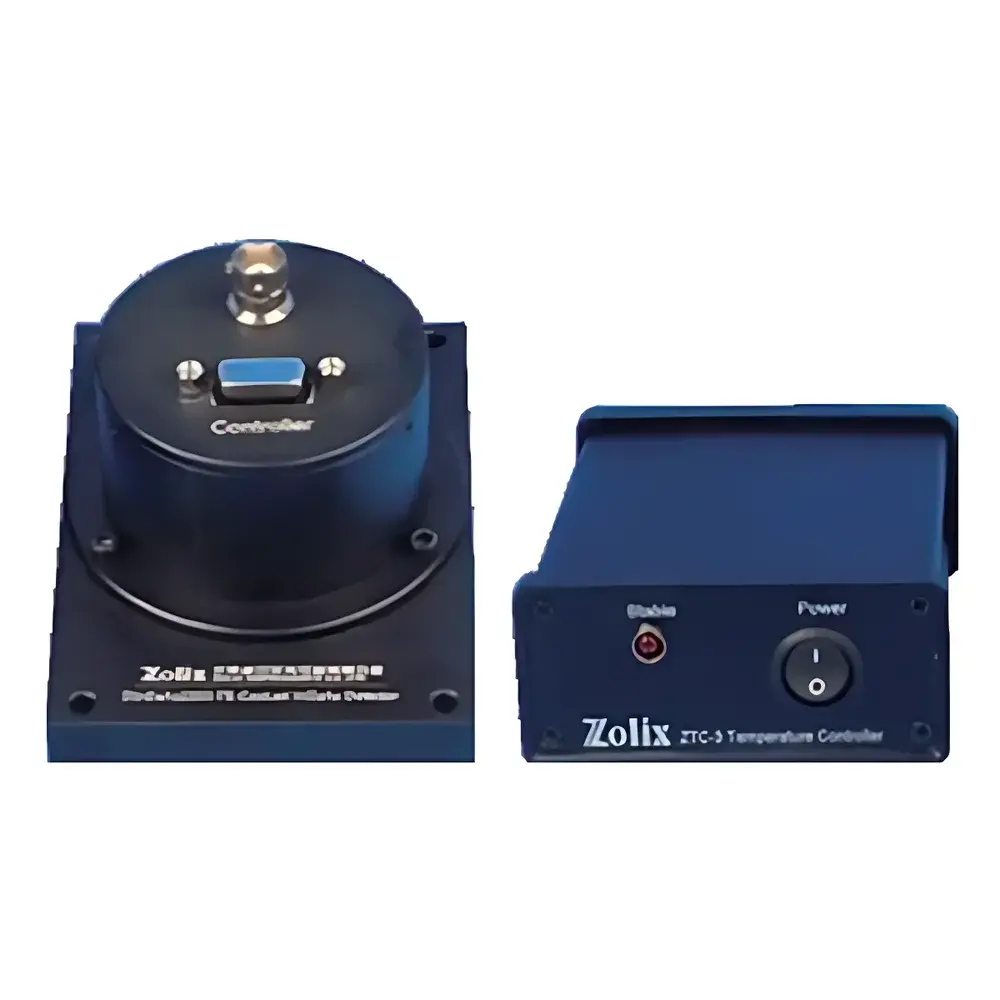
ZOLIX DInGaAs Series TE-Cooled Indium Gallium Arsenide (InGaAs) Photodetector
| Brand | ZOLIX |
|---|---|
| Origin | Beijing, China |
| Manufacturer Type | Original Equipment Manufacturer (OEM) |
| Product Line | DInGaAs-TE Series |
| Cooling Method | Thermoelectric (TE) Staged Cooling |
| Spectral Range | 800–1700 nm / 800–2600 nm (model-dependent) |
| Active Area Diameter | 3 mm |
| Peak Responsivity | 0.9–1.3 A/W |
| Typical D* | 4.5×10¹¹–8.4×10¹³ cm·Hz½/W |
| Typical NEP | 3.2×10⁻¹⁵–6.0×10⁻¹³ W/Hz½ |
| Operating Detector Temperature | –20 °C to –40 °C |
| Temperature Stability | ±0.5 °C |
| Ambient Operating Temperature | +10 °C to +40 °C |
| Output Mode | Current (positive polarity) |
| Compatible Preamp Models | ZPA-7, ZPA-7P, ZAMP |
| Required Temperature Controller | ZTC or ZTC-H (model-specific) |
Overview
The ZOLIX DInGaAs Series TE-Cooled Indium Gallium Arsenide (InGaAs) Photodetectors are engineered for high-sensitivity, low-noise detection in near-infrared (NIR) and short-wave infrared (SWIR) spectral regions. These detectors operate on the principle of photoconductive conversion—incident photons with energy exceeding the bandgap of InGaAs generate electron-hole pairs, producing a proportional photocurrent. The thermoelectric (TE) cooling architecture enables stable operation at sub-ambient temperatures (down to –40 °C), significantly suppressing dark current and improving signal-to-noise ratio (SNR), particularly critical for low-light spectroscopic applications such as FTIR, laser-induced fluorescence, optical coherence tomography (OCT), and gas-phase absorption spectroscopy. Unlike uncooled InGaAs detectors, the DInGaAs-TE series maintains consistent responsivity and linearity across extended integration times, making it suitable for quantitative measurements requiring high reproducibility and long-term stability.
Key Features
- Thermoelectrically cooled InGaAs photodiodes with two-stage Peltier elements for precise thermal regulation
- Three model variants supporting distinct spectral ranges: DInGaAs1700-TE (800–1700 nm), DInGaAs2600-TE (800–2600 nm), and DInGaAs2600H-TE (800–2600 nm, optimized for higher responsivity)
- Uniform 3 mm diameter active area with anti-reflection coated window for maximal quantum efficiency
- Typical detectivity (D*) up to 8.4×10¹³ cm·Hz½/W and noise-equivalent power (NEP) as low as 3.2×10⁻¹⁵ W/Hz½ — enabling detection of weak NIR/SWIR signals
- Integrated thermal management interface compatible with ZOLIX ZTC and ZTC-H temperature controllers for closed-loop stabilization (±0.5 °C accuracy)
- Current-output configuration with positive polarity; designed for direct interfacing with transimpedance amplifiers or lock-in amplifiers
- OEM-ready mechanical housing with standard SMA or FC fiber coupling options and electrical feedthroughs compliant with industrial vacuum and benchtop integration requirements
Sample Compatibility & Compliance
The DInGaAs-TE detectors are compatible with free-space and fiber-coupled optical configurations, supporting both collimated beam and multimode fiber inputs (e.g., 200 µm core diameter). They comply with IEC 61000-6-3 (EMC emission standards) and meet RoHS Directive 2011/65/EU for hazardous substance restrictions. When integrated into analytical systems subject to regulatory oversight—including pharmaceutical QC labs or environmental monitoring platforms—the detector’s stable calibration traceability supports adherence to ISO/IEC 17025:2017 requirements for measurement uncertainty reporting. While the detector itself is not FDA 21 CFR Part 11-certified, its use within validated instrument architectures (e.g., coupled to ZOLIX DCS300PA data acquisition units with audit-trail-enabled firmware) facilitates GLP/GMP-compliant workflows.
Software & Data Management
These detectors do not include embedded firmware or onboard digitization; they function as analog front-end sensors. Signal conditioning is performed externally via compatible preamplifiers (ZPA-7, ZPA-7P) or the integrated dual-channel amplifier within the ZOLIX DCS300PA data acquisition system. When used with DCS300PA, full synchronization with external triggers, real-time baseline correction, and 16-bit ADC sampling at up to 1 MS/s are supported. Raw current output data can be exported in CSV or HDF5 format for post-processing in MATLAB, Python (NumPy/SciPy), or LabVIEW environments. For system-level validation, calibration certificates (including spectral responsivity curves and NEP characterization reports) are provided per unit upon request, aligned with NIST-traceable reference standards.
Applications
- Fourier-transform infrared (FTIR) spectrometry in material identification and polymer analysis
- Quantitative gas sensing using tunable diode laser absorption spectroscopy (TDLAS) at 1300–2300 nm
- Process analytical technology (PAT) for real-time monitoring of chemical reactions in pharmaceutical manufacturing
- Non-destructive testing (NDT) of composite materials using SWIR reflectance imaging
- Time-resolved photoluminescence decay measurements in semiconductor research
- Calibration transfer between laboratory and field-deployable NIR instruments
FAQ
Do these detectors require external amplification before connection to a DAQ system?
Yes — all DInGaAs-TE models output current signals. Direct connection to voltage-input devices (e.g., oscilloscopes or DAQ cards without built-in transimpedance stages) requires an external I-V converter such as the ZAMP or ZPA-7 series. The DCS300PA is an exception, as it integrates dual-channel programmable gain amplifiers.
What is the recommended temperature controller for DInGaAs2600H-TE?
The ZTC-H controller is specifically matched to the higher thermal load of the DInGaAs2600H-TE variant and provides enhanced PID tuning for improved stability at –20 °C operating point.
Can the detector be operated without active cooling?
While functional at ambient temperature, uncooled operation increases dark current by approximately two orders of magnitude, degrading NEP and dynamic range — thus compromising performance in low-flux or high-resolution applications.
Is fiber coupling standardized across all DInGaAs-TE models?
All variants support SMA-905 and FC/PC connector options; however, optimal coupling efficiency requires matching the fiber NA and core diameter to the 3 mm active area geometry — custom collimation optics are available upon request.
How frequently should calibration verification be performed?
For routine laboratory use under stable environmental conditions, annual verification against a NIST-traceable reference source is recommended; more frequent checks are advised when used in regulated environments or following mechanical shock or thermal cycling events.






