
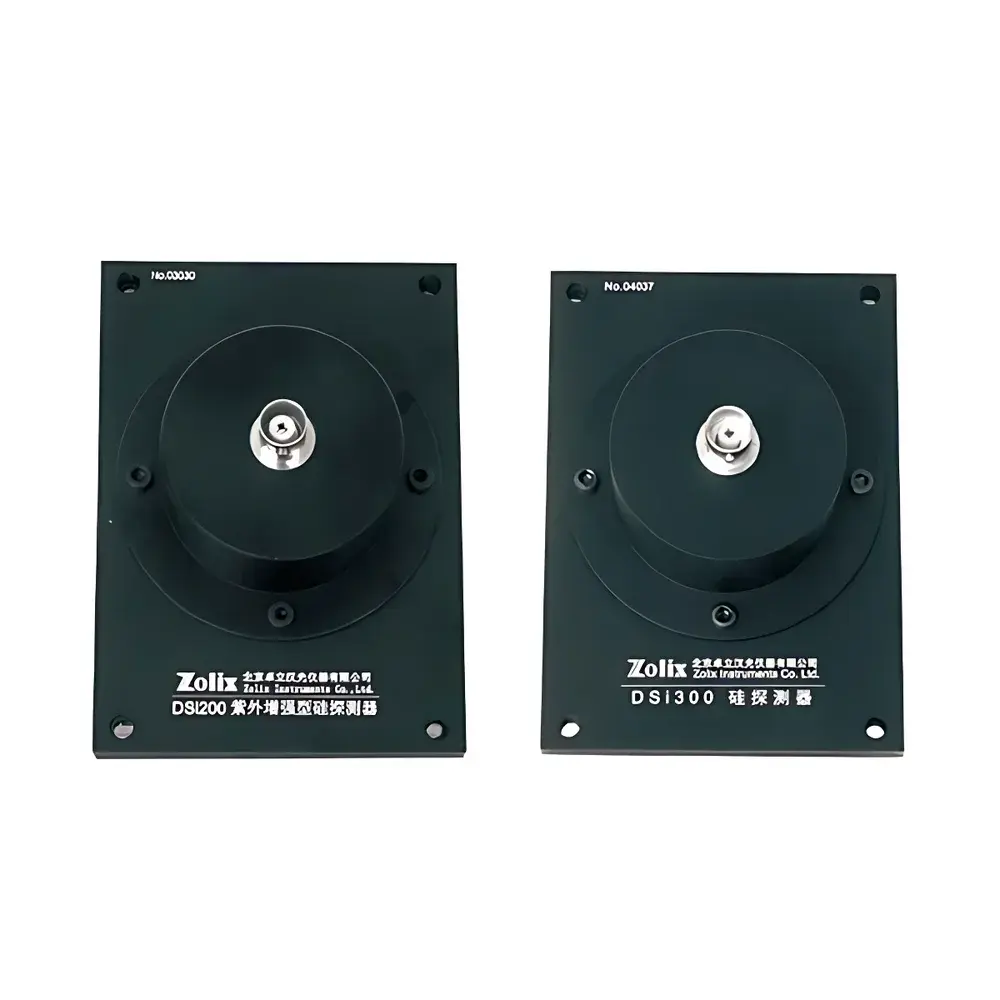
ZOLIX DSi Series Silicon Photodetectors
| Brand | ZOLIX |
|---|---|
| Model | DSi Series |
| Type | Silicon Photodiode Detector (Room-Temperature, Current-Output) |
| Spectral Range | DSi200: 200–1100 nm (UV-enhanced) |
| DSi300 | 350–1100 nm (Blue-enhanced) |
| Active Area | 100 mm² (Φ11.28 mm) |
| Peak Responsivity | DSi200: 0.52 A/W @ 820 nm |
| DSi300 | ≥0.55 A/W @ 970 nm |
| UV Responsivity | DSi200: ≥0.09 A/W @ 254 nm |
| DSi300 | ≥0.15 A/W @ 410 nm |
| Rise Time | 5.9 µs |
| Operating Temperature | −10 to +60 °C |
| Storage Temperature | −20 to +70 °C |
| Shunt Resistance | DSi200: >5 MΩ |
| DSi300 | >10 MΩ |
| NEP | DSi200: 4.5×10⁻¹³ W/√Hz |
| DSi300 | 2.0×10⁻¹³ W/√Hz |
| Max. Bias-Free Current | DSi200: 0.11 mA |
| DSi300 | 0.0 mA |
| Junction Capacitance @ 0 V | DSi200: 4500 pF |
| DSi300 | 8800 pF |
| Output Polarity | Positive (P-type anode) |
| Output Mode | Photocurrent (unamplified, high-impedance current source) |
Overview
The ZOLIX DSi Series Silicon Photodetectors are precision, room-temperature photodiodes engineered for broadband spectral detection in spectroscopic and optical measurement systems. Designed as OEM-grade components for integration into spectrometers, monochromators, fluorescence readers, and laser power monitoring setups, the DSi detectors operate on the principle of photovoltaic conversion—generating a photocurrent proportional to incident photon flux within their specified wavelength range. The series comprises two variants: the DSi200, featuring UV-enhanced silicon with extended responsivity down to 200 nm, and the DSi300, optimized for blue-to-NIR performance with peak sensitivity at 970 nm. Both models utilize high-purity, single-crystal silicon with passivated surfaces to minimize dark current and maximize quantum efficiency stability across environmental fluctuations. Their large active area (100 mm²) enables efficient light collection from divergent or low-intensity beams without requiring complex focusing optics—making them especially suitable for applications involving integrating spheres, fiber-coupled sources, or collimated beam profiling.
Key Features
- Two spectrally optimized variants: DSi200 (UV-enhanced, 200–1100 nm) and DSi300 (blue-enhanced, 350–1100 nm)
- Large uniform active area of 100 mm² (Φ11.28 mm), supporting high optical throughput and spatial averaging
- High shunt resistance (>5 MΩ for DSi200; >10 MΩ for DSi300) ensuring low leakage current and improved signal-to-noise ratio
- Low noise-equivalent power (NEP): 4.5×10⁻¹³ W/√Hz (DSi200) and 2.0×10⁻¹³ W/√Hz (DSi300), enabling reliable detection of weak optical signals
- Fast temporal response with rise time of 5.9 µs—compatible with pulsed laser measurements and modulated light sources
- Robust thermal design: operational stability maintained from −10 °C to +60 °C, with storage capability up to +70 °C
- Current-output architecture with positive polarity (P-type anode), compatible with standard transimpedance amplifier topologies
Sample Compatibility & Compliance
The DSi detectors are designed for use with free-space, fiber-optic, or integrated optical paths delivering irradiance within standard laboratory safety limits (IEC 62471 Class 1 or 2). They exhibit no intrinsic spectral calibration traceability but are supplied with normalized responsivity curves referenced to NIST-traceable standards. When integrated into analytical instruments intended for regulated environments (e.g., pharmaceutical QC labs), the DSi series supports compliance with ISO/IEC 17025 requirements for detector verification—provided end-users perform periodic responsivity validation using calibrated reference lamps (e.g., tungsten-halogen or deuterium sources per ASTM E275 and ISO 17025 Annex C). No hazardous substances are used in manufacturing; RoHS 3 and REACH conformity documentation is available upon request.
Software & Data Management
As passive analog sensing elements, the DSi detectors do not include embedded firmware or digital interfaces. However, they are fully interoperable with industry-standard data acquisition platforms—including ZOLIX’s DCS300PA dual-channel system, which integrates programmable gain transimpedance amplifiers and 16-bit ADCs. When paired with the ZAMP I-V amplifier, users gain access to adjustable gain (10⁴–10⁸ V/A), low-noise front-end conditioning, and BNC output compatibility with oscilloscopes, lock-in amplifiers (e.g., Stanford Research SR830), and DAQ cards (NI USB-6211, Keysight 34972A). All signal conditioning hardware supports audit-ready logging when operated under GLP/GMP-compliant software environments (e.g., LabVIEW with 21 CFR Part 11 add-ons or MATLAB Production Server with electronic signature modules).
Applications
- UV-Vis-NIR spectrophotometer detector modules (replacement or upgrade for legacy PMT or CCD-based systems)
- Laser-induced fluorescence (LIF) and Raman scattering intensity monitoring
- Optical power metering in laser safety and alignment workflows
- Integrating sphere-based reflectance and transmittance measurements (ASTM E903, ISO 9050)
- Time-resolved photoluminescence decay analysis with gated detection systems
- Process analytical technology (PAT) sensors for real-time reaction monitoring in flow cells
FAQ
Can the DSi200 or DSi300 be used without an external amplifier?
Yes—but only when interfaced with instrumentation explicitly rated for direct current-input operation (e.g., certain lock-in amplifiers or specialized electrometers). For optimal signal integrity, linearity, and noise performance, a transimpedance amplifier such as the ZAMP is strongly recommended.
Is temperature stabilization required during operation?
No active cooling or heating is needed; both models are characterized and warranted over −10 °C to +60 °C. However, for sub-0.5% responsivity drift in long-duration measurements, ambient temperature should be held within ±2 °C using lab HVAC control.
What is the maximum permissible optical power density before saturation or damage?
The DSi series is rated for continuous-wave irradiance up to 100 mW/cm² at wavelengths >400 nm. At deep UV (<254 nm), derate to ≤20 mW/cm² to prevent surface degradation. Pulsed operation requires peak power assessment per EN 60825-1.
Are calibration certificates provided with each unit?
Factory spectral responsivity data (A/W vs. λ) is included digitally with each shipment. NIST-traceable calibration certificates are available as an optional service (ZOLIX CAL-SI-01) with uncertainty budgets compliant with ISO/IEC 17025.





