
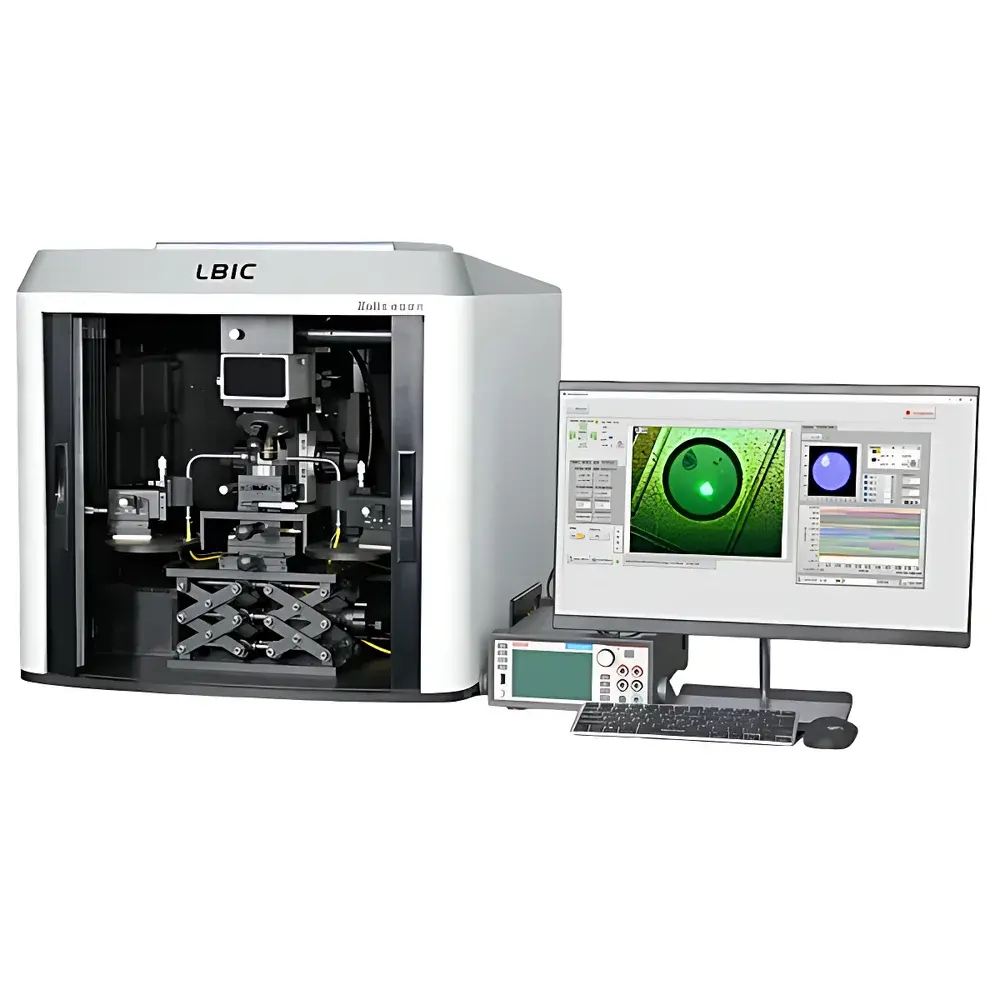
ZOLIX DSR500-LBIC Laser Beam Induced Current Imaging System
| Brand | ZOLIX |
|---|---|
| Origin | Beijing, China |
| Manufacturer Type | Direct Manufacturer |
| Model | DSR500-LBIC |
| Laser Wavelength (Standard) | 532 nm |
| Laser Power Stability | ≤1% over 4 h |
| Maximum Scan Range (20× objective) | 260 × 200 µm |
| Positional Repeatability | <1 µm |
| Minimum Step Size | 0.2 µm |
| Laser Spot Size | ~2 µm |
| Microscope Objective | Olympus 20×, WD = 7.5 mm, VIS range (350–750 nm) |
| Current Measurement | Keithley 2450 SourceMeter®, Range: 1 nA – 1 A, Noise Floor: 50 pA, Resolution: 20 fA, Accuracy: 0.03% |
| Probe Stage | 65 mm vacuum chuck, XYZ probe motion (12 mm travel, 0.7 µm resolution), sample XY translation (25 mm travel, 5 µm resolution) |
| Software Functions | LBIC mapping, I-V curve point-by-point acquisition, region-of-interest selection, thresholding, contour/3D visualization, spectral responsivity (optional, 200–2500 nm), EQE calculation, data export (TXT/Excel) |
Overview
The ZOLIX DSR500-LBIC Laser Beam Induced Current (LBIC) Imaging System is a precision micro-scale optoelectronic characterization platform engineered for quantitative spatial mapping of photogenerated current distribution in semiconductor devices. It operates on the fundamental principle of scanning a focused laser beam across a stationary device under bias while synchronously measuring localized photocurrent via calibrated microprobes. Unlike conventional stage-scanning systems, the DSR500-LBIC employs galvanometric scanning optics—ensuring diffraction-limited spot consistency (<2 µm) and eliminating mechanical vibration artifacts during high-resolution mapping. The system integrates a stabilized visible laser source (standard 532 nm, optional 405 nm or 635 nm), an upright metallurgical microscope with long-working-distance objectives, a vacuum-compatible probe station, and a high-fidelity current source-measure unit (Keithley 2450). Its architecture conforms to metrological best practices for optoelectronic device evaluation, supporting traceable measurements aligned with ISO/IEC 17025–recommended uncertainty frameworks and enabling compliance-ready documentation for GLP/GMP environments.
Key Features
- Galvo-based scanning architecture: Enables sub-micron positional repeatability (<1 µm) and maintains constant Gaussian beam profile across full field—critical for quantitative LBIC uniformity assessment.
- Multi-wavelength excitation capability: Standard 532 nm laser (≤1% power drift over 4 h); optional dual-laser configuration supports comparative spectral response analysis without realignment.
- Modular probe station: Features dual independently adjustable probe holders, 65 mm vacuum chuck, and decoupled sample XY translation (25 mm range, 5 µm resolution) for rapid device exchange without optical recalibration.
- High-sensitivity current measurement: Keithley 2450 SourceMeter® delivers 20 fA resolution, 50 pA noise floor, and 0.03% basic accuracy—validated per NIST-traceable calibration protocols.
- Visualized ROI selection: Software interface overlays real-time CCD preview onto coordinate grid; users define arbitrary rectangular or polygonal scan areas directly on live image—ensuring “what you see is what you map.”
- Comprehensive data acquisition modes: Includes fixed-bias LBIC mapping, multi-point I-V curve acquisition per pixel, and optional spectral responsivity/EQE mapping (200–2500 nm) with monochromator integration.
Sample Compatibility & Compliance
The DSR500-LBIC accommodates rigid and semi-rigid planar samples up to 65 mm in diameter, including silicon wafers (c-Si, mc-Si, a-Si), III–V heterostructures (e.g., GaN, InP), organic photovoltaics (OPVs), perovskite thin films, 2D materials (MoS₂, WSe₂), and focal-plane arrays (FPAs). Sample mounting uses non-destructive vacuum clamping; probe contact is established via tungsten tips (5/10/20 µm diameter) with programmable force control. All electrical interfaces comply with IEC 61000-4-5 surge immunity standards. Data integrity meets FDA 21 CFR Part 11 requirements through audit-trail-enabled software with user authentication, electronic signatures, and immutable raw-data logging. System validation documentation supports IQ/OQ protocols per ASTM E2918 and ISO 17025 Annex A2.
Software & Data Management
ZOLIX LBIC-Control v3.x provides a unified environment for instrument orchestration, real-time visualization, and post-processing. Core modules include: (1) Scan Engine—configures step size (0.2–30 µm), dwell time, voltage bias, and trigger synchronization; (2) Live Monitoring—displays CCD feed, laser position crosshair, and instantaneous current readout; (3) Data Visualization—supports contour plots, surface-rendered 3D topography, line-profile extraction, and logarithmic scaling; (4) Advanced Analysis Toolkit—implements threshold masking, FFT-based spatial frequency filtering, local variance mapping, and pixel-wise EQE derivation using calibrated spectral irradiance. Export formats include ASCII (TXT), Excel (.xlsx), HDF5, and industry-standard .tiff stacks. All datasets embed metadata (timestamp, laser power, objective ID, bias conditions) compliant with FAIR principles.
Applications
The DSR500-LBIC serves as a primary tool for failure analysis and process optimization in photovoltaic R&D and semiconductor manufacturing. It quantifies lateral non-uniformities in charge collection efficiency across solar cell emitters, identifies shunt paths and recombination-active grain boundaries in polycrystalline films, maps interfacial defect density in heterojunctions (e.g., Si/SiO₂, perovskite/HTL), and characterizes pixel-to-pixel responsivity variation in CMOS image sensors. In academic research, it enables correlation of nanoscale morphology (via AFM/SEM co-registration) with local quantum yield in 2D material photodetectors. Additional use cases include evaluating edge recombination in mesa-structured LEDs, probing carrier diffusion length gradients in graded-bandgap absorbers, and validating passivation layer coverage uniformity.
FAQ
What laser wavelengths are supported, and can they be changed during operation?
The system ships with a stabilized 532 nm diode-pumped solid-state laser. Optional 405 nm and 635 nm lasers are available as factory-installed modules—wavelength switching requires manual optic replacement and recalibration; no in-situ tunability is provided.
Is the system compatible with cryogenic or environmental chambers?
Yes—the probe station features standard SMA and triax feedthroughs; third-party vacuum/cryogenic stages (e.g., Janis ST-500) can be integrated via custom flange adapters. Optical path length compensation must be performed manually for temperature-induced focus shift.
How is current measurement traceability ensured?
Keithley 2450 units are supplied with NIST-traceable calibration certificates. ZOLIX provides annual recalibration service packages aligned with ISO/IEC 17025-accredited laboratories.
Can I perform time-resolved LBIC measurements?
No—the standard configuration acquires steady-state photocurrent only. Time-resolved variants (ns–µs resolution) require optional pulsed laser integration and fast digitizer hardware, available as a custom OEM module.
Does the software support automated wafer-level mapping with pattern recognition?
Basic die identification via fiducial marker detection is included. Full automated wafer navigation with alignment to mask layout files (GDSII/OASIS) is available as an add-on module requiring external metrology-grade stage feedback.




