
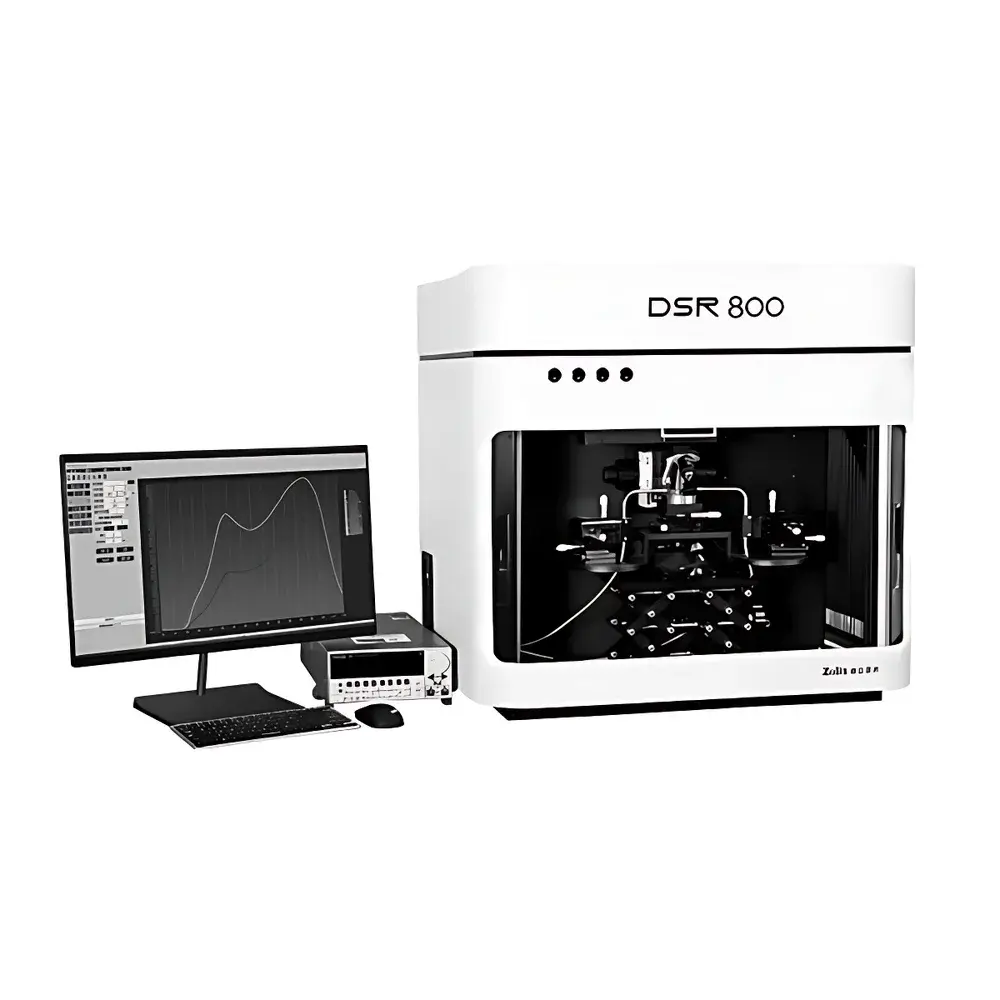
ZOLIX DSR800 Transient Photoelectric Performance Test System
| Brand | ZOLIX |
|---|---|
| Origin | Beijing, China |
| Manufacturer Type | Direct Manufacturer |
| Product Category | Domestic |
| Model | DSR800 |
| Instrument Class | Laser Flash Photolysis System |
| Spectral Range | Configurable (300–1700 nm with optional extensions) |
| Spectral Resolution | Dependent on monochromator & detector selection |
| Temporal Resolution | Down to 400 ps (selectable: 4 ns / 2 ns / 1.14 ns / 800 ps / 400 ps) |
| Light Sources | Nanosecond pulsed lasers (375–1310 nm), semiconductor lasers (266–2200 nm), high-stability programmable LED (flash response ≤100 ns |
| Microscopy Module | Four objective mounting ports |
| Sample Stage | Motorized XYZ translation stage |
| Data Acquisition | 2 or 4 channels |
| input impedance | 1 MΩ / 50 Ω |
| Measurement Modes | Steady-state I–V, transient photovoltage (TPV), transient photocurrent (TPC), open-circuit voltage decay (OCVD), time-resolved charge extraction (TRCE), electrically modulated TPV/TPC, user-defined protocols |
| IPCE Extension | 300–1100 nm standard |
Overview
The ZOLIX DSR800 Transient Photoelectric Performance Test System is a modular, research-grade instrumentation platform engineered for quantitative time-domain characterization of optoelectronic device dynamics. It operates on the principle of time-resolved photoresponse analysis—using precisely timed, spectrally defined optical excitation pulses to generate carrier populations in semiconductor or hybrid active layers, followed by high-bandwidth electrical signal acquisition of resulting photovoltage or photocurrent transients. The system integrates ultrafast laser excitation (nanosecond to sub-nanosecond pulse widths), programmable solid-state light sources, inverted microscope-coupled micro-illumination optics, and GHz-class digitizers to resolve carrier transport, recombination, and extraction kinetics across timescales from hundreds of picoseconds to seconds. Designed for laboratory environments requiring traceable, repeatable, and configuration-flexible transient measurements, the DSR800 serves as a core tool in photovoltaic R&D, optoelectronic sensor development, and fundamental charge-carrier physics studies.
Key Features
- Multi-source excitation architecture supporting synchronized nanosecond pulsed lasers (375–1310 nm), tunable semiconductor lasers (266–2200 nm), and high-brightness, low-jitter programmable LEDs (pulse width down to 10 µs; rise time <100 ns)
- Integrated upright/inverted microscope module with four objective bays, enabling rapid switching between 10×, 20×, and 50× objectives for spatially resolved micro-illumination and localized probing
- Motorized XYZ sample stage with ±10 mm travel range and 1 µm repeatability, optimized for precise alignment of excitation spot and electrode contact geometry
- Probe station compatibility accommodating both coplanar and vertical heterojunction architectures, including standardized 2.54 mm pitch back-electrode fixtures and customizable stage inserts
- High-fidelity data acquisition subsystem featuring selectable temporal resolution (400 ps–4 ns), 2.5 GS/s real-time sampling, 10 M-point memory depth, and dual-impedance inputs (1 MΩ / 50 Ω) for optimal signal fidelity across voltage and current domains
Sample Compatibility & Compliance
The DSR800 accommodates a broad spectrum of thin-film and bulk optoelectronic devices—including perovskite, organic, dye-sensitized, CIGS, and silicon-based photovoltaics—as well as photodetectors (Si, GaN, InGaAs), photoconductors, and emerging 2D-material heterostructures. Its modular probe interface supports both top-contact and interdigitated electrode configurations. All hardware and firmware comply with CE electromagnetic compatibility (EMC) directives. Software workflows support audit-trail logging and user-access control, facilitating alignment with GLP-compliant laboratory practices. While not pre-certified to ISO/IEC 17025, the system’s traceable timing calibration, documented uncertainty budgets for temporal and spectral parameters, and deterministic trigger synchronization enable integration into ISO 9001- or ASTM E2847-aligned quality systems.
Software & Data Management
The DSR800 is operated via ZOLIX’s proprietary LabMaster Control Suite—a Windows-based application providing synchronized instrument orchestration, real-time waveform preview, batch parameter scripting, and post-acquisition fitting modules. Raw data are saved in HDF5 format with embedded metadata (excitation wavelength, pulse energy, bias conditions, acquisition settings). Built-in analysis tools include exponential decay fitting (mono-/bi-/triple-exponential), derivative calculation for rise/fall time quantification, differential capacitance extraction, and charge-integrated transient modeling. Export options include CSV, MATLAB .mat, and ASCII formats. The software architecture supports automated compliance reporting templates aligned with USP analytical instrument qualification (AIQ) phases—Installation Qualification (IQ), Operational Qualification (OQ), and Performance Qualification (PQ)—and includes configurable electronic signatures meeting FDA 21 CFR Part 11 requirements.
Applications
- Quantitative determination of carrier lifetime, mobility, and diffusion length via transient photovoltage (TPV) and transient photocurrent (TPC) decay kinetics
- Open-circuit voltage decay (OCVD) and time-resolved charge extraction (TRCE) for recombination pathway discrimination in multi-junction and tandem solar cells
- Electrically modulated transient measurements to isolate field-dependent carrier dynamics under variable bias and illumination conditions
- Micro-scale spatial mapping of local photoresponse heterogeneity using confocal illumination and stage rastering
- IPCE/EQE mapping across 300–1700 nm for spectral response validation and bandgap analysis in novel absorber materials
- Dynamic impedance spectroscopy integration via synchronized voltage modulation and transient acquisition
FAQ
What excitation sources are included by default?
The base configuration includes a high-stability programmable LED source (10 µs–1 s pulse width). Nanosecond lasers and semiconductor lasers are available as optional add-ons, with wavelength selection dependent on application-specific requirements.
Can the DSR800 perform simultaneous dual-wavelength excitation?
Yes—through external TTL synchronization and independent trigger routing, the system supports interleaved or co-incident excitation from two distinct light sources, enabling pump-probe or dual-excitation kinetic studies.
Is the software compatible with third-party analysis platforms such as Python or Igor Pro?
All acquired datasets are stored in open-format HDF5 files with documented schema; Python libraries (h5py, numpy) and Igor Pro HDF5 import modules enable full interoperability for custom modeling and statistical analysis.
Does the system support cryogenic or environmental chamber integration?
The mechanical design features standardized flange interfaces and feedthrough-compatible cabling. Integration with commercial cryostats (4–300 K) and inert-gas gloveboxes is supported via optional vacuum-rated stages and fiber-coupled optical paths.
How is temporal resolution calibrated and verified?
Calibration is performed using a reference photodiode with known impulse response (<100 ps) and a fast oscilloscope traceable to NIST standards. Full-system jitter characterization is documented in the PQ report provided with each instrument shipment.
Related Products





