
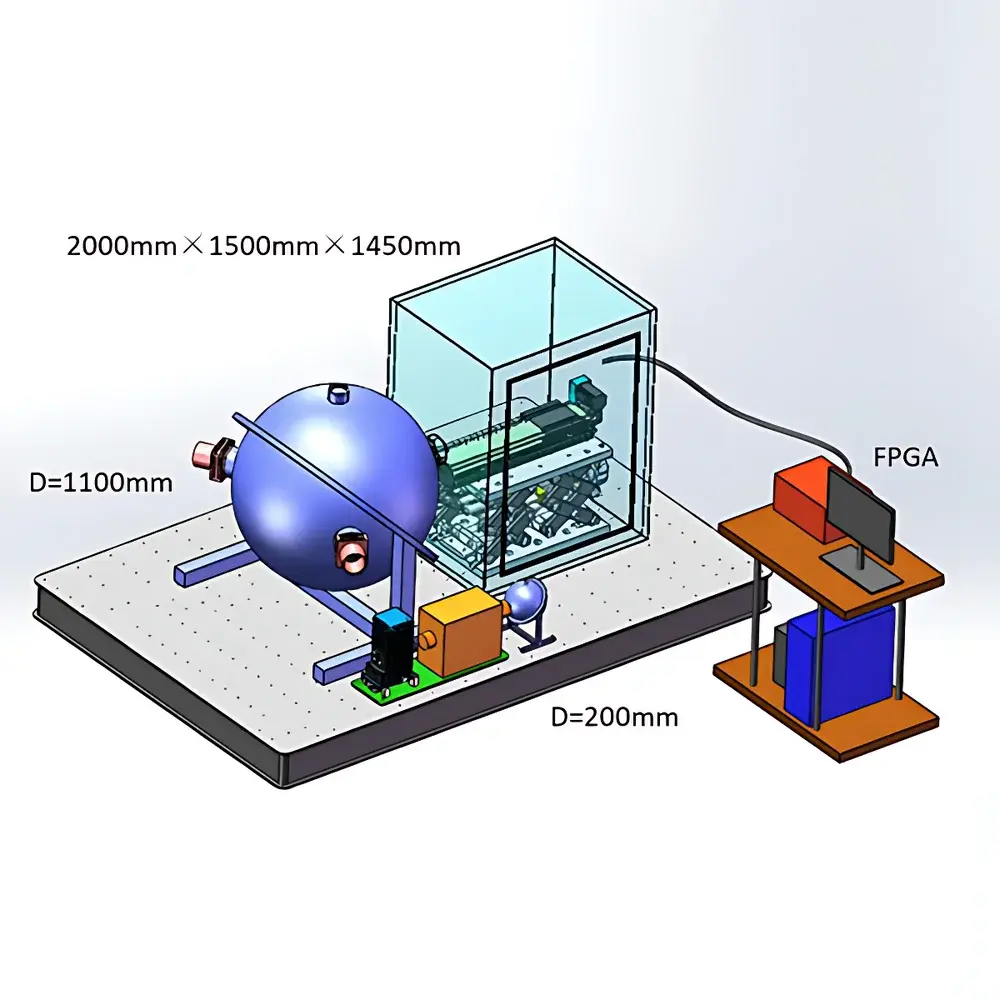
ZOLIX DSR900 Camera Characterization and Quantum Efficiency Test System
| Brand | ZOLIX |
|---|---|
| Model | DSR900 |
| Origin | Beijing, China |
| Manufacturer Type | Direct Manufacturer |
| Compliance | EMVA 1288:2020 & GB/T 17444–2013 |
| Light Source Spectral Range | 200–2500 nm |
| Monochromator Resolution | 0.08 nm @ 1200 grooves/mm grating |
| Integrating Sphere Diameter (Monochrome) | 200 mm, Reflectivity >95% (F4 coating, 250–2500 nm) |
| White-light Integrating Sphere | Up to 1100 mm diameter, Output Port ≥100 mm, Uniformity ≤1% (Ø100 mm), Stability ≤1% (30 min) |
| Darkroom Suppression Ratio | >10⁴ (80 dB) across 300–1700 nm |
| Darkroom Dimensions | ≥2000 × 1500 × 1450 mm |
| Motion Control | Motorized XYZ stage (X >100 mm, Z = 100 mm) |
| Data Interface | RS422, LVDS, Camera Link, USB |
| Acquisition Rate | 30 Hz |
| Uncertainty (k=2) | U<sub>rel</sub> = (0.9–4.0)% (800–2500 nm), (1.1–0.9)% (400–800 nm), (2.1–1.1)% (250–400 nm) |
Overview
The ZOLIX DSR900 Camera Characterization and Quantum Efficiency Test System is a fully integrated, standards-compliant metrology platform engineered for rigorous photometric, radiometric, and electro-optical evaluation of image sensors and digital cameras. Built upon the foundational principles of quantum efficiency (QE) measurement—defined as the ratio of photoelectrons generated per incident photon—the DSR900 implements traceable, spectrally resolved responsivity calibration using monochromatic illumination and absolute photon flux quantification. Its architecture adheres strictly to the European Machine Vision Association (EMVA) 1288:2020 standard for camera characterization and the Chinese national standard GB/T 17444–2013, ensuring compatibility with international quality assurance frameworks including ISO/IEC 17025 and supporting GLP/GMP-aligned validation workflows. The system supports both visible (340–800 nm) and extended near-infrared (NIR) imaging devices up to 2500 nm, making it suitable for scientific CMOS, sCMOS, InGaAs, and cooled CCD sensor evaluation in R&D labs, manufacturing QA, and third-party calibration facilities.
Key Features
- Full-spectrum tunable monochromatic source: 150 W stabilized xenon lamp coupled to a 320 mm focal length monochromator (F/4.2, resolution 0.08 nm @ 1200 g/mm grating), delivering calibrated irradiance from 200 nm to 2500 nm with stray light suppression <1×10⁻⁵
- Dual integrating sphere configuration: 200 mm diameter F4-coated sphere for monochromatic QE testing; optional large-format (up to 1100 mm) PTFE-coated sphere for uniform broadband illumination (340–2500 nm) with spatial uniformity ≤1% over Ø100 mm
- High-isolation darkroom environment: Internal volume ≥2 m³, optical background suppression >10⁴ (80 dB) across 300–1700 nm, equipped with motorized XYZ translation stages (X >100 mm, Z = 100 mm) for precise sensor alignment and multi-position repeatability
- FPGA-based real-time data acquisition module: Supports multiple interface protocols (Camera Link, LVDS, RS422, USB), 30 Hz frame capture rate, and synchronized trigger control for temporal noise analysis and dynamic range assessment
- Standards-driven software engine: Fully automated execution of EMVA 1288 test sequences—including dark signal non-uniformity (DSNU), photo response non-uniformity (PRNU), temporal noise, saturation capacity, and linearity—with built-in uncertainty propagation per GUM (JCGM 100:2008)
Sample Compatibility & Compliance
The DSR900 accommodates a broad range of imaging devices, including area-scan and line-scan sensors, scientific cameras with global or rolling shutter architectures, and custom OEM modules with C-mount, F-mount, or direct PCB-level interfaces. Sensor formats up to 44 mm diagonal are supported via adjustable mounting fixtures and collimated beam path optimization. All measurements comply with EMVA 1288:2020 Annex A (uncertainty budgeting), ISO 15739:2013 (noise and dynamic range), and GB/T 17444–2013 (imaging performance metrics). Calibration traceability is maintained through NIST-traceable reference detectors and spectral irradiance standards; uncertainty statements are reported at k = 2 coverage factor per ISO/IEC Guide 98-3. The system is compatible with FDA 21 CFR Part 11 requirements when deployed with audit-trail-enabled software configurations and role-based user access controls.
Software & Data Management
ZOLIX’s proprietary DSR-Control Suite provides a deterministic, scriptable test environment compliant with ASTM E2789–19 for imaging system validation. The software performs full workflow automation—from hardware initialization and exposure parameter sweep to raw image ingestion, pixel-level statistical analysis, and standardized report generation (PDF + XML). Key analytical modules include fixed-pattern noise decomposition, photon transfer curve (PTC) fitting, quantum efficiency spectrum extraction, and non-uniformity correction matrix derivation. All datasets retain full metadata (wavelength, integration time, gain, temperature, ambient conditions) and support export to HDF5, TIFF, or CSV for downstream analysis in MATLAB, Python (NumPy/SciPy), or LabVIEW. Audit trails record operator actions, parameter changes, and calibration events with timestamped digital signatures, satisfying GLP documentation requirements.
Applications
- Quantum efficiency mapping and spectral responsivity calibration of back-illuminated sCMOS and EMCCD sensors
- Dynamic range and linearity verification for astronomical and biomedical imaging systems operating under low-light conditions
- Manufacturing process validation for infrared camera modules used in thermal inspection, autonomous vehicle vision, and defense EO/IR systems
- Reference-grade characterization of hyperspectral and multispectral sensor arrays prior to field deployment
- Research-grade evaluation of novel photodetector materials (e.g., perovskite, 2D semiconductors) requiring sub-percent uniformity and high SNR metrology
FAQ
Does the DSR900 support both front- and back-illuminated sensors?
Yes—the system accommodates both architectures via configurable illumination geometry and optional collimated beam delivery for angular response characterization.
Can the software generate EMVA 1288-compliant PDF reports automatically?
Yes—each test run produces a standards-conforming report containing all required figures, tables, uncertainty budgets, and pass/fail flags against EMVA-defined thresholds.
Is the monochromator wavelength calibration traceable to NIST standards?
Yes—factory calibration uses certified holmium oxide and mercury-argon spectral line references, with optional on-site recalibration services available.
What is the minimum detectable signal level for low-noise sensor evaluation?
With optimized integration times and cooled sensor operation, the system achieves effective read noise <1.5 e⁻ RMS and enables photon transfer analysis down to ~0.1 e⁻/pixel/s signal levels.
How is thermal drift managed during long-duration QE scans?
The xenon source features active power stabilization and thermal feedback control; the darkroom maintains ambient stability ±0.5 °C, and all optics are mounted on low-expansion kinematic bases to minimize focus shift.






