
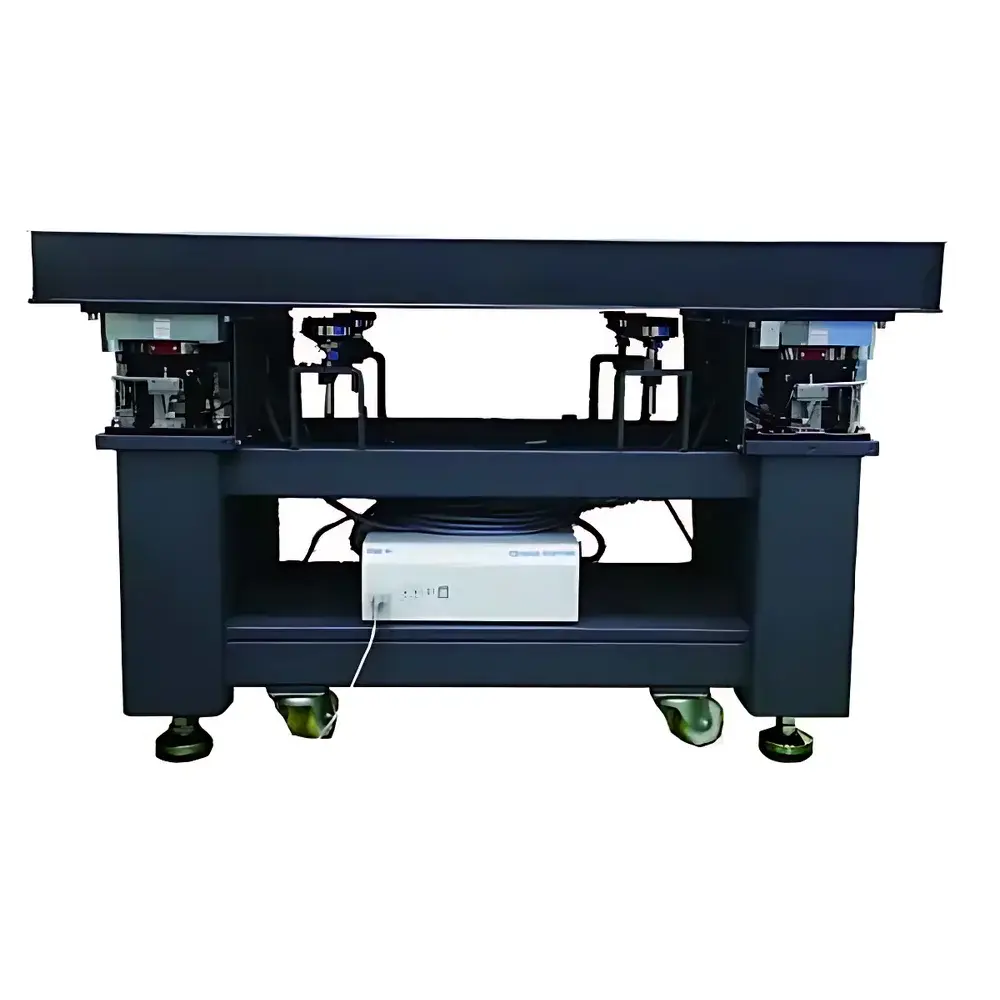
ZOLIX DVIA Precision Active Vibration Isolation Optical Platform
| Brand | ZOLIX |
|---|---|
| Model | DVIA |
| Origin | Beijing, China |
| Manufacturer Type | Direct Manufacturer |
| Platform Construction | Triple-layer honeycomb core with inertial six-degree-of-freedom (6-DOF) active feedback control |
| Active Isolation Band | 0.5–10 Hz (≥90% transmissibility reduction) |
| Natural Frequency Range | 0.5–100 Hz |
| Top Surface | 4.0 mm thick 430-series high-permeability nickel-chromium stainless steel |
| Base Plate | 4.0 mm carbon steel with black oxide finish |
| Side Walls | 2.0 mm carbon steel encapsulated with high-damping polyethylene |
| Honeycomb Core | Steel-based, 0.25 mm wall thickness, 3.2 cm² cell area |
| Surface Flatness | ±0.1 mm over 600 mm² |
| Mounting Pattern | M6 threaded holes on 25 mm × 25 mm grid (imperial options available), edge margin 37.5 mm |
| Threaded Hole Sealing | Cylindrical isolation cup beneath each M6 thread for contamination control |
| Damping Mechanism | Broadband passive damping integrated with real-time active compensation |
Overview
The ZOLIX DVIA Precision Active Vibration Isolation Optical Platform is an engineered solution for ultra-stable optical and electron microscopy environments requiring sub-micron positional fidelity. Unlike passive optical tables relying solely on mass and constrained-layer damping, the DVIA implements a closed-loop, six-degree-of-freedom (6-DOF) active vibration cancellation system based on inertial sensing and real-time electromagnetic actuation. This architecture enables dynamic suppression of ground-borne and facility-induced disturbances—particularly critical in the 0.5–10 Hz range where most building microseisms and HVAC-induced resonances occur. With ≥90% isolation efficiency across this low-frequency band, the DVIA meets stringent stability requirements for scanning transmission electron microscopy (STEM), high-resolution scanning electron microscopy (SEM), atomic force microscopy (AFM), and laser interferometric metrology systems operating under ISO 14644-1 Class 5 or better cleanroom conditions.
Key Features
- Six-axis inertial sensing array delivering real-time detection of translational (X/Y/Z) and rotational (pitch/yaw/roll) vibrations at sub-milligal resolution
- Integrated electromagnetic actuators providing broadband correction with response time < 20 ms and auto-balancing convergence within 3 seconds of load change
- Triple-layer rigidized honeycomb core structure: 0.25 mm-thick steel walls forming uniform 3.2 cm² hexagonal cells, optimized for stiffness-to-mass ratio and modal damping
- Top plate fabricated from 4.0 mm 430-series high-permeability nickel-chromium stainless steel—engineered for minimal magnetic interference and exceptional thermal stability (CTE ≈ 10.5 × 10⁻⁶ /°C)
- Base plate and perimeter side walls constructed from 4.0 mm and 2.0 mm carbon steel respectively, with black oxide surface treatment for corrosion resistance and EMI shielding enhancement
- M6 threaded mounting grid on 25 mm × 25 mm pitch (imperial 1″ option available), with 37.5 mm clearance to outer edge ensuring full utilization of active area
- Individual cylindrical isolation cups beneath each threaded hole prevent particulate ingress and simplify maintenance without compromising structural integrity
Sample Compatibility & Compliance
The DVIA platform supports payloads ranging from 50 kg to 500 kg (dependent on selected thickness: 100 mm, 200 mm, or 300 mm), maintaining flatness compliance per ISO 10360-2 (±0.1 mm over 600 mm²). Its non-magnetic top surface and low-outgassing construction make it suitable for UHV-compatible instrumentation including cryo-SEM stages and in-situ TEM holders. The platform conforms to mechanical safety standards IEC 61000-6-2 (immunity) and IEC 61000-6-4 (emission), and its active control electronics comply with CE and RoHS directives. When deployed in regulated environments—such as semiconductor process labs or pharmaceutical R&D facilities—the DVIA’s deterministic response profile supports audit-ready documentation per ISO/IEC 17025 and FDA 21 CFR Part 11 requirements for instrument qualification (IQ/OQ/PQ).
Software & Data Management
The DVIA operates via embedded ARM-based controller with Ethernet and RS-232 interfaces. Optional ZOLIX VIB-Manager software provides real-time spectral analysis (FFT up to 100 Hz bandwidth), transmissibility mapping, and logging of vibration history with timestamped event tagging. All control parameters—including gain tuning, frequency weighting filters, and sensor calibration offsets—are stored in non-volatile memory with write-protection. Audit trails record operator actions, configuration changes, and system health status—enabling GLP/GMP-aligned traceability. Data export is supported in CSV and HDF5 formats for integration into LabArchives, MATLAB, or Python-based analysis pipelines.
Applications
- High-magnification electron microscopy (SEM, TEM, STEM) requiring <1 nm RMS positional drift over 1-hour acquisition windows
- Atomic force microscopy (AFM), scanning tunneling microscopy (STM), and near-field optical microscopy (NSOM) where tip-sample interaction forces are highly sensitive to vertical jitter
- Laser interferometry systems used in gravitational wave prototype experiments, precision length metrology, and nanoscale displacement calibration
- Confocal and multiphoton fluorescence microscopes performing long-duration time-lapse imaging of live-cell dynamics
- Wafer-level inspection tools and mask alignment systems in semiconductor front-end process development
- Optical coherence tomography (OCT) and digital holographic microscopy platforms demanding phase stability < λ/20 over visible-NIR bands
FAQ
What is the minimum recommended payload for stable operation?
The DVIA achieves optimal control performance with payloads ≥80 kg; lighter loads require manual gain adjustment via VIB-Manager to avoid overcompensation.
Can the platform be integrated with existing building seismic isolation systems?
Yes—the DVIA is designed for cascade installation: it functions effectively atop passive inertia bases or building-mounted slab isolators without signal interference or control loop instability.
Is vacuum compatibility available for in-situ TEM applications?
Standard DVIA units are not UHV-rated; however, ZOLIX offers custom variants with vacuum-compatible gasketing, low-outgassing adhesives, and non-lubricated actuators upon request.
How often does the system require recalibration?
Factory calibration remains valid for 24 months under normal lab conditions; annual verification using NIST-traceable shaker excitation is recommended for GxP-regulated use.
Are imperial-threaded mounting options certified to ASME B1.1 standards?
Yes—optional 1/4″-20 UNC threaded inserts meet ASME B1.1 Class 2A tolerance and are pre-torqued to 1.5 N·m during assembly.




