
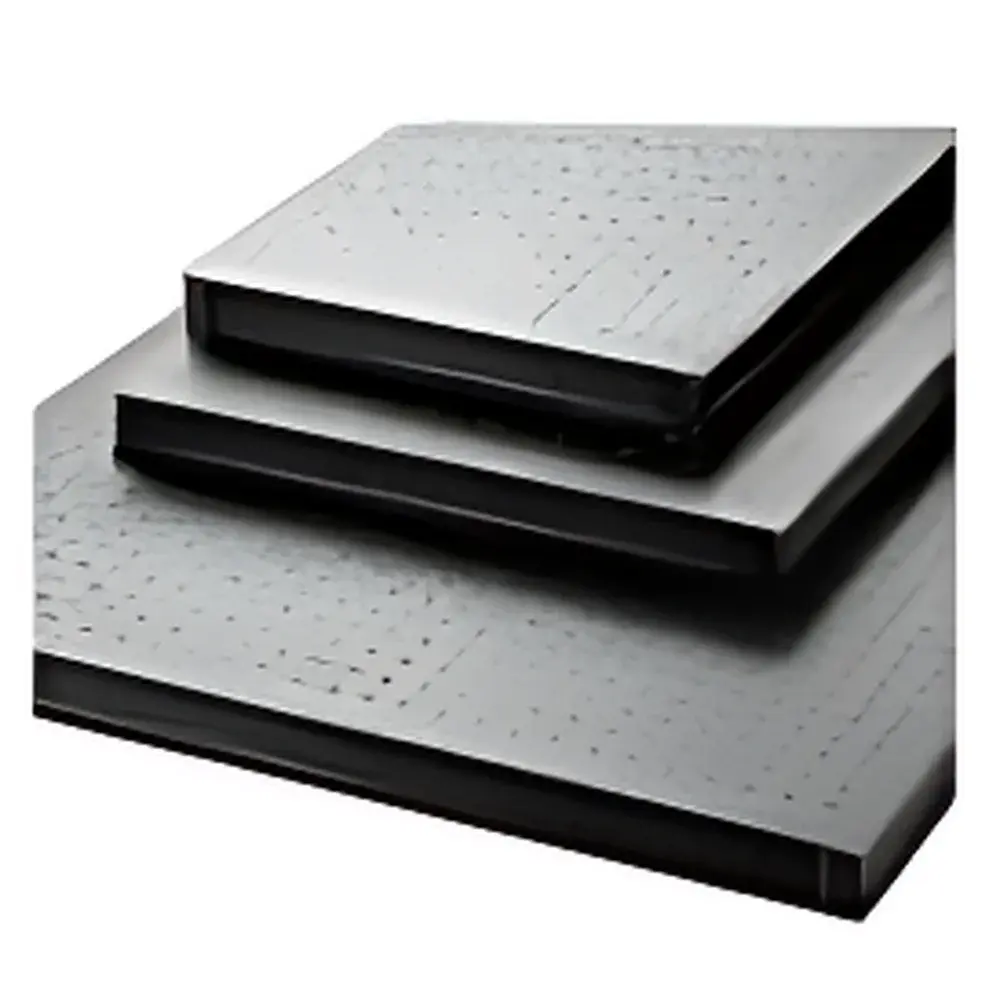
ZOLIX DVIO-B Series Stainless Steel Optical Breadboard (Imported from Korea)
| Brand | ZOLIX |
|---|---|
| Origin | Korea |
| Manufacturer | DAEIL Co., Ltd. |
| Type | Imported Optical Platform Surface |
| Model | DVIO-B Series |
| Structure | Triple-layer sandwich with steel honeycomb core |
| Top Plate | 4.0 mm thick ASTM A240 430 stainless steel (low thermal expansion, high magnetic permeability) |
| Base Plate | 4.0 mm thick carbon steel, black oxide finish |
| Side Walls | 2.0 mm carbon steel clad with high-damping polyethylene |
| Thickness Options | 50 / 100 / 200 / 300 mm |
| Surface Flatness | ±0.1 mm over 600 mm × 600 mm |
| Hole Pattern | M6 threaded holes on 25 mm × 25 mm grid (imperial 1" grid optional) |
| Edge Margin | 37.5 mm from outermost hole to platform edge |
| Isolation Cups | Individual cylindrical sealing cups beneath each M6 thread |
| Honeycomb Core | 0.25 mm gauge steel, cell area 3.2 cm² |
| Weight Density | 87 kg/m² (50 mm), 122 kg/m² (100 mm), 139 kg/m² (200 mm), 165 kg/m² (300 mm) |
Overview
The ZOLIX DVIO-B Series Stainless Steel Optical Breadboard is a precision-engineered optical platform surface manufactured by DAEIL Co., Ltd. in Korea and distributed globally under the ZOLIX brand. Designed for demanding laser alignment, interferometry, quantum optics, and metrology applications, it employs a true triple-layer sandwich architecture: a low-thermal-expansion 430-series stainless steel top plate, a high-stiffness steel honeycomb core, and a robust carbon steel base. This configuration delivers exceptional static rigidity, dynamic damping, and long-term dimensional stability—critical for maintaining sub-micron optical path integrity in vibration-sensitive environments. Unlike monolithic or aluminum-based platforms, the DVIO-B’s engineered core geometry minimizes resonant amplification across the 1–1000 Hz range while resisting thermal drift due to its matched coefficient of thermal expansion (CTE) between top and base layers. Its non-magnetic 430 stainless steel surface supports compatibility with magnetic shielding enclosures and satisfies stringent cleanroom handling requirements without outgassing or particulate shedding.
Key Features
- Triple-layer structural design with vacuum-bonded steel honeycomb core (0.25 mm wall thickness, 3.2 cm² hexagonal cells) for optimal stiffness-to-mass ratio and broadband vibration attenuation.
- 4.0 mm thick top plate fabricated from ASTM A240 430 stainless steel—selected for low CTE (~10.4 µm/m·°C), high magnetic permeability (enabling passive magnetic field confinement), and corrosion resistance in controlled laboratory atmospheres.
- Individual cylindrical isolation cups beneath every M6 threaded hole prevent debris accumulation and simplify maintenance—essential for ISO Class 5–7 cleanroom integration and repeated reconfiguration cycles.
- Base plate features 4.0 mm carbon steel with black oxide conversion coating, providing uniform grounding continuity and EMI shielding capability compliant with IEC 61000-6-3 emission limits.
- Perimeter side walls consist of 2.0 mm carbon steel fully encapsulated with viscoelastic polyethylene damping material, suppressing edge-mode vibrations and reducing airborne acoustic coupling.
- Surface flatness certified to ±0.1 mm over any 600 mm × 600 mm region per ISO 10360-2, verified via coordinate measuring machine (CMM) traceable to NIST standards.
Sample Compatibility & Compliance
The DVIO-B platform is compatible with standard optomechanical components including kinematic mounts, translation stages, rotation stages, and lens holders conforming to ANSI/BICSI/ISO 10110 mounting interfaces. Its M6 grid (25 mm pitch, 37.5 mm edge margin) aligns with international optical breadboard conventions and supports direct integration with Thorlabs, Newport, and Standa accessories. The platform meets mechanical compliance requirements for ISO 14644-1 cleanroom use (non-shedding surface, no volatile organic compounds), and its conductive structure satisfies electrostatic discharge (ESD) control per ANSI/ESD S20.20. While not intrinsically rated for hazardous locations, its construction enables installation in GMP-aligned analytical laboratories where equipment qualification (IQ/OQ/PQ) documentation is required. Structural integrity has been validated per ASTM E1527-21 for static load distribution up to 500 kg uniformly applied over 1 m².
Software & Data Management
As a passive mechanical component, the DVIO-B requires no embedded firmware or driver software. However, its dimensional specifications—including exact flatness maps, mass distribution profiles, and modal analysis reports—are provided in standardized formats (STEP AP214, PDF calibration certificates, CSV resonance frequency tables) for integration into lab infrastructure management systems. These files support digital twin modeling in COMSOL Multiphysics® and ANSYS Mechanical™ for predictive vibration analysis. Calibration data is archived with full traceability to national metrology institutes (KRISS, NMIJ), and certificate validity follows ISO/IEC 17025:2017 guidelines. For regulated environments operating under FDA 21 CFR Part 11, the platform’s physical attributes are documented within equipment master files (EMF) and included in validation protocols for optical measurement systems subject to GLP or GMP audits.
Applications
- Laser cavity alignment and stabilization in ultrafast and frequency-stabilized systems (e.g., Ti:sapphire oscillators, fiber lasers).
- Interferometric setups requiring sub-wavelength path-length stability, including Michelson, Mach-Zehnder, and LIGO-style gravitational wave detection prototypes.
- Quantum optics experiments involving trapped ions, cold atoms, or photonic integrated circuits where mechanical drift induces decoherence.
- High-resolution microscopy platforms (STED, PALM, SIM) where stage-induced jitter degrades lateral resolution below 50 nm.
- Calibration laboratories performing ISO 10110-5 surface form verification using Fizeau interferometers or optical profilers.
- Cleanroom-based semiconductor metrology stations handling EUV mask inspection tools and wafer alignment subsystems.
FAQ
Is the DVIO-B platform suitable for ultra-high vacuum (UHV) applications?
Yes—the 430 stainless steel top plate and welded steel honeycomb core exhibit low outgassing rates (<1×10⁻¹⁰ Torr·L/s·cm² after 24 h bakeout at 150°C), meeting ASTM E595 requirements for space-grade UHV components.
Can imperial-threaded components be mounted directly?
Yes—imperial 1/4″-20 threaded inserts are available as factory-installed options; alternatively, M6-to-1/4″-20 adapter sleeves maintain positional repeatability within ±2.5 µm.
What is the maximum recommended payload for a 1500 mm × 1000 mm DVIO-B-200T platform?
Static load capacity is 850 kg when uniformly distributed; point loads exceeding 120 kg must be supported via localized stiffening plates per ISO 10360-2 Annex D.
Does the platform require periodic recalibration?
No—flatness and structural integrity are inherently stable; however, annual verification using a laser tracker or autocollimator is recommended for Grade-A metrology installations.
Are custom hole patterns or cutouts available?
Yes—custom CNC machining services are offered with GD&T tolerances per ASME Y14.5-2018, including coaxial fiducials and datum reference frames for automated alignment systems.




