
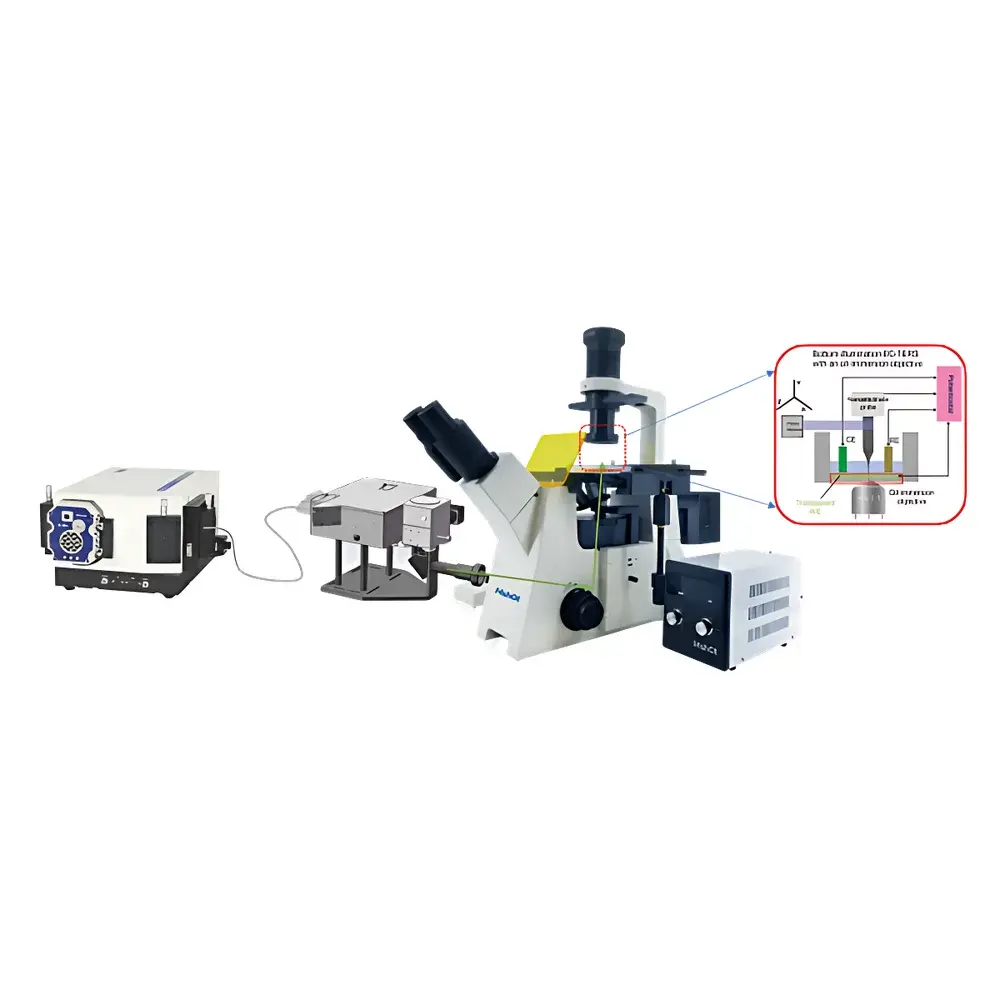
ZOLIX EC-TERS Electrochemical Tip-Enhanced Raman Spectroscopy System
| Brand | ZOLIX |
|---|---|
| Origin | Beijing, China |
| Manufacturer Type | Direct Manufacturer |
| Instrument Category | Domestic |
| Model | EC-TERS |
| Pricing | Upon Request |
| Instrument Type | Confocal Micro-Raman Spectrometer |
| Spectral Resolution | <2 cm⁻¹ |
| Spatial Resolution | <1 µm (XY) |
| Excitation Sources | 532 nm (100 mW), 633 nm (>15 mW) |
| Spectrograph Focal Length | 320 mm with Triple Grating Turret |
| Detector | ≥2000×256 pixels, 300–1000 nm spectral range, >90% peak QE, deep-cooled to −60 °C |
Overview
The ZOLIX EC-TERS Electrochemical Tip-Enhanced Raman Spectroscopy System is an integrated, research-grade platform engineered for in situ and operando molecular characterization of electrochemical interfaces at sub-micron spatial resolution. Combining confocal micro-Raman spectroscopy with electrochemical control and atomic-force-microscope (AFM)-based tip enhancement, the system enables nanoscale vibrational fingerprinting of adsorbates, reaction intermediates, and interfacial species under realistic electrochemical conditions—including aqueous electrolytes, controlled potential regimes, and dynamic current flow. Its inverted microscope architecture supports bottom-side laser excitation and back-scattered Raman collection—ensuring optimal optical throughput and compatibility with standard electrochemical cells. The core measurement principle leverages localized surface plasmon resonance (LSPR) at a metallized AFM tip, enhancing Raman cross-sections by up to 10⁶–10⁸× while maintaining diffraction-unlimited spatial confinement (<10 nm effective probe volume). This allows direct correlation between electrochemical stimuli (e.g., applied potential, cyclic voltammetry scan rate) and chemically specific vibrational responses at electrode hotspots.
Key Features
- Inverted confocal optical design with dual-wavelength excitation (532 nm / 633 nm) and high-throughput triple-grating spectrograph (320 mm focal length)
- Deep-cooled back-illuminated CCD detector (≥2000 × 256 pixels; quantum efficiency >90% at peak; operating temperature −60 °C) for high signal-to-noise ratio in low-light TERS conditions
- Integrated XYZ piezo-controlled AFM probe stage and XY piezo-driven electrochemical cell stage, enabling precise co-registration of tip position, laser focus, and electrode location
- Simultaneous electrochemical control via potentiostat interface (compatible with standard bipotentiostats) supporting CV, LSV, CA, EIS, and chronoamperometric protocols
- Native compatibility with conventional micro-Raman, electrochemical Raman (EC-Raman), and full TERS modalities—switchable without realignment
- Optimized for liquid-phase operation: sealed electrochemical flow cells or static droplet configurations with inert atmosphere capability (N₂/Ar purging)
Sample Compatibility & Compliance
The EC-TERS system accommodates a broad range of electrode substrates—including Au, Pt, Ag, carbon-based electrodes (glassy carbon, graphene, CNT), and conductive metal oxides—configured as working electrodes in standard three-electrode cells (WE/CE/RE). It supports both solid-state and solution-phase electrocatalytic systems, battery electrode slurries (ex situ and quasi-in situ), corrosion studies on coated metals, and electrosynthetic intermediates in organic media. All mechanical, optical, and electronic subsystems comply with IEC 61000-6-3 (EMC emission standards) and IEC 61010-1 (safety requirements for laboratory equipment). Data acquisition workflows support audit-ready metadata logging per GLP/GMP guidelines, including timestamped potential/current traces synchronized with spectral acquisition. While not pre-certified for FDA 21 CFR Part 11, the software architecture provides configurable user access controls, electronic signature fields, and immutable raw data storage—enabling internal validation for regulated environments.
Software & Data Management
ZOLIX EC-TERS Control Suite is a modular, Windows-based application built on LabVIEW RT and Python 3.9 backend libraries. It unifies instrument control (laser power, grating selection, detector integration time, piezo positioning), electrochemical parameter scripting, and real-time spectral visualization. Key modules include: (1) TERS Alignment Wizard, guiding users through tip-laser-sample overlap optimization using scattering intensity mapping; (2) Potential-Synchronized Acquisition, triggering spectral capture at defined voltage windows or derivative maxima during CV scans; (3) Spectral Library Manager, supporting peak fitting (Voigt/Lorentzian), baseline correction (Asymmetric Least Squares), and multivariate analysis (PCA, MCR-ALS) for reaction pathway deconvolution. Raw spectra are saved in HDF5 format with embedded metadata (applied potential, current, time stamp, grating ID, detector settings). Export options include ASCII, .csv, and JCAMP-DX for third-party chemometrics tools. All configuration files and processing histories are version-tracked and exportable for method transfer or regulatory submission.
Applications
- Battery Interface Science: Mapping SEI composition heterogeneity across graphite or silicon anodes during lithiation/delithiation cycles
- Electrocatalysis: Identifying adsorbed *CO, *OH, or *OOH intermediates on single-crystal Pt(111) or doped NiFe LDH under OER conditions
- Corrosion Mechanisms: Resolving chloride-induced passive film breakdown on stainless steel at grain boundaries
- Electrosynthesis: Tracking C–N bond formation in reductive amination reactions on Cu electrodes with temporal resolution down to 100 ms
- Biosensor Interfaces: Characterizing thiol-monolayer conformational switching on Au electrodes upon redox-triggered DNA hybridization
FAQ
What electrochemical techniques are natively supported?
Potentiodynamic methods (CV, LSV), potentiostatic methods (CA, CP), galvanostatic methods (GCPL), and electrochemical impedance spectroscopy (EIS) — all synchronized with spectral acquisition via TTL or analog trigger signals.
Can the system operate in ambient air or only inert atmospheres?
Both: the standard configuration includes N₂/Ar gas inlet ports for electrochemical cells; optional glovebox-integrated mounting plates enable full inert-atmosphere operation down to <0.1 ppm O₂/H₂O.
Is AFM topography acquired simultaneously with Raman mapping?
Yes — force-distance curves and contact-mode topography are collected in parallel with TERS point spectra or line scans using the same probe, with sub-nanometer vertical resolution.
What spectral calibration standards are recommended?
Silicon (520.7 cm⁻¹), cyclohexane (2847 cm⁻¹ C–H stretch), and neon lamp emission lines; automated calibration routines correct for grating thermal drift during long-duration experiments.
Does the system support polarization-resolved TERS measurements?
Yes — motorized half-wave plate and linear polarizer module (optional accessory) enable incident and scattered light polarization control for symmetry-sensitive mode assignment.



