
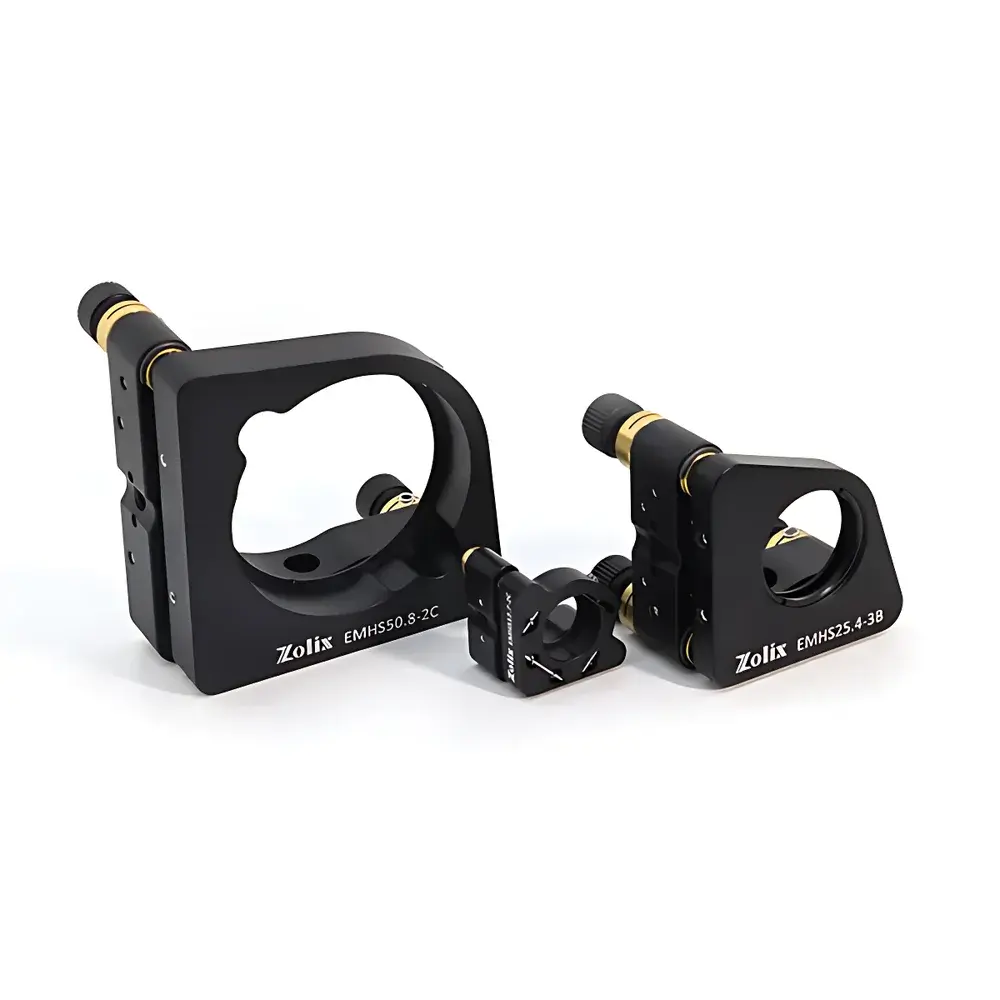
ZOLIX EMHS Series Standard Optical Mounts
| Brand | ZOLIX |
|---|---|
| Origin | Beijing, China |
| Manufacturer Type | Direct Manufacturer |
| Product Line | EMHS Series |
| Material Options | 6061-T6 & 7075-T6 Aluminum Alloys |
| Adjustment Axes | 2-Axis (Pitch/Yaw) or 3-Axis (Pitch/Yaw + Z-Translation) |
| Angular Resolution | 0.78°/rev, 0.39°/rev, or 0.24°/rev |
| Max Angular Range | ±3.5° or ±4° (Pitch/Yaw) |
| Z-Axis Travel | ±2 mm to ±3.2 mm |
| Mounting Hole Pattern | M4 threaded or countersunk holes (2×) |
| Included Accessories | SM05/SM1/M30 retaining rings, M4 cap screws, reset springs (4×), 2 mm hex key compatibility |
Overview
The ZOLIX EMHS Series Standard Optical Mounts are precision-engineered kinematic platforms designed for high-stability angular alignment and positional fine-tuning of optical components in research-grade laser systems, interferometers, spectroscopy setups, and optical metrology laboratories. These mounts operate on the principle of differential micrometer-driven angular displacement—leveraging calibrated M4×0.25 or M6×0.25 stainless steel adjustment screws to convert rotational input into precise pitch and yaw motion with sub-degree repeatability. Constructed from aerospace-grade aluminum alloys—including both 6061-T6 (optimized for machinability and surface finish) and 7075-T6 (selected for enhanced stiffness-to-weight ratio)—each mount balances mechanical rigidity, thermal stability, and long-term dimensional integrity under repeated load cycling. The modular design supports interchangeable mounting interfaces and accommodates standard optical diameters ranging from Ø12.7 mm to Ø50.8 mm, making the EMHS series compatible with industry-standard optics holders, lens tubes, and breadboard-integrated optical tables.
Key Features
- Precision angular adjustment via dual- or triple-axis kinematic architecture: 2-axis models provide independent pitch and yaw control; 3-axis variants add vertical (Z-axis) translation for collimation optimization and beam height alignment.
- Three resolution options: 0.78°/rev (M4×0.25 screw), 0.39°/rev (M6×0.25, standard configuration), and 0.24°/rev (M6×0.25, high-resolution variant) — enabling fine-grained control over alignment sensitivity without sacrificing mechanical robustness.
- Fully integrated locking mechanism: All adjustment screws feature either lever-type or flexure-based locking systems, ensuring zero drift during thermal cycling or vibration exposure while maintaining full adjustability without tool re-engagement.
- Multi-mode optical component retention: Selectable fixation methods include SM-threaded retaining rings (for Ø12.7–Ø50.8 mm optics), POM-tipped set screws (non-marring contact for coated surfaces), and spring-loaded leaf clamp designs for low-profile or thin substrates (e.g., pellicles or wedges).
- Consistent optical axis height registration: Each model maintains a defined theoretical optical center height (e.g., 12.7 mm, 25.4 mm, or 36.5 mm), facilitating rapid system integration and minimizing iterative realignment across multi-element optical trains.
- Surface-treated for durability and ESD mitigation: All units undergo sandblasted matte black anodization (Type II, 25 µm thickness), providing corrosion resistance, reduced stray light reflection, and improved grip for manual handling.
Sample Compatibility & Compliance
The EMHS Series is validated for use with plano and curved mirrors (dielectric, metallic, or protected silver coatings), laser windows, polarizers, waveplates, and beam splitters up to 8.5 mm thick (model-dependent). Mounting interfaces comply with ISO 10110-7 surface quality referencing and ANSI/OEOSC OP1.002 mechanical interface standards for optical positioning hardware. While not certified to specific regulatory frameworks (e.g., FDA 21 CFR Part 11), the mechanical traceability of adjustment parameters—combined with documented repeatability of ≤±0.02° over 1000 cycles—supports GLP/GMP-aligned lab documentation practices when integrated into validated optical assembly workflows.
Software & Data Management
As a purely mechanical alignment platform, the EMHS Series requires no embedded firmware, drivers, or proprietary software. All adjustments are manually executed using a standard 2 mm hex key, ensuring full compatibility with cleanroom environments and electromagnetic-sensitive applications (e.g., ultrafast laser labs or quantum optics experiments). For digital workflow integration, users may log angular positions via external encoders or vision-based alignment systems; the consistent thread pitch and marked screw rotation increments enable straightforward position-to-angle conversion tables suitable for LabVIEW, Python (NumPy), or MATLAB-based calibration scripts.
Applications
- Laser cavity alignment and resonator optimization in DPSS, Ti:Sapphire, and fiber laser systems.
- Beam steering and collimation in free-space optical interconnects and LIDAR prototype development.
- Interferometric path-length balancing in Michelson, Mach–Zehnder, and Sagnac configurations.
- Positional calibration of photodetectors, CCD/CMOS sensors, and spatial light modulators (SLMs) relative to incident wavefronts.
- Teaching laboratory use in undergraduate optics courses—supporting hands-on instruction in ray tracing, polarization manipulation, and coherence analysis.
- Integration into automated optical benches where passive mounts serve as stable anchor points for motorized actuators or piezoelectric stages.
FAQ
What is the maximum optic thickness supported by EMHS mounts?
Maximum thickness varies by model: 4 mm (Ø12.7 mm), 3.5 mm (Ø25.4 mm), 5.5 mm (Ø30 mm), and 8.5 mm (Ø50.8 mm) — determined by clearance between retention mechanism and base plate.
Can EMHS mounts be used in vacuum environments?
Yes — all materials (6061-T6, 7075-T6 aluminum, stainless steel screws, POM components) are UHV-compatible when properly cleaned and outgassing-tested; however, anodized surfaces require verification per ASTM E595 for total mass loss (TML) and collected volatile condensable materials (CVCM).
Is there a recommended torque specification for the adjustment screws?
No torque specification is published; users should apply only sufficient force to achieve smooth motion without binding — typically <0.15 N·m for M4 screws and <0.35 N·m for M6 screws — to preserve thread integrity and locking mechanism function.
How does the lever lock differ from the flexure lock?
Lever locks (used in select EMHS-B variants) provide rapid, tactile engagement via cam action; flexure locks (EMHS-C variants) employ elastic deformation of a monolithic aluminum arm for continuous clamping pressure without hysteresis or wear-related slippage.
Are replacement retaining rings available separately?
Yes — ZOLIX supplies SM05, SM1, SM2, and M30 retaining rings as standalone accessories (P/N: RR-SM05-AL, RR-SM1-AL, etc.), compatible with standard Thorlabs and Newport optical tube systems.




