
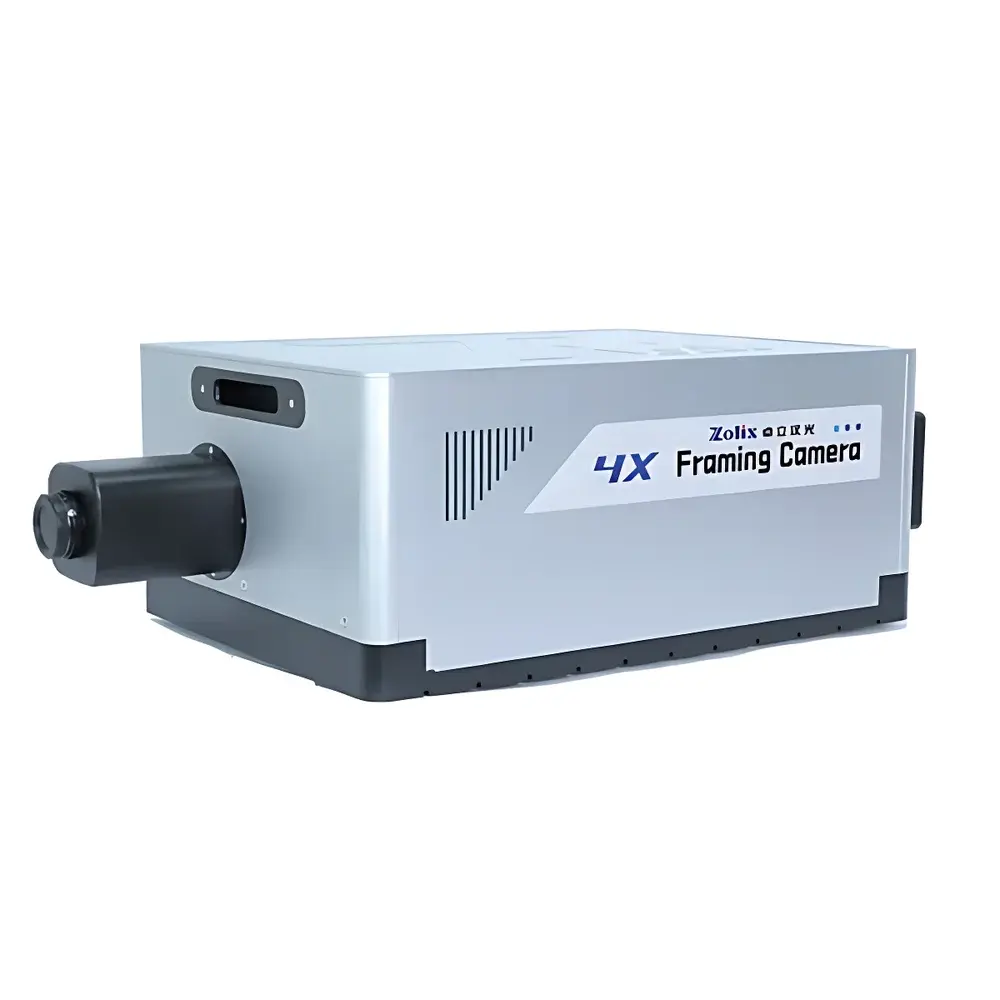
ZOLIX FC Series Visible-Light Framing Camera (Dual-Exposure)
| Brand | ZOLIX |
|---|---|
| Model | FC Series |
| Type | Dual-Exposure Visible-Light Framing Camera |
| Channel Count | 4 |
| Frame Count Options | 4-frame & 8-frame modes |
| Spatial Resolution | >25 lp/mm |
| Spectral Response | 350–850 nm |
| Gating Width | 3 ns to DC |
| Gating & Delay Resolution | 1 ns |
| Delay Range | 0–1 s |
| Image Intensifier Cathode Diameter | 18 mm |
| Max Intensifier Gain | 1×10⁴ |
| Sensor Format | 1932 × 1452 (4× readout) |
| ADC Depth | 12-bit |
| Pixel Size | 4.5 µm × 4.5 µm |
| Trigger Jitter (input-to-output) | <100 ps (typ.), <200 ps (max.) |
| Minimum Inter-Frame Interval | 1 ns (frames 1–4 and 5–8), 250 ns (between frame 4 and frame 5 in 8-frame dual-exposure mode) |
| Coupling | Fiber-optic faceplate |
| Phosphor Screen | P47 |
| Native Delay | <36.5 µs + 4 µs |
Overview
The ZOLIX FC Series Visible-Light Framing Camera (Dual-Exposure) is a high-speed, gated intensified imaging system engineered for ultrafast transient visualization in the visible spectrum (350–850 nm). It operates on the principle of optical framing—where a single incident light pulse is spatially divided into multiple sub-images (frames) captured simultaneously or at precisely controlled temporal offsets by an intensified sensor with programmable gating. Unlike streak or scanning cameras, framing cameras preserve full 2D spatial information per frame, enabling quantitative analysis of rapidly evolving phenomena such as plasma ignition, laser-induced breakdown, shockwave propagation, and microsecond-scale discharge dynamics. The FC Series implements dual-exposure capability within an 8-frame architecture: four frames are acquired in the first exposure window, followed by a second, independently gated set of four frames—yielding up to eight temporally resolved images from a single event, with sub-nanosecond timing fidelity between most frames and a configurable 250 ns inter-burst gap between the fourth and fifth frames. This architecture balances temporal density, hardware simplicity, and cost-efficiency without compromising photon detection efficiency or spatial fidelity.
Key Features
- Programmable dual-exposure operation: supports both 4-frame and 8-frame acquisition modes from a single trigger event.
- Sub-nanosecond temporal resolution: 1 ns step resolution for gate delay and width control; typical trigger jitter <100 ps ensures synchronization repeatability across multi-camera setups.
- High spatial fidelity: >25 lp/mm system resolution (P47 phosphor screen coupled via fiber-optic faceplate to a 1932 × 1452, 12-bit CMOS sensor with 4.5 µm pixels).
- Ultrafast gating: minimum gate width of 3 ns, extendable to continuous (DC) integration for low-light static imaging.
- Flexible delay range: 0–1 s programmable inter-frame delay, enabling alignment with external stimuli such as Q-switched lasers or pulsed power sources.
- Robust intensifier performance: 18 mm cathode diameter image intensifier with gain up to 1×10⁴, optimized for low-noise, high-dynamic-range capture of weak transient signals.
- Integrated data acquisition: unified software environment supporting real-time preview, frame registration, metadata embedding (timestamp, gate parameters), and export compliant with HDF5 and TIFF formats.
Sample Compatibility & Compliance
The FC Series is compatible with standard C-mount and F-mount optical interfaces, permitting direct coupling to microscopes, spectrographs, or collimated beam paths. Its spectral response (350–850 nm) aligns with common visible-light diagnostics—including nitrogen laser emission (337 nm), frequency-doubled Nd:YAG (532 nm), and broadband incandescence. All timing and acquisition parameters are stored in non-volatile memory and traceable via embedded timestamps, satisfying requirements for GLP-compliant experimental documentation. While not certified for medical or aerospace use out-of-the-box, the system’s deterministic timing behavior and parameter reproducibility support validation under ISO/IEC 17025 laboratory accreditation frameworks. Firmware logs include full audit trails of gate settings, delays, and exposure configurations—enabling retrospective verification in regulated R&D environments.
Software & Data Management
The FC Series is operated via ZOLIX Framing Control Suite—a Windows-based application developed in accordance with IEC 62591 (WirelessHART) principles for deterministic real-time command execution. The software provides synchronized multi-camera triggering, batch parameter scripting, and live histogram overlay for exposure optimization. Acquired datasets embed EXIF-compatible metadata: absolute UTC timestamps (via optional GPS sync), gate width/delay values, intensifier gain, and sensor temperature. Export options include lossless 12-bit TIFF stacks and hierarchical HDF5 files with group-level annotations for frame indexing and calibration coefficients. All configuration changes are logged with user ID, timestamp, and hash-verified parameter sets—meeting foundational expectations of FDA 21 CFR Part 11 for electronic records in preclinical research applications.
Applications
- Laser-induced plasma diagnostics: capturing spatiotemporal evolution of breakdown plumes with <1 ns inter-frame discrimination.
- Electric discharge characterization: resolving microsecond-scale arc formation, streamer propagation, and current zero-crossing in vacuum interrupters or spark gaps.
- Ballistic imaging: visualizing projectile wake structures and shock front interactions in transparent media using double-pulse illumination.
- Combustion science: tracking flame kernel development and soot formation in rapid compression machines or shock tubes.
- Material ablation studies: quantifying melt ejection, vapor plume expansion, and recoil pressure dynamics during ultrashort-pulse laser processing.
- Time-resolved fluorescence lifetime mapping: when paired with pulsed excitation sources, enabling multi-decay channel analysis without mechanical scanning.
FAQ
What distinguishes the dual-exposure mode from standard 8-frame operation?
In dual-exposure mode, the camera acquires two sequential bursts of four frames each—separated by a user-defined delay (minimum 250 ns)—with independent gate control per burst. This enables differential contrast imaging (e.g., pump-probe, pre-/post-ionization) without requiring two separate cameras.
Is the 1 ns inter-frame timing specification guaranteed across all operating conditions?
Yes—the 1 ns step resolution is hardware-limited by the FPGA-based timing engine and verified under thermal stabilization (20–25 °C ambient). Timing drift remains <±50 ps over 8-hour continuous operation.
Can the FC Series be synchronized with external laser systems?
Yes—via TTL/PECL-compatible trigger input with adjustable polarity and threshold; optional optical isolation module available for EMI-prone environments.
Does the system support real-time frame buffering during high-repetition-rate experiments?
No—this is a single-shot framing camera. For repetitive events, external frame-locked triggering and external storage (e.g., RAID-6 NVMe array) are required to sustain >1 Hz acquisition duty cycle.
How is spatial calibration performed?
A NIST-traceable USAF 1951 target is supplied with calibration certificate; software includes MTF calculation tools and distortion correction based on polynomial fitting of fiducial grid images.




