
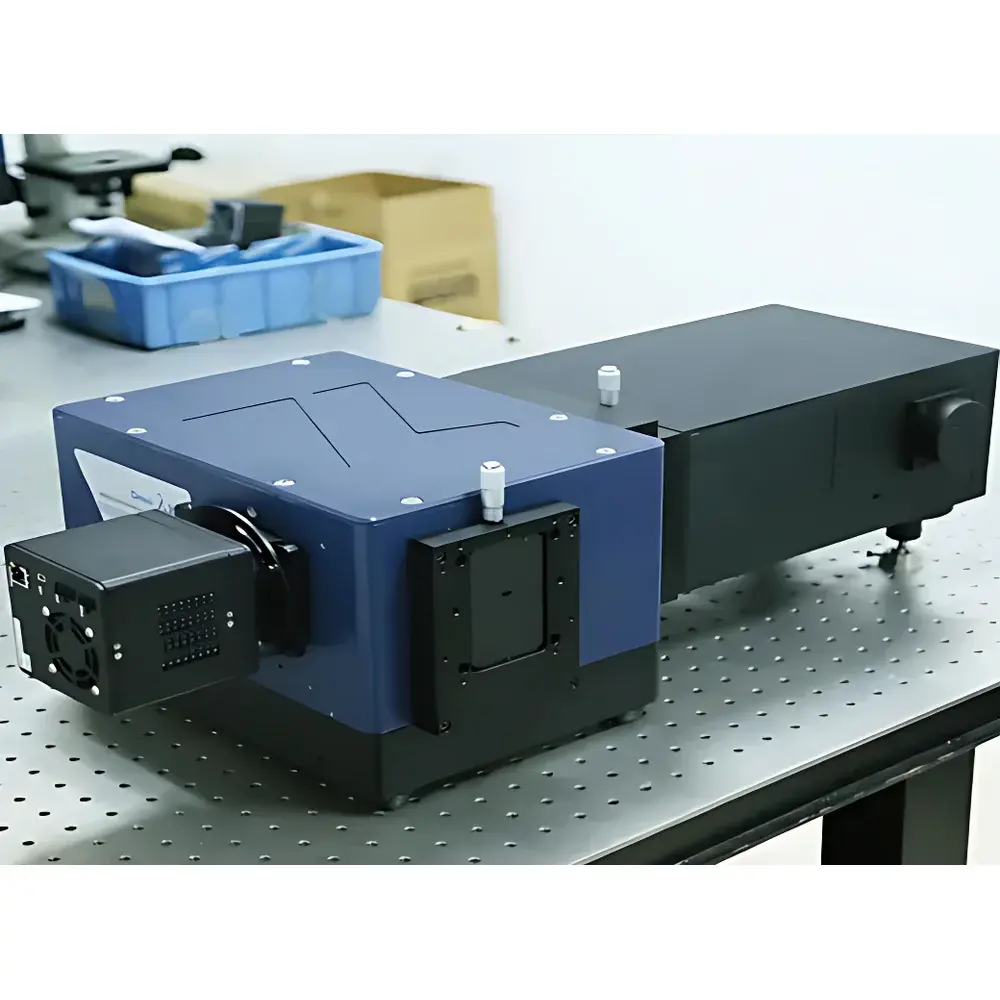
ZOLIX FEDU “Feidu” Micro-Raman Spectrometer
| Brand | ZOLIX |
|---|---|
| Origin | Beijing, China |
| Manufacturer Type | Original Equipment Manufacturer (OEM) |
| Product Category | Domestic |
| Model | FEDU |
| Instrument Type | Confocal Micro-Raman Spectrometer |
| Spectral Range | 300–1100 nm |
| Spectral Resolution | 10 cm⁻¹ |
| Minimum Wavenumber | 100 cm⁻¹ |
| Wavenumber Repeatability | ±1 cm⁻¹ |
| Laser Wavelength | 532 nm |
| Laser Power | 50 mW |
| Raman Shift Range | 200–2000 cm⁻¹ |
| Fluorescence Range (optional) | 550–850 nm |
| Optical Resolution | 2 nm |
| Detector | Back-Illuminated CCD |
| Power Supply | 110/220 V AC (12 V @ 4 A DC adapter output) |
| Dimensions | 800 × 400 × 350 mm |
| Weight | <10 kg |
Overview
The ZOLIX FEDU “Feidu” Micro-Raman Spectrometer is a purpose-engineered confocal Raman system designed for pedagogical rigor and operational accessibility in undergraduate physics and chemistry laboratories. Built upon established Raman scattering principles—where monochromatic laser light (532 nm) interacts with molecular vibrational modes to generate inelastically scattered photons—the instrument delivers calibrated, reproducible spectral data across the 200–2000 cm⁻¹ Raman shift range. Its optical architecture integrates a stabilized diode-pumped solid-state laser, precision-coupled confocal microscopy optics, and a high-quantum-efficiency back-illuminated CCD detector, enabling direct spatial localization of spectroscopic signals from micron-scale sample regions. Unlike research-grade systems requiring extensive alignment or environmental stabilization, the FEDU prioritizes mechanical robustness, thermal drift mitigation, and plug-and-play operability—making it suitable for repeated student use under standard classroom conditions without dedicated vibration isolation or temperature-controlled enclosures.
Key Features
- Confocal micro-Raman configuration with integrated 532 nm excitation source (50 mW nominal output) and adjustable focus for diffraction-limited spatial sampling
- Fixed-grating spectrometer delivering 10 cm⁻¹ wavenumber resolution and ±1 cm⁻¹ repeatability over extended acquisition sessions
- Back-illuminated CCD detector optimized for visible-NIR sensitivity (300–1100 nm), supporting both Raman and optional fluorescence measurements (550–850 nm)
- Compact benchtop form factor (800 × 400 × 350 mm; <10 kg) with integrated laser power supply, optical path enclosure, and sample chamber
- Pre-aligned optical train minimizing setup time and reducing alignment-related measurement variability across teaching cohorts
- Dual-mode capability: standardized Raman acquisition on reference materials (e.g., sulfur, CCl₄) and optional fluorescence mode using Rhodamine 6G for comparative spectroscopic instruction
Sample Compatibility & Compliance
The FEDU accommodates solid, liquid, and powder samples mounted on standard microscope slides or Petri dishes. Its open-access sample chamber permits rapid specimen exchange and accommodates auxiliary tools such as manual XYZ translation stages (user-supplied). While not certified for GLP/GMP-regulated environments, the system adheres to fundamental optical safety standards (IEC 60825-1 Class 3B laser compliance) and includes interlocked laser shuttering and beam path containment. All spectral calibrations are traceable to NIST-traceable mercury-argon lamp standards (optional accessory). Data acquisition workflows align with academic laboratory best practices—including metadata tagging (laser power, integration time, grating position), raw file export in industry-standard formats (.txt, .csv), and audit-ready log generation within the software environment.
Software & Data Management
The included spectral acquisition and analysis suite provides real-time preview, dark-current subtraction, cosmic-ray removal, baseline correction (polynomial and asymmetric least squares), peak fitting (Gaussian/Lorentzian models), and spectral library matching. Software supports batch processing of multi-sample datasets and exports fully annotated spectra compliant with JCAMP-DX v5.01 format. All user actions—including parameter changes, calibration events, and analysis steps—are timestamped and logged locally, satisfying basic requirements for educational traceability and reproducibility reporting. No cloud dependency or proprietary runtime is required; the application runs natively on Windows 10/11 (64-bit) with standard OpenGL support.
Applications
The FEDU serves as a foundational platform for teaching core concepts in molecular spectroscopy, including: Rayleigh vs. Raman scattering selection rules; Stokes/anti-Stokes intensity asymmetry; resonance enhancement effects; phonon mode assignment in crystalline solids; solvent-solute interactions via band shifts; and comparative analysis of Raman-active versus IR-active vibrational modes. Laboratory exercises include quantitative evaluation of spectral resolution using sulfur’s 472 cm⁻¹ mode, assessment of instrumental repeatability across multiple acquisitions, and side-by-side comparison of Raman and fluorescence responses using Rhodamine 6G. The system also supports inquiry-based projects such as polymer crystallinity mapping, pigment identification in art conservation samples, and stress-induced peak shifts in semiconductor thin films—when paired with optional translation stages and external illumination sources.
FAQ
Is the FEDU compatible with third-party spectroscopic databases?
Yes—exported spectra conform to JCAMP-DX v5.01 and can be imported into commercial libraries (e.g., KnowItAll, BioRad KnowItAll) or open-source tools (e.g., PyMca, SpecView).
Does the system require external cooling or air conditioning?
No. The CCD operates at thermoelectrically stabilized temperatures (−10 °C typical), and the optical bench is engineered for ambient operation (15–30 °C, non-condensing humidity).
Can the laser wavelength be upgraded to 785 nm for reduced fluorescence interference?
Not natively—the FEDU is fixed at 532 nm. For low-fluorescence applications, users may employ notch filters or select low-fluorescence substrates (e.g., silicon wafers, CaF₂ slides).
What maintenance is required during normal teaching use?
Annual verification of wavelength calibration using the optional Hg-Ar lamp is recommended; no routine optical realignment or detector recalibration is necessary under standard operating conditions.
Is FDA 21 CFR Part 11 compliance supported?
No—the software does not implement electronic signatures or audit trail encryption. It is intended for educational and non-regulated research use only.



