
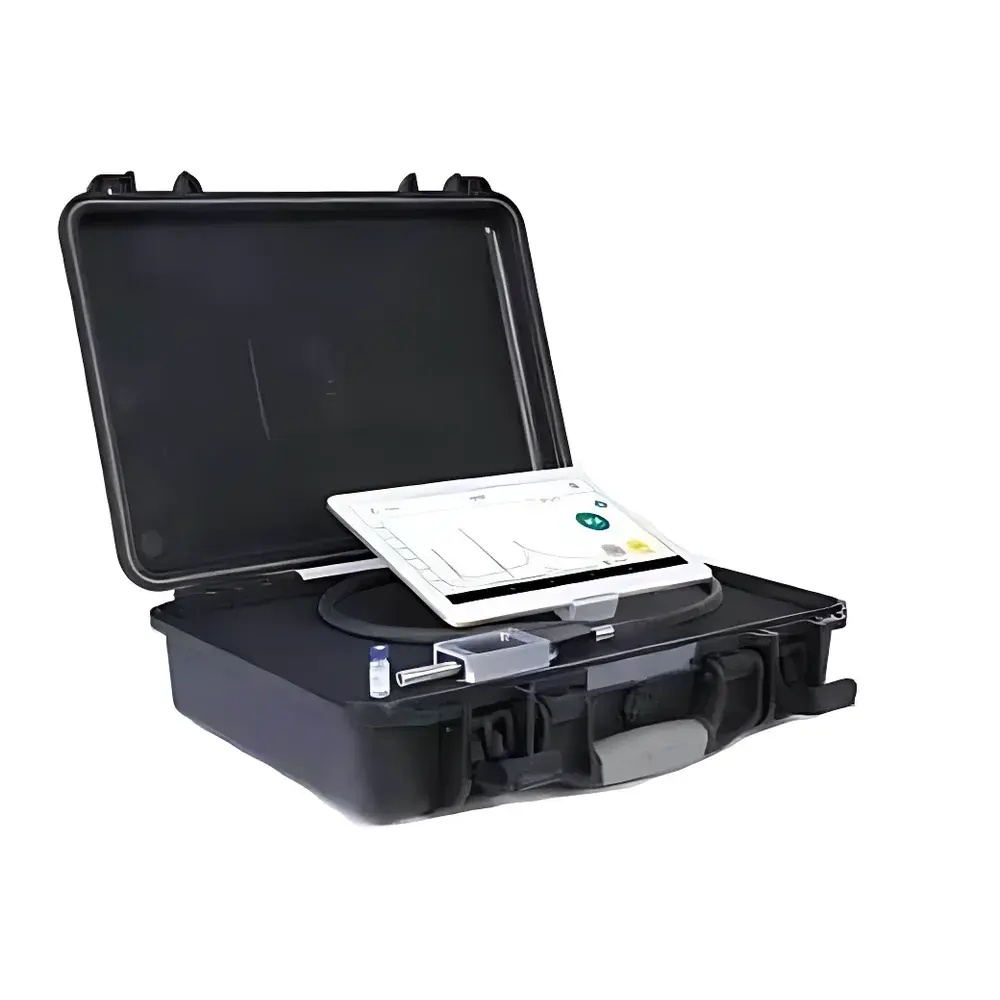
ZOLIX FI-FO Portable Fiber-Optic Coupled Raman Spectrometer
| Brand | ZOLIX |
|---|---|
| Origin | Beijing, China |
| Manufacturer Type | Original Equipment Manufacturer (OEM) |
| Product Category | Domestic |
| Model | FI-FO |
| Instrument Type | Portable / Handheld Raman Spectrometer |
| Spectral Range | 200–2750 cm⁻¹ |
| Spectral Resolution | 8–10 cm⁻¹ |
| Excitation Wavelengths | 785 nm / 830 nm / 1064 nm |
| Laser Power | 0–500 mW |
| Laser Linewidth | <0.1 nm |
| Detector | Back-Illuminated CCD (for 785/830 nm) / Cooled InGaAs PDA (for 1064 nm) |
| Operating System Options | Android 7.1 or Windows 10 |
| Battery Capacity | 10,200 mAh (75 Wh) |
| Dimensions | 430 × 130 × 120 mm |
| Screen | 10-inch capacitive touchscreen |
| Onboard Database | Integrated reference spectral library |
| Runtime | >4 hours on full charge |
Overview
The ZOLIX FI-FO Portable Fiber-Optic Coupled Raman Spectrometer is a field-deployable, high-fidelity analytical instrument engineered for quantitative and qualitative molecular identification via inelastic light scattering. Based on the fundamental principle of Raman spectroscopy—where monochromatic laser excitation induces vibrational mode shifts in chemical bonds—the FI-FO delivers lab-grade spectral fidelity in a ruggedized, battery-powered platform. Its fiber-optic coupling architecture decouples the excitation source and spectrometer from the sampling interface, enabling non-contact, standoff, or immersion-based measurements across heterogeneous, irregular, or temperature-sensitive samples. Designed for compliance with international field analysis workflows, the system supports both point-and-shoot verification and spatially resolved mapping when integrated with motorized stages or external positioning hardware. The core optical path incorporates low-stray-light spectrograph design, thermally stabilized laser diodes, and wavelength-calibrated detectors—ensuring traceable spectral accuracy per ISO/IEC 17025 metrological requirements.
Key Features
- Fiber-optic probe interface with detachable, chemically inert stainless-steel or quartz-tipped probes—enabling safe measurement of hazardous, volatile, or reactive substances without direct instrument exposure.
- Modular excitation platform supporting three NIR laser wavelengths (785 nm, 830 nm, and 1064 nm), each optimized for specific sample classes: 785 nm for general-purpose organic/inorganic analysis; 830 nm for reduced fluorescence in biological matrices; 1064 nm for highly fluorescent or dark-colored samples including pharmaceutical tablets and polymer composites.
- Integrated 10-inch capacitive touchscreen running either Android 7.1 or Windows 10, eliminating dependency on external PCs and streamlining GLP-compliant data capture with timestamped metadata (operator ID, GPS coordinates, ambient temperature/humidity if externally logged).
- Onboard spectral library containing >1,200 reference spectra covering pharmaceutical actives and excipients, illicit substances (including precursor chemicals listed under UN Convention Against Illicit Traffic), food adulterants (e.g., Sudan dyes, melamine), gemological standards (diamond, ruby, emerald), and mineral phases (quartz, calcite, kaolinite).
- Ruggedized magnesium-alloy chassis with IP54-rated ingress protection, shock-absorbing corner mounts, and MIL-STD-810G compliant drop testing—validated for transport in standard airline carry-on luggage and operation in ambient temperatures from −10 °C to +45 °C.
- Embedded spectral preprocessing engine supporting automatic cosmic ray removal, baseline correction (asymmetric least squares), fluorescence subtraction (polynomial or iterative), and peak deconvolution—exportable as CSV or JCAMP-DX for third-party chemometric analysis (e.g., PCA, PLS-DA).
Sample Compatibility & Compliance
The FI-FO accommodates solid powders, liquids, gels, films, and semi-crystalline materials without mandatory sample preparation. Its fiber-probe geometry permits measurement through transparent packaging (glass vials, PET bottles, blister packs), enabling non-destructive quality control in GMP-regulated environments. For regulated applications—including pharmaceutical raw material verification (USP ), forensic evidence triage (ASTM E2599-21), and food safety screening (EU Regulation No. 853/2004)—the system supports audit-trail-enabled operation when configured with Windows 10 and INScan-Lite software compliant with FDA 21 CFR Part 11 requirements (electronic signatures, role-based access control, immutable log files). All spectral calibrations are traceable to NIST SRM 2241 (silicon) and SRM 2242 (cyclohexane), with certificate-of-calibration provided per unit shipment.
Software & Data Management
Two native software environments are offered: INScan-Lite (Windows 10) and RamanScan App (Android 7.1). INScan-Lite provides full spectral acquisition control, multivariate statistical tools, report generation (PDF/Excel), and integration with LIMS via ODBC or HL7 interfaces. The Android version delivers rapid pass/fail decision logic using user-defined threshold matching against onboard libraries—ideal for frontline inspectors performing real-time screening at border checkpoints or warehouse receiving docks. Both platforms support encrypted local storage (AES-256), USB-C data export, and optional cloud synchronization with AWS-hosted spectral repositories featuring RBAC and SOC 2 Type II security certification.
Applications
- Pharmaceutical Process Analytical Technology (PAT): Real-time monitoring of crystallization endpoints, blend uniformity, and polymorphic transitions during granulation and tableting.
- Forensic Science: Identification of unknown white powders, seized drug samples, and trace residues on clothing or toolmarks—aligned with INTERPOL’s Raman Interoperability Framework.
- Cultural Heritage Analysis: Non-invasive pigment identification in paintings, frescoes, and illuminated manuscripts; detection of degradation products (e.g., lead soaps, copper acetates) without micro-sampling.
- Agri-Food Safety: Rapid detection of unauthorized colorants (e.g., Acid Orange II), pesticide residues on produce surfaces, and adulteration in edible oils (e.g., argan oil diluted with sunflower oil).
- Hazardous Material Response: Field identification of unknown industrial chemicals, explosives precursors (e.g., nitromethane, hydrogen peroxide solutions), and toxic industrial compounds (TICs) per NFPA 472 protocols.
- Geoscience & Mining: In situ mineral phase mapping in drill cores or outcrops; differentiation of polymorphs (e.g., anatase vs. rutile TiO₂) and hydration states (e.g., gypsum vs. bassanite).
FAQ
Is the FI-FO suitable for quantitative analysis?
Yes—when used with internal standard calibration or partial least squares (PLS) regression models developed using certified reference materials, the FI-FO achieves repeatability of ±3% RSD for concentration determination in homogeneous liquid mixtures.
Can it perform surface-enhanced Raman spectroscopy (SERS)?
The system supports SERS via optional fiber-coupled SERS substrates (colloidal Au/Ag nanoparticle suspensions or chip-based nanostructured surfaces); detection limits for thiophene derivatives reach 10⁻⁹ M under optimized conditions.
Does it comply with regulatory data integrity requirements?
When operated with Windows 10 and INScan-Lite, the FI-FO meets ALCOA+ principles and supports 21 CFR Part 11 compliance through electronic signatures, audit trails, and secure user authentication.
What maintenance is required for field deployment?
No routine optical alignment is needed; the sealed spectrograph and laser module are factory-aligned and vibration-tested. Recommended biannual verification using NIST-traceable silicon wafer and cyclohexane standards.
How is spectral calibration validated over time?
Each acquisition includes automated Si reference peak tracking at 520.7 cm⁻¹; drift compensation algorithms adjust pixel-to-wavenumber mapping in real time, maintaining calibration stability within ±0.5 cm⁻¹ over 8-hour continuous operation.
Related Products





