
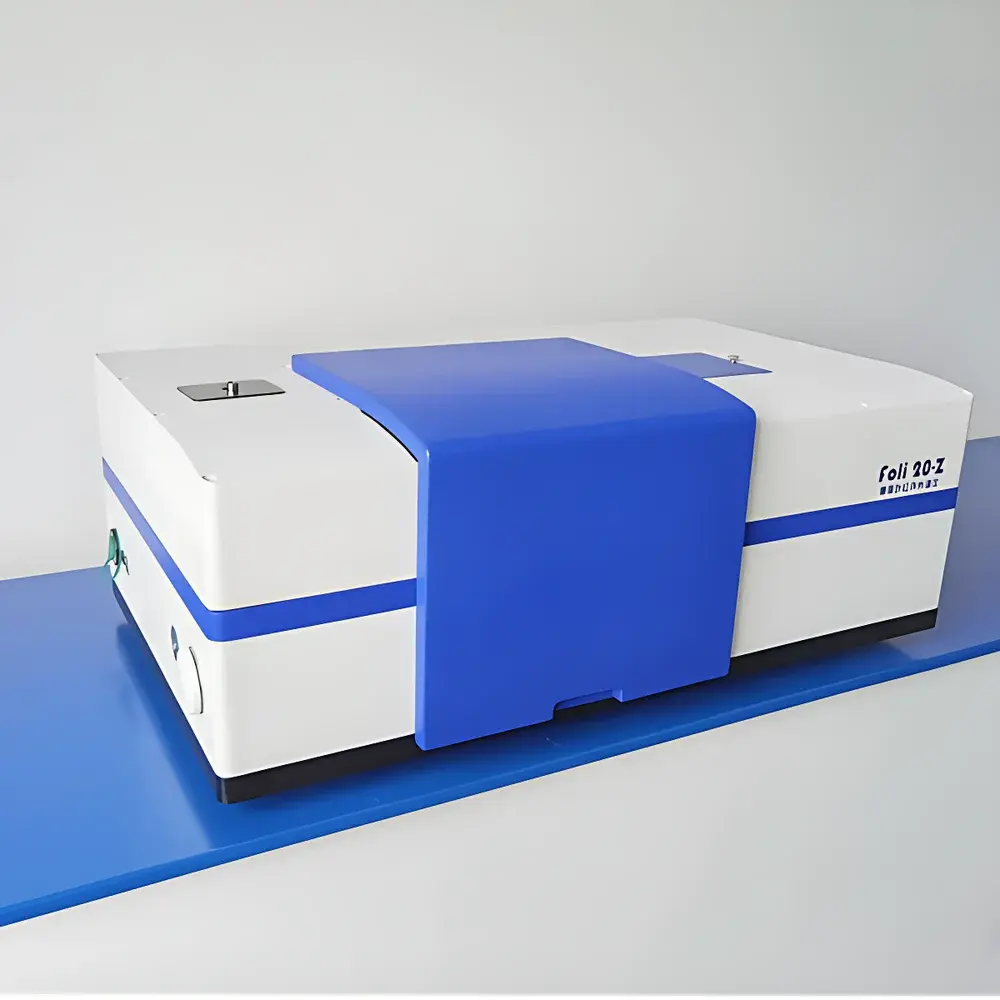
ZOLIX FI-R3X Desktop Fourier Transform Infrared (FTIR) Spectrometer
| Brand | ZOLIX |
|---|---|
| Origin | Beijing, China |
| Manufacturer Type | Original Equipment Manufacturer (OEM) |
| Instrument Type | Fourier Transform Infrared Spectrometer |
| Spectral Range | 5000–500 cm⁻¹, 5000–650 cm⁻¹, or 7500–400 cm⁻¹ (model-dependent) |
| Spectral Resolution | ≤1 cm⁻¹ |
| Wavenumber Accuracy | ≤0.01 cm⁻¹ |
| Signal-to-Noise Ratio | ≥40,000:1 (at 4 cm⁻¹, 1 min scan) |
| Beam Splitter Options | ZnSe or KBr |
| Detector Options | High-sensitivity DLaTGS or Liquid-Nitrogen-Cooled MCT |
| Dimensions | 685 × 415 × 223 mm |
| Weight | 20 kg |
Overview
The ZOLIX FI-R3X is a high-performance desktop Fourier Transform Infrared (FTIR) spectrometer engineered for versatility, precision, and laboratory-grade reproducibility in both routine analysis and advanced research applications. Based on Michelson interferometry with a monolithic, kinematically mounted corner-cube interferometer, the FI-R3X delivers stable optical alignment and long-term wavenumber fidelity—critical for quantitative spectral comparison, kinetic studies, and regulatory-compliant measurements. Its modular large-sample compartment accommodates diverse sampling geometries without realignment, supporting transmission, attenuated total reflectance (ATR), specular reflection, diffuse reflection, and gas-phase analysis across mid-infrared (MIR) spectral windows. Unlike conventional single-configuration FTIR systems, the FI-R3X is designed as a platform instrument: its standardized optical interface, mechanical mounting rails, and electrical I/O ports enable seamless integration of third-party accessories—including those from Pike Technologies, Harrick, and Specac—without compromising beam path integrity or calibration traceability.
Key Features
- Modular dual-chamber architecture with interchangeable optical modules for simultaneous or sequential measurement modes (e.g., ATR + transmission)
- Interchangeable beam splitters (ZnSe for broad-band operation; KBr for extended low-wavenumber range down to 400 cm⁻¹)
- Optional liquid-nitrogen-cooled MCT detector for enhanced sensitivity in low-concentration or weak-absorbing species detection
- Integrated focusing and collimated transmission beam paths—both accessible via motorized mirror selection
- Thermally stabilized optical bench with passive damping to minimize environmental drift during long-duration scans
- Compliance-ready design: supports audit trails, user access control, and electronic signatures per FDA 21 CFR Part 11 when paired with validated software environments
Sample Compatibility & Compliance
The FI-R3X supports solid, liquid, powder, thin-film, and gaseous samples across heterogeneous material classes—including polymers, catalysts, pharmaceuticals, inorganic oxides, and biological macromolecules. Its compatibility with ISO 1833-1 (textile fiber identification), ASTM E1252 (general principles of IR qualitative analysis), and USP (infrared spectroscopy for pharmaceutical excipients) is ensured through factory-calibrated wavenumber accuracy (≤0.01 cm⁻¹) and photometric linearity (transmittance precision ≤±0.1%). The system meets GLP/GMP documentation requirements when operated with compliant data acquisition software, enabling full traceability of instrument parameters, sample metadata, and processing history. Optional vacuum-compatible high-temperature ATR cells (up to 300 °C) and variable-temperature transmission stages (−60 °C to 600 °C) extend applicability to in situ catalytic reaction monitoring under controlled atmospheres.
Software & Data Management
The FI-R3X operates with ZOLIX’s proprietary SpectraStudio software suite—a Windows-based application supporting spectral acquisition, baseline correction, peak deconvolution, library searching (including NIST, SDBS, and custom databases), and multivariate analysis (PCA, PLS). Raw interferogram and spectrum files are stored in vendor-neutral formats (e.g., JCAMP-DX v6.0) to ensure long-term archival integrity. Data export options include CSV, ASCII, and HDF5 for integration into LIMS or MATLAB-based modeling workflows. Software validation packages—including IQ/OQ documentation templates and test protocols aligned with ISO/IEC 17025—are available upon request for regulated laboratories.
Applications
- In situ catalysis characterization: real-time monitoring of adsorbed species (e.g., pyridine, CO) using high-temperature DRIFTS cells and flow reactors
- Pharmaceutical solid-state analysis: polymorph identification, hydrate/dehydrate transitions, and excipient compatibility screening via temperature-controlled ATR
- Polymer degradation kinetics: oxidation onset detection and carbonyl index quantification under thermal aging conditions
- Gas-phase trace analysis: ppb-level detection of corrosive or reactive gases (e.g., HCl, NH₃, SO₂) using 5-m pathlength multipass cells
- Materials science: interfacial chemistry of coatings, thin-film thickness determination via interference fringe analysis, and surface functionalization verification
- OEM integration: configurable trigger I/O and Ethernet-based remote control for embedding into automated analytical platforms or process analyzers
FAQ
What is the difference between the FI-R3X-A and FI-R3X-B models?
The FI-R3X-A uses a ZnSe beam splitter optimized for 5000–500 cm⁻¹ operation, while the FI-R3X-B employs a KBr beam splitter to extend coverage down to 400 cm⁻¹—enabling analysis of heavy-atom vibrations and lattice modes.
Can the FI-R3X be used for quantitative analysis in compliance with pharmacopeial standards?
Yes—when configured with DLaTGS detection, certified reference materials, and validated software workflows, it meets USP , EP 2.2.24, and JP 2.07 requirements for identity testing and assay.
Is the system compatible with external gas handling systems for in situ reaction studies?
Yes—the rear panel includes dedicated vacuum and purge gas ports with pressure-rated fittings (max 0.5 MPa), enabling direct coupling to mass flow controllers, reactor manifolds, and cryogenic cooling lines.
Does the FI-R3X support spectral subtraction for background correction in ATR measurements?
Yes—SpectraStudio provides real-time single-beam subtraction, ratioing, and atmospheric compensation algorithms, including automatic water/CO₂ vapor removal using built-in reference libraries.
What level of technical support and calibration services are offered post-purchase?
ZOLIX provides on-site installation qualification (IQ), annual performance verification (OQ/PQ), NIST-traceable wavenumber and photometric calibration, and lifetime firmware updates—all documented per ISO/IEC 17025 guidelines.




