
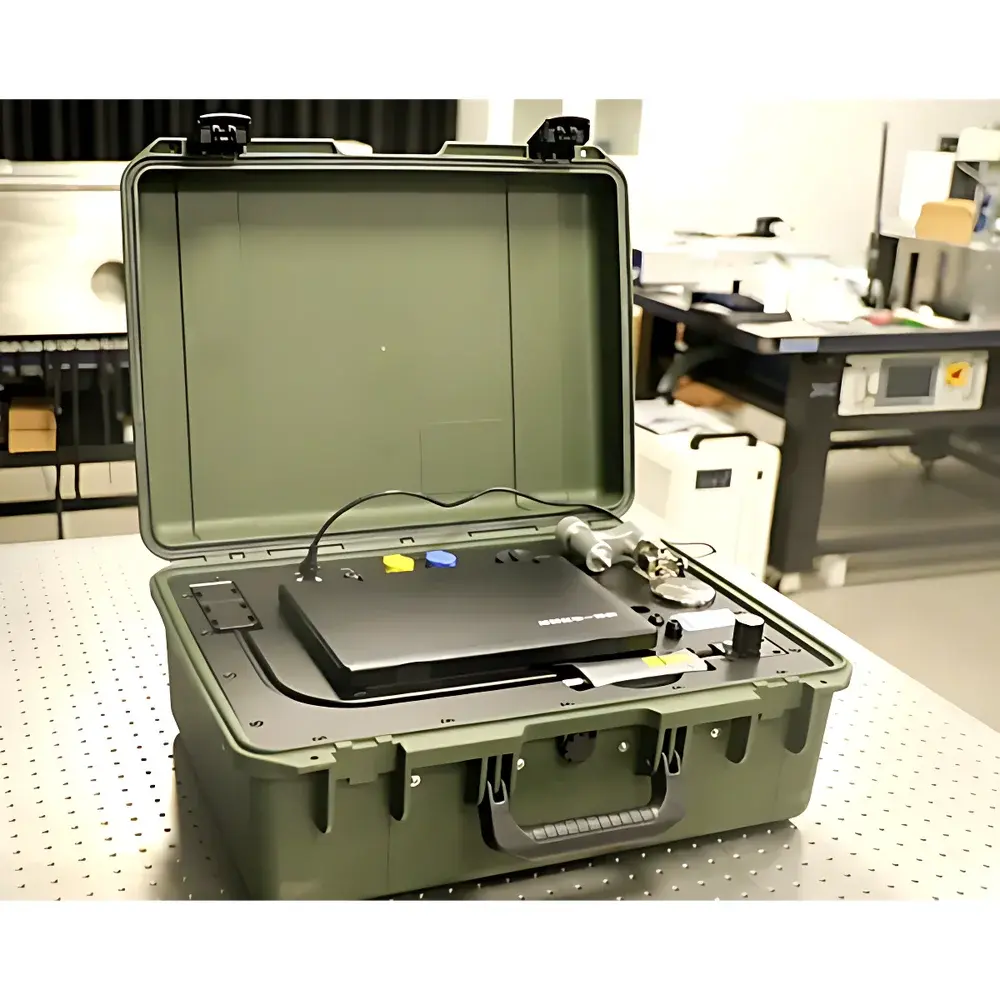
ZOLIX FI-RIR Portable Combined FTIR and Raman Spectrometer
| Brand | ZOLIX |
|---|---|
| Model | FI-RIR |
| Type | Portable Hybrid FTIR–Raman Spectrometer |
| Origin | Beijing, China |
| Manufacturer | ZOLIX (OEM/ODM Capable) |
| Spectral Range (FTIR) | 5000–500 cm⁻¹ |
| Spectral Resolution (FTIR) | ≤2 cm⁻¹ |
| Wavenumber Accuracy (FTIR) | ≤0.2 cm⁻¹ |
| Wavenumber Precision (FTIR) | ≤0.05 cm⁻¹ |
| Spectral Range (Raman) | 200–2500 cm⁻¹ |
| Raman Resolution | 8–12 cm⁻¹ |
| Excitation Laser | 785 nm solid-state diode laser |
| Laser Power | >350 mW, continuously adjustable (0–100%) |
| Detector (FTIR) | Sealed, moisture-resistant DLaTGS with integrated 24-bit ADC (KBr window) |
| Detector (Raman) | Scientific-grade CMOS array |
| Interferometer | Domestic high-stability立体-angle-mirror interferometer (lifetime >10 years) |
| Beam Splitter | ZnSe for mid-IR, humidity-resistant |
| ATR Crystal | Industrial-grade diamond (abrasion-, corrosion-, and chemically resistant) |
| Operating Environment | Ambient temperature (no liquid nitrogen or cryogenic cooling required) |
| Battery Life | >4 h continuous operation (integrated Li-ion pack) |
| Enclosure Rating | IP67 |
| Dimensions (L×W×H) | 540 × 410 × 210 mm |
| Weight | 15 kg |
| OS | Windows 10 embedded (full Chinese UI) |
| Data Interface | Gigabit Ethernet, dual USB 3.0, vehicle DC input support |
Overview
The ZOLIX FI-RIR is a field-deployable, fully integrated hybrid spectrometer combining Fourier Transform Infrared (FTIR) and dispersive Raman spectroscopy in a single ruggedized platform. Engineered for dual-mode molecular fingerprinting, it leverages complementary vibrational selection rules—FTIR probing dipole moment changes and Raman detecting polarizability fluctuations—to deliver orthogonal spectral information from the same sample location without repositioning or instrumentation switching. This co-located measurement capability significantly enhances identification confidence for complex or heterogeneous materials where either modality alone may yield ambiguous results. Designed for operational continuity across environmental extremes, the system operates uncooled at ambient temperatures and meets IP67 ingress protection standards—enabling reliable use in outdoor emergency response, border inspection checkpoints, hazardous material containment zones, and mobile forensic laboratories. Its architecture adheres to fundamental spectroscopic metrology principles: wavelength-calibrated interferometry for FTIR and grating-based dispersion with pixel-registered CMOS detection for Raman, both traceably aligned to NIST-traceable reference standards.
Key Features
- True simultaneous dual-spectroscopy platform: No mechanical switching or realignment between FTIR and Raman modes—ensures spatial correlation of spectral data points.
- Diamond ATR module with rotary pressure head: Enables reproducible contact force control (10⁶ measurements under aggressive chemical exposure.
- Self-contained power and computing: Integrated 10-inch capacitive touchscreen tablet running Windows 10 with preloaded spectral processing suite; hot-swappable battery supports >4 h field operation (tested per IEC 62133).
- Robust optical train: Domestic high-stability立体-angle-mirror interferometer (patent-pending alignment retention), ZnSe beam splitter with anti-humidity coating, and sealed DLaTGS detector with on-board 24-bit ADC eliminate drift during extended field deployment.
- Regulatory-ready software architecture: Audit trail logging, electronic signature support, and user role-based access control compliant with GLP/GMP documentation requirements per FDA 21 CFR Part 11 Annex 11 guidelines.
Sample Compatibility & Compliance
The FI-RIR accommodates diverse physical states without sample preparation: bulk solids (e.g., polymer pellets, tablet fragments), loose powders (pharmaceutical APIs, illicit drug mixtures), opaque films (packaging laminates), corrosive liquids (organic solvents, acid/base solutions), and semi-transparent matrices (gels, biological tissues). Its diamond ATR interface tolerates pH 0–14 exposure and resists scratching by Mohs 9+ materials. All optical components comply with ISO 17025:2017 calibration traceability protocols. The system supports ASTM E1421 (standard practice for Raman microscopy), ASTM E2412 (FTIR quantitative analysis), and ISO 8510-2 (ATR measurement geometry). Built-in spectral libraries include >2400 validated reference spectra aligned with UNODC precursor chemical lists, USP monographs, and EU REACH substance inventories.
Software & Data Management
The embedded SpectraSuite™ software provides unified workflow management for both modalities. FTIR functions include automated CO₂/H₂O atmospheric compensation, diamond absorption subtraction, peak deconvolution (Gaussian–Lorentzian fitting), and quantitative PLS regression modeling. Raman modules support cosmic ray removal, fluorescence background correction (asymmetric least squares), and intensity-normalized spectral matching against local or networked databases. All spectral acquisitions are time-stamped, geotagged (via optional GPS dongle), and stored in vendor-neutral JCAMP-DX format. Data export supports CSV, ASCII, and .spc formats; reports generate PDF/HTML with embedded metadata (instrument ID, operator, calibration status, uncertainty estimates). Database administration permits creation of encrypted, version-controlled local libraries with configurable match thresholds (Cosine, Euclidean, Correlation).
Applications
- Forensic science: Identification of seized narcotics (e.g., fentanyl analogues, synthetic cannabinoids), explosive residues (TNT, PETN), and counterfeit pharmaceuticals via spectral library matching and differential peak ratio analysis.
- Environmental monitoring: On-site detection of microplastics (PET, PP, PS) in soil/water matrices; quantification of pesticide residues on crop surfaces using ATR-FTIR peak area integration.
- Industrial safety: Real-time verification of chemical identity in unknown containers during hazmat incidents; confirmation of cleaning validation on pharmaceutical manufacturing equipment.
- Cultural heritage: Non-invasive pigment analysis (vermilion, azurite) and polymer binder identification (acrylic vs. alkyd) in paintings and textiles without sampling.
- Food safety: Rapid screening for adulterants (melamine in milk powder, Sudan dyes in spices) and authentication of origin markers (olive oil fatty acid profiles).
FAQ
Does the FI-RIR require external cooling or cryogenic gases for detector operation?
No. Both the DLaTGS (FTIR) and CMOS (Raman) detectors operate at ambient temperature. No liquid nitrogen, thermoelectric coolers, or compressed air systems are needed.
Can spectral data be exported to third-party chemometric platforms like MATLAB or Unscrambler?
Yes. All raw and processed spectra export in JCAMP-DX, CSV, and ASCII formats compatible with industry-standard multivariate analysis toolkits.
What regulatory documentation is provided for audit readiness?
Each unit ships with Factory Calibration Certificate (traceable to NIST SRMs), IQ/OQ documentation templates, and software validation summary per GAMP5 guidelines.
Is remote firmware/software update supported?
Yes. Over-the-air updates via secure HTTPS connection; update packages digitally signed and verified prior to installation.
How is spectral reproducibility validated across field units?
All production units undergo inter-instrument agreement testing using NIST SRM 2062 (polystyrene film) and SRM 2242 (caffeine), with wavenumber repeatability <±0.03 cm⁻¹ and intensity RSD <1.8% (n=10).
Related Products





