
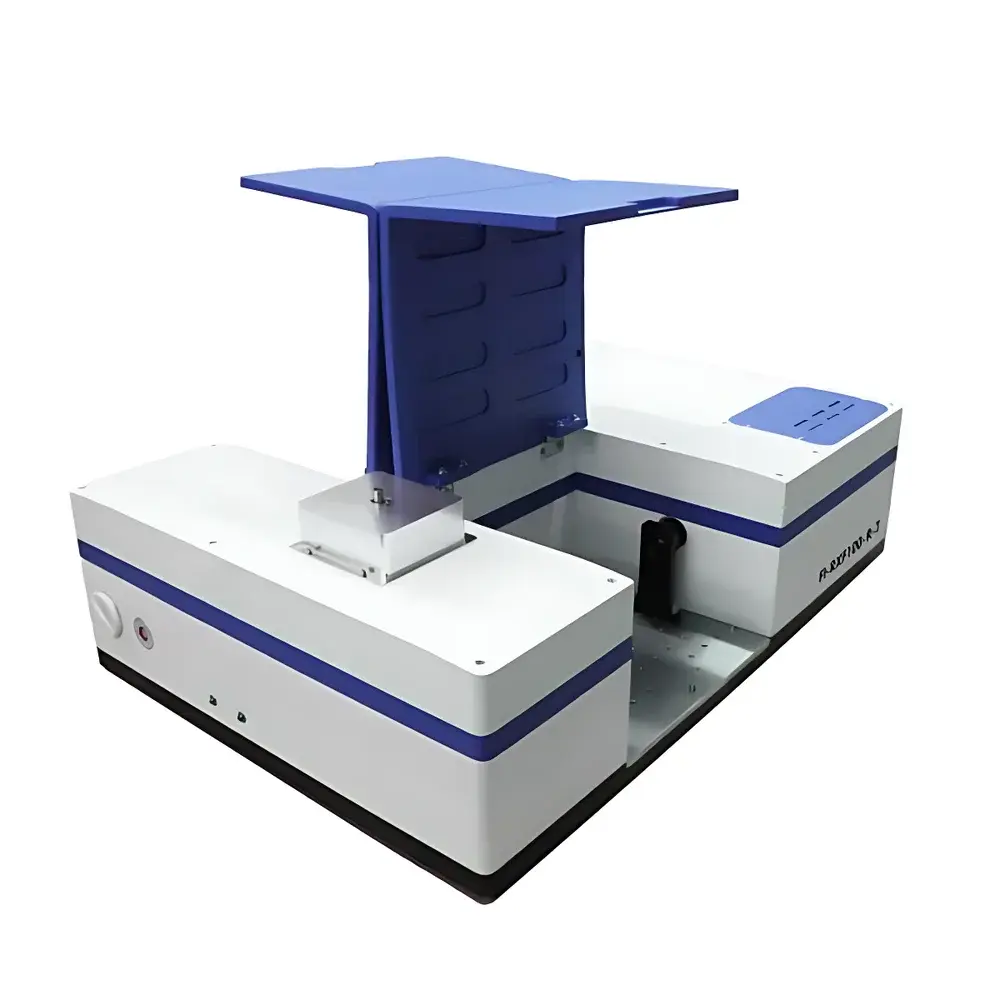
ZOLIX FI-RXF100-R-T Dual-Channel, Dual-Sample-Chamber Fourier Transform Infrared (FTIR) Spectrometer
| Brand | ZOLIX |
|---|---|
| Origin | Beijing, China |
| Manufacturer Type | Original Equipment Manufacturer (OEM) |
| Instrument Type | Laboratory FTIR Spectrometer |
| Spectral Range | 8000–350 cm⁻¹ / 5000–500 cm⁻¹ |
| Spectral Resolution | ≤0.4 cm⁻¹ |
| Wavenumber Accuracy | ≤0.005 cm⁻¹ |
| Interferometer | Domestic High-Stability Cubic Corner Retroreflector Interferometer |
| Beamsplitter | ZnSe (Moisture-Resistant), Optional KBr |
| Detectors | Liquid-N₂-Cooled MCT (≥10 h hold time), DLaTGS (Room-Temperature, Humidity-Resistant) |
| Scan Speed Options | 2.5K–60K points/sec (6 selectable steps) |
| Software | Windows 10–Based Native Chinese GUI with ASTM E1421–compliant spectral processing, automated channel switching, K-M transformation, background validity tracking, and GLP-ready audit trail logging |
Overview
The ZOLIX FI-RXF100-R-T is a dual-channel, dual-sample-chamber Fourier transform infrared (FTIR) spectrometer engineered for high-throughput, multi-modal spectroscopic analysis in research laboratories and third-party testing facilities. Based on Michelson-type interferometry with a permanently aligned cubic corner retroreflector interferometer, the system delivers exceptional optical stability and long-term wavenumber reproducibility—critical for quantitative kinetic studies and in situ catalytic characterization. Its core innovation lies in two physically separate, optically equivalent sample compartments housed within a single compact chassis (750 × 515 × 223 mm), eliminating mechanical reconfiguration while enabling simultaneous or sequential measurement under distinct experimental conditions. This architecture supports true parallel operation across transmission, ATR, diffuse reflectance, specular reflectance, and transflection modes—without manual accessory swaps or realignment. Designed for rigorous compliance environments, the instrument meets foundational requirements of ISO/IEC 17025 for method validation and supports traceable calibration via NIST-traceable polystyrene film standards.
Key Features
- Dual independent sample chambers with fully automated optical path switching—no manual intervention required between measurements.
- Integrated detector selection logic: software-controlled auto-switching between liquid-nitrogen-cooled MCT (for high-sensitivity mid-IR detection, 8000–600 cm⁻¹) and humidity-resistant DLaTGS (broad dynamic range, 5000–500 cm⁻¹), each equipped with integrated analog-to-digital conversion (ADC).
- Variable scan speed control (2.5K to 60K points/sec, six discrete settings) optimized for signal-to-noise ratio versus temporal resolution—essential for time-resolved in situ experiments.
- Automated Kubelka-Munk (K-M) transformation engine embedded in acquisition software for quantitative diffuse reflectance data normalization—enabling direct comparison of catalyst surface adsorption/desorption kinetics across temperature ramps.
- Full background management system: automatic timestamping, validity window alerts, and recall-by-experiment-context functionality to ensure spectral integrity during long-duration catalytic runs.
- Large-volume sample compartment (≥120 mm diameter access) accommodating industrial-grade accessories—including heated transmission cells, high-vacuum/high-pressure diffuse reflectance stages, variable-angle specular reflectometers, and diamond/ZnSe/Ge ATR crystals.
- Moisture-resistant ZnSe beamsplitter standard; optional KBr variant available for extended low-wavenumber coverage down to 350 cm⁻¹.
- Long-life ceramic IR source (1550 K operating temperature) with thermal stabilization circuitry ensuring consistent spectral radiance over >10,000 hours.
Sample Compatibility & Compliance
The FI-RXF100-R-T accommodates solid, liquid, and gaseous samples across standardized geometries compliant with ASTM E1252 (general IR sampling), ASTM E168 (qualitative analysis), and ASTM E1421 (quantitative multicomponent analysis). Its dual-chamber design inherently supports comparative studies—e.g., reference gas-phase spectrum acquisition in Chamber A while simultaneously monitoring catalyst surface species evolution in Chamber B under controlled gas flow and thermal ramping. For regulated environments, the system’s software implements audit-trail logging per FDA 21 CFR Part 11 requirements, including user authentication, parameter change history, raw-data immutability flags, and electronic signature support. All spectral metadata (date/time, operator ID, instrument configuration, environmental sensor readings) are embedded in .spa/.spc file headers for GLP/GMP traceability.
Software & Data Management
The native Windows 10 application provides full spectral acquisition, preprocessing, and interpretation capabilities without third-party dependencies. Core modules include: real-time interferogram monitoring; phase correction and apodization selection (Happ-Genzel, Blackman-Harris); atmospheric CO₂/H₂O subtraction; baseline correction (asymmetric least squares); peak integration with customizable thresholding; and library search against built-in NIST/EPA/ICDD reference databases. Quantitative workflows support univariate Beer-Lambert modeling and multivariate PLS regression with cross-validation diagnostics. All reports export to PDF or Excel with configurable templates—including instrument certification status, calibration certificate numbers, and uncertainty budgets derived from manufacturer specifications and in-house verification protocols.
Applications
Primary use cases span heterogeneous catalysis R&D, polymer degradation analysis, pharmaceutical polymorph identification, and environmental contaminant screening. In catalysis, the system enables in situ and operando studies using purpose-built reaction cells: high-temperature (≤800 °C) vacuum diffuse reflectance cells for probing Brønsted/Lewis acid site distribution; high-pressure (≤20 bar) transmission cells for monitoring adsorbed intermediates during Fischer–Tropsch synthesis; and cryogenic (77 K) vacuum cells for isolating metastable surface species. For QA/QC labs, its dual-chamber capability allows concurrent validation of incoming raw materials (Chamber A) against certified reference standards (Chamber B), reducing turnaround time by up to 40% compared to single-channel systems. The platform also supports ISO 1833–2 (textile fiber identification) and USP (pharmaceutical excipient verification) through preconfigured method templates.
FAQ
Does the FI-RXF100-R-T support automated background collection for both channels independently?
Yes—each chamber maintains its own background acquisition queue with configurable frequency, averaging count, and expiration policy. Backgrounds are tagged with chamber ID and timestamped for contextual reuse.
Can the system perform real-time spectral subtraction during continuous acquisition?
Yes—dynamic background subtraction is enabled during continuous mode, with user-defined update intervals and drift compensation algorithms.
Is the MCT detector compatible with standard liquid nitrogen dewars?
Yes—the detector uses industry-standard 25 mm diameter, 100 mm height LN₂ dewars with integrated anti-frost panel and auto-shutoff valve interface.
What spectral libraries are included by default?
The base installation includes the NIST 2022 IR Library (27,000+ spectra), EPA Compendium Method TO-15, and ICDD Polymer Additives Database—with optional expansion licenses for pharmaceutical, forensic, or petrochemical collections.
How is wavenumber accuracy verified during routine operation?
Accuracy is validated using polystyrene film (ASTM E1421) at 1601.5 cm⁻¹ and 1028.1 cm⁻¹ peaks; deviation logs are automatically appended to QC reports and trigger alert thresholds at ±0.003 cm⁻¹.






