
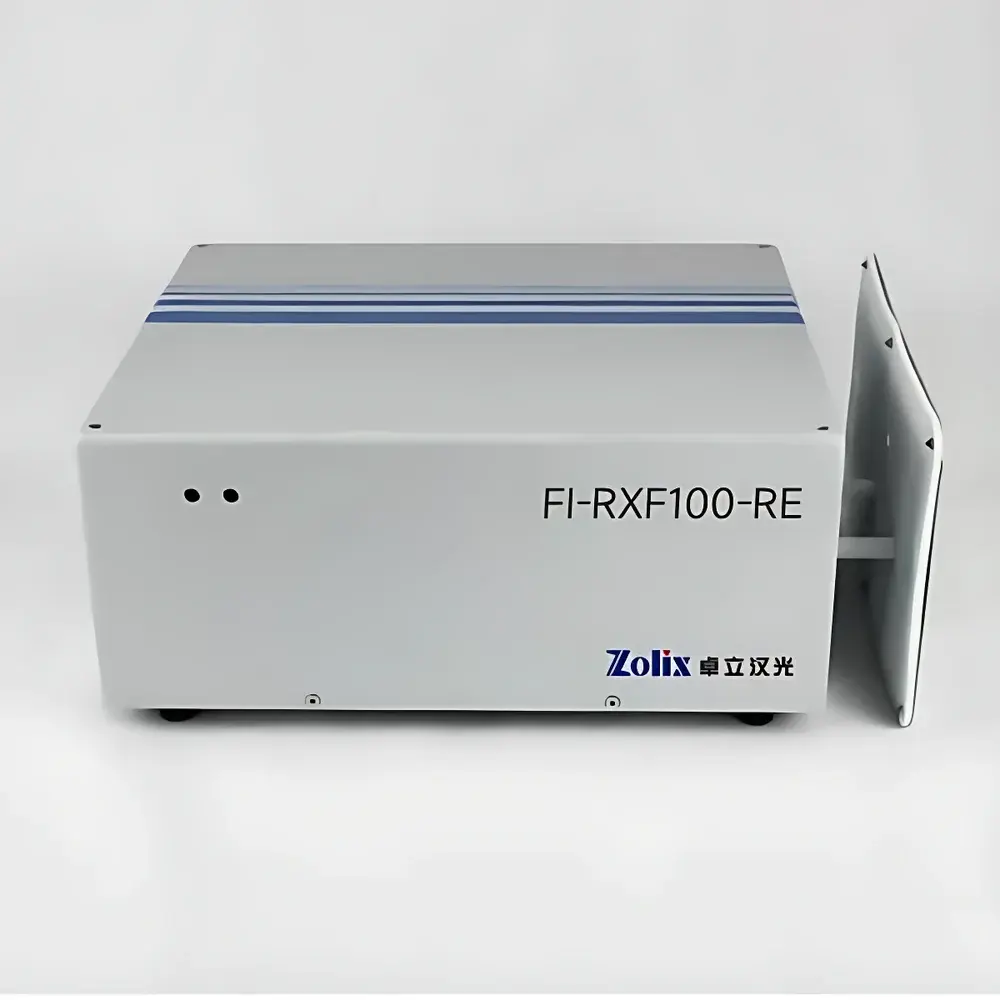
ZOLIX FI-RXF100-RE Fourier Transform Infrared Emission Spectrometer
| Brand | ZOLIX |
|---|---|
| Origin | Beijing, China |
| Manufacturer Type | Original Equipment Manufacturer (OEM) |
| Instrument Type | Laboratory Benchtop FTIR Emission Spectrometer |
| Spectral Range | Standard 500–5000 cm⁻¹ (Optional: 400–7500 cm⁻¹, 400–10000 cm⁻¹, or extended to 12500 cm⁻¹ in NIR) |
| Spectral Resolution | <2 cm⁻¹ (Typical operational resolution: 8 cm⁻¹) |
| Detector Configuration | Dual-detector mounting positions (RT DTGS, liquid-N₂-cooled MCT, or InGaAs) |
| Optical Path | Selectable focused or collimated beam path |
| Beam Splitter | ZnSe substrate (standard) |
| Interferometer | Permanently aligned Michelson interferometer with solid-state laser reference |
| Power Supply | 100–240 VAC, 50–60 Hz, 20 W |
| Dimensions | 44 × 33 × 18 cm (W×D×H, including emission baffle) |
| Weight | 12 kg |
| Operating Environment | 5–40 °C, 0–100% RH |
Overview
The ZOLIX FI-RXF100-RE is a purpose-built, benchtop Fourier Transform Infrared (FTIR) emission spectrometer engineered for quantitative and qualitative analysis of thermal infrared radiation emitted directly from materials under controlled thermal conditions. Unlike conventional transmission, reflection, or ATR-based FTIR techniques, emission spectroscopy operates on the principle of Planck’s blackbody radiation law and Kirchhoff’s law of thermal radiation—enabling non-contact, non-destructive characterization of emissivity, spectral radiance, and temperature-dependent radiative behavior. The instrument integrates a dedicated emission optical platform compatible with calibrated reference blackbodies (e.g., IR-563/301 cavity blackbody, 50–1050 °C, ε > 0.99), high-precision temperature-controlled sample stages, and configurable apertures (8 adjustable iris settings) to optimize signal-to-noise ratio across diverse target geometries and emission intensities. Its permanently aligned Michelson interferometer—stabilized by a solid-state HeNe laser reference (10+ year lifetime)—ensures long-term spectral fidelity and measurement reproducibility essential for comparative emissivity studies and time-resolved thermal emission monitoring.
Key Features
- Optimized emission optics architecture: Dedicated beam path minimizes stray radiation and maximizes radiant flux throughput to the detector.
- Dual-detector mounting station: Enables rapid hardware switching between room-temperature DTGS, liquid-nitrogen-cooled MCT (for mid-IR), and InGaAs (for extended NIR up to 12500 cm⁻¹) without realignment.
- ZnSe-based beam splitter and window assembly: Resistant to ambient humidity; optional KBr or fused silica optics available for specific spectral range or environmental requirements.
- Modular spectral extension capability: Internal optical reconfiguration supports seamless expansion from standard mid-IR (500–5000 cm⁻¹) into far-IR (down to 400 cm⁻¹) or near-IR (up to 12500 cm⁻¹).
- Focused or collimated beam selection: Adapts optical geometry to match sample size, distance, and emission divergence—critical for remote or large-area targets (e.g., building façades, solar thermal absorbers).
- Blackbody-integrated workflow support: Fully compatible with NIST-traceable cavity blackbodies and programmable temperature controllers for absolute emissivity calibration per ASTM E1933 and ISO 18434-1.
Sample Compatibility & Compliance
The FI-RXF100-RE accommodates a broad spectrum of thermally active samples—including opaque ceramics, metallic coatings, polymer films, plasma plumes, combustion flames, biomedical tissues, and architectural materials—without requiring physical contact or spectral preprocessing. It supports both high-temperature (>800 °C) and ambient-temperature emissivity determination: for room-temperature solids, emissivity is derived indirectly via reflectance measurements (using optional integrating sphere or specular reflection accessories) combined with Kirchhoff’s law (ε = 1 − R, assuming negligible transmittance). All emission data acquisition workflows comply with GLP-aligned documentation practices, and spectral processing software includes audit-trail logging, user-access controls, and metadata embedding consistent with FDA 21 CFR Part 11 readiness. Calibration traceability aligns with ISO/IEC 17025 requirements when used with certified blackbody references.
Software & Data Management
The bundled ZOLIX SpectraAnalysis Pro software provides full control over interferometer parameters, detector selection, aperture configuration, and spectral acquisition settings (scans, co-addition, phase correction). Real-time spectral display includes radiance-calibrated y-axis units (W·sr⁻¹·cm⁻²·cm), baseline correction algorithms (Rubberband, Concave Rubberband), and emissivity calculation modules that subtract background radiation contributions—essential for accurate ε(ν,T) derivation in environments with significant ambient thermal load. Export formats include CSV, JCAMP-DX, and HDF5 for interoperability with MATLAB, Python (SciPy, h5py), and third-party chemometric platforms. All raw interferograms and processed spectra are timestamped, user-annotated, and stored with full instrumental metadata (detector type, resolution, apertures, ambient T/RH), enabling full experimental reproducibility and regulatory submission readiness.
Applications
- High-temperature emissivity mapping of ceramic composites and aerospace thermal protection systems (TPS).
- Spectral characterization of industrial heating elements, incandescent sources, and NIR LED emitters (up to 12500 cm⁻¹).
- In-situ monitoring of plasma emission signatures in semiconductor process chambers.
- Building material radiative property validation for energy modeling (ASHRAE 140, ISO 13790).
- Combustion diagnostics: flame temperature profiling and specie identification via CO₂, H₂O, and CO emission bands.
- Medical device verification: thermal emission consistency testing of infrared therapy lamps and photobiomodulation devices.
- Solar selective absorber evaluation: α/ε ratio quantification across 400–10000 cm⁻¹ for concentrated solar power (CSP) applications.
- Textile and coating emissivity screening for thermal camouflage and passive radiative cooling research.
FAQ
Can the FI-RXF100-RE measure emissivity of room-temperature samples?
Yes—via indirect reflectance-based emissivity calculation using optional accessories (integrating sphere or variable-angle reflectance stage), following Kirchhoff’s law and energy conservation principles.
Is the instrument compatible with external temperature controllers or vacuum chambers?
Yes—the emission platform features standardized flange interfaces (CF-35 or KF-40 adaptable) and analog/digital I/O ports for synchronization with external PID controllers, cryostats, or environmental chambers.
What spectral calibration standards are supported?
NIST-traceable polystyrene film (for wavenumber accuracy), certified blackbody sources (e.g., IR-563/301), and atmospheric water vapor/CO₂ absorption features for routine verification.
Does the system support automated temperature-ramped emissivity scans?
Yes—software scripting (Python API included) enables synchronized temperature ramping, dwell-time acquisition, and batch emissivity computation across defined thermal cycles.
How is background radiation handled during low-emissivity or low-temperature measurements?
The software implements configurable background subtraction protocols, including single-point ambient reference capture and dynamic background tracking during extended acquisitions.




