
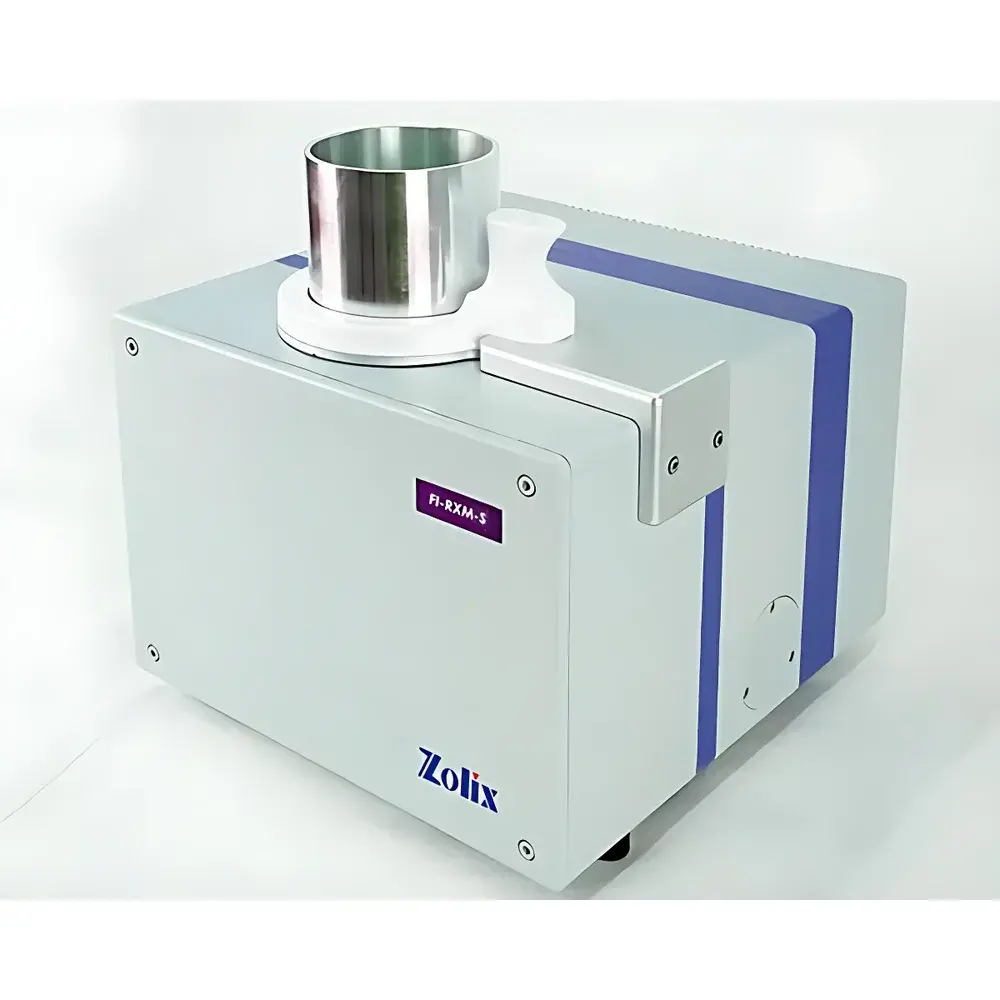
ZOLIX FI-RXM-S Fourier Transform Near-Infrared Spectrometer
| Brand | ZOLIX |
|---|---|
| Origin | Beijing, China |
| Manufacturer Type | Original Equipment Manufacturer (OEM) |
| Product Category | Domestic |
| Model | FI-RXM-S |
| Price | Upon Request |
| Application Scope | General-purpose (Universities & Research Institutions) |
| Spectral Range | 12,500–4,000 cm⁻¹ (800–2500 nm) |
| Spectral Resolution | Better than 2 cm⁻¹ |
| Wavenumber Accuracy | < 0.1 cm⁻¹ |
| Light Source | Tungsten-Halogen Lamp (5-year lifetime) |
| Interferometer | Solid-angle Mirror Interferometer with Permanent Alignment |
| Beam Splitter | Calcium Fluoride (CaF₂) |
| Detector | Thermoelectrically Cooled Indium Gallium Arsenide (InGaAs) |
| Sample Compartment | Sapphire Rotating Cup (Low-OH, High-Transmittance) |
| Laser | Solid-State Laser (10-year lifetime) |
| Integration Sphere | Gold-Coated Internal Integrating Sphere with Auto-Switching Gold Reference Background |
| Environmental Monitoring | Real-time internal temperature and humidity display with automatic humidity alarm |
| Software | Built-in chemometric suite supporting preprocessing, multivariate calibration (PLS, PCR), multi-component simultaneous prediction, and model transfer |
Overview
The ZOLIX FI-RXM-S Fourier Transform Near-Infrared (FT-NIR) Spectrometer is a benchtop analytical instrument engineered for high-fidelity, non-destructive compositional analysis of solid and semi-solid materials across academic, agricultural, food science, and textile research laboratories. Based on Michelson interferometry with a solid-angle mirror design, the system delivers stable optical alignment over extended operation cycles—eliminating routine realignment requirements common in traditional moving-mirror interferometers. Its full NIR spectral coverage (800–2500 nm / 12,500–4,000 cm⁻¹) enables broad-band molecular overtone and combination band detection, particularly sensitive to C–H, N–H, and O–H vibrational modes. The integrated gold-coated integrating sphere ensures uniform illumination and collection geometry for diffuse reflectance measurements, mitigating particle-size and surface-texture effects that compromise spectral reproducibility in heterogeneous solids such as feed grains, dairy powders, or blended textiles.
Key Features
- Permanently aligned solid-angle mirror interferometer—designed for long-term mechanical and thermal stability without periodic recalibration
- Gold-coated integrating sphere with automated background reference switching—optimized for robust diffuse reflectance quantification across diverse sample morphologies
- Thermoelectrically cooled InGaAs detector—provides low-noise signal acquisition with enhanced signal-to-noise ratio (SNR) across the entire spectral range
- CaF₂ beam splitter—selected for high transmittance and minimal water vapor absorption interference in the critical 1400–1900 nm region
- Sapphire rotating sample cup—chemically inert, low-hydroxyl, and UV-NIR transparent; minimizes spectral artifacts from container absorption or scattering
- Real-time environmental monitoring—onboard sensors continuously log internal temperature and relative humidity, triggering audible/visual alerts when humidity exceeds user-defined thresholds (e.g., >60% RH) to protect optics and detector integrity
- Dual-laser referencing system—solid-state laser (10-year lifetime) ensures precise wavenumber calibration traceable to NIST-traceable standards
Sample Compatibility & Compliance
The FI-RXM-S accommodates a wide array of solid and semi-solid matrices through interchangeable sampling accessories: an automated rotating stage with large-diameter sample cup (for corn, soybeans, or granular feeds), Petri-dish adapter (for yogurts, pastes, or gels), small-volume cup (for pharmaceutical powders or herbal extracts), and trans-reflectance stage (for viscous transparent media such as silicone oils or crude glycerin). All configurations maintain consistent optical path geometry and minimize operator-induced variability. The instrument meets general laboratory safety and electromagnetic compatibility (EMC) requirements per IEC 61326-1. While not pre-certified for GMP or FDA 21 CFR Part 11 environments, its software architecture supports audit trail logging, user access control, and electronic signature readiness—enabling customization for GLP-compliant workflows upon request.
Software & Data Management
The proprietary ZOLIX NIR Analysis Suite provides a modular, scriptable platform for method development and routine analysis. It includes standardized preprocessing routines (Savitzky-Golay smoothing, multiplicative scatter correction, standard normal variate, first/second derivative), PLS and PCR regression engines, and cross-validation protocols compliant with ASTM E1655 and ISO 12099. Calibration models may be built for single or multiple analytes simultaneously (e.g., protein + fat + moisture in milk powder), with residual error reporting aligned to AOAC guidelines. Spectral libraries are stored in HDF5 format for metadata-rich archiving; raw interferograms and processed spectra are exportable in JCAMP-DX and CSV formats. Remote monitoring and batch processing are supported via TCP/IP interface for integration into LIMS environments.
Applications
The FI-RXM-S serves as a primary screening tool in quality assurance and fundamental research settings. In animal nutrition labs, it quantifies crude protein, lysine, fiber, and ash content in feedstuffs without solvent extraction. In dairy R&D, it delivers rapid, reagent-free measurement of casein, lactose, and somatic cell count proxies in raw milk and whey concentrates. Food chemistry applications include moisture mapping in baked goods, fatty acid profile estimation in edible oils, and authenticity verification of botanical extracts. In textile analytics, it discriminates cotton, linen, spandex, and nylon blends based on cellulose vs. polyamide spectral signatures—supporting compliance with ISO 2076 and AATCC Test Method 20A.
FAQ
What sample preparation is required for solid feed analysis?
Minimal preparation: grinding to ≤1 mm particle size and homogenization are recommended; no chemical derivatization or solvent extraction is needed.
Can the instrument be validated for regulatory submissions?
Yes—the system supports IQ/OQ documentation packages and can be configured with 21 CFR Part 11-compliant software modules including electronic signatures, role-based access, and immutable audit trails.
Is spectral data compatible with third-party chemometric tools like Unscrambler or MATLAB?
Yes—raw and processed spectra export in JCAMP-DX, ASCII, and HDF5 formats; calibration models may be exported as PMML for external deployment.
How often does the interferometer require maintenance?
The solid-angle mirror design eliminates dynamic alignment drift; no routine optical recalibration is specified—only annual verification using NIST-traceable polystyrene film is recommended.
What is the typical measurement repeatability for protein quantification in wheat flour?
Under controlled humidity (<50% RH) and standardized cup rotation, RSD for protein prediction is ≤0.35% (w/w) across ten replicate scans of homogenized samples.
Related Products




