
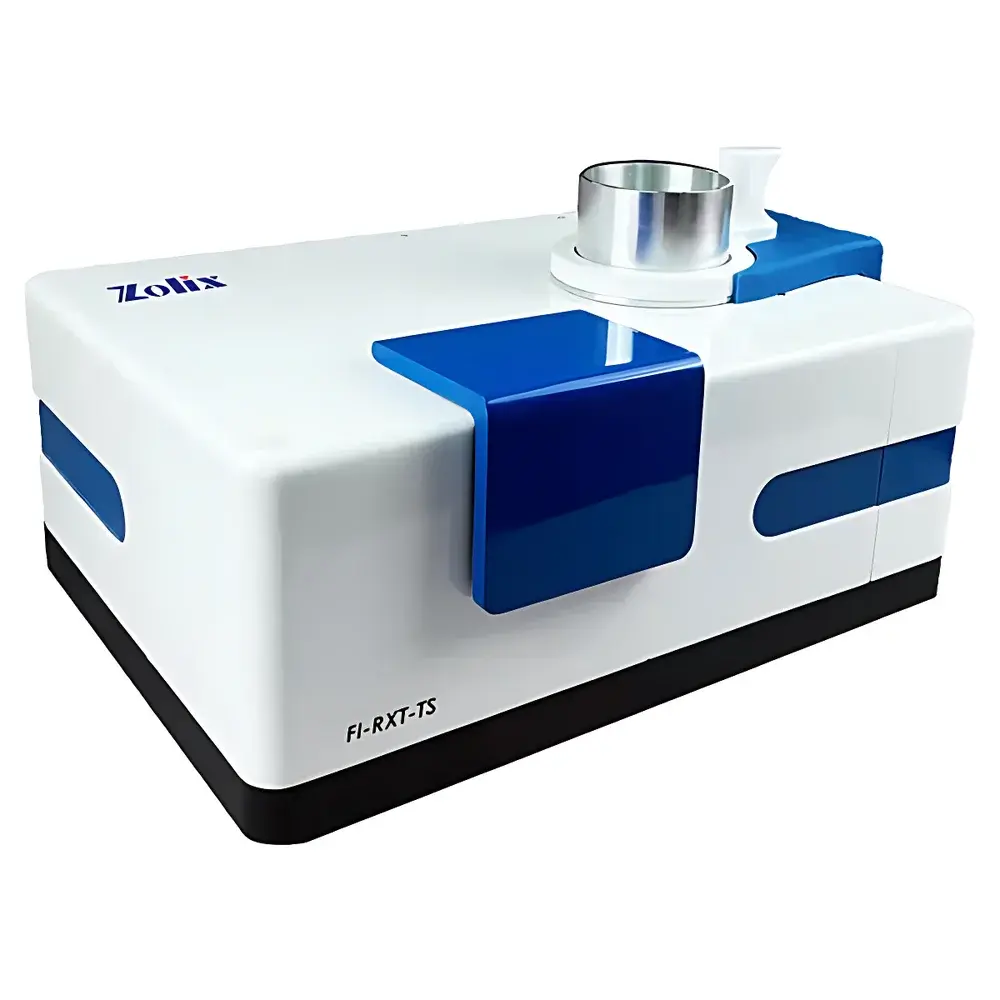
ZOLIX FI-RXT-TS Fourier Transform Near-Infrared Spectrometer
| Brand | ZOLIX |
|---|---|
| Model | FI-RXT-TS |
| Origin | Beijing, China |
| Manufacturer | ZOLIX (OEM Producer) |
| Instrument Type | Laboratory FT-NIR Spectrometer |
| Optical Principle | Fourier Transform Interferometry |
| Spectral Range | 12,500–4,000 cm⁻¹ (800–2500 nm) |
| Spectral Resolution | <2 cm⁻¹ |
| Wavelength Accuracy | <0.1 cm⁻¹ |
| Light Source | Tungsten-Halogen Lamp (5-year lifetime) |
| Interferometer | Cube-Corner Retroreflector-Based, Self-Aligning Design |
| Beam Splitter | CaF₂ |
| Detector | Thermoelectrically Cooled InGaAs |
| Laser | Solid-State Reference Laser (10-year lifetime) |
Overview
The ZOLIX FI-RXT-TS Fourier Transform Near-Infrared Spectrometer is a dual-path, laboratory-grade analytical instrument engineered for high-fidelity spectral acquisition across the full near-infrared region (800–2500 nm, or 12,500–4,000 cm⁻¹). Built upon a robust Michelson-type interferometer architecture with cube-corner retroreflectors, it delivers intrinsic optical stability and long-term alignment integrity—critical for quantitative routine analysis in regulated environments. Unlike dispersive NIR systems, the FI-RXT-TS leverages multiplex (Fellgett) and throughput (Jacquinot) advantages inherent to FT-NIR methodology, enabling simultaneous detection of all wavelengths with superior signal-to-noise ratio and measurement reproducibility. Its dual-channel optical design shares a single interferometer and detector assembly, dynamically routing light via motorized optics to either a transmission path (for liquids) or a reflection path (for solids), eliminating inter-channel calibration drift and ensuring cross-modal comparability.
Key Features
- Dual-mode optical architecture: Integrated transmission and diffuse reflectance channels sharing one interferometer core and InGaAs detector—ensuring spectral consistency between liquid and solid measurements.
- Transmission module: Equipped with thermostatically controlled sample chamber (±0.1 °C stability), compatible with standard cuvettes (1–5 mm pathlength) and vials (6 mm/8 mm OD); supports temperature-dependent reaction monitoring and viscosity-correlated spectral studies.
- Reflection module: Features a precision-engineered integrating sphere with internal gold-coated walls and auto-switching reference background—optimized for low-scatter, high-albedo solid samples including powders, granules, and textured surfaces.
- High-stability interferometer: Monolithic cube-corner retroreflector design with passive thermal compensation; no moving mirrors—eliminates mechanical hysteresis and enables >10,000 consecutive scans without recalibration.
- CaF₂ beam splitter and solid-state HeNe laser: Deliver broadband transmittance and sub-pixel wavelength referencing accuracy (<0.1 cm⁻¹), essential for multivariate calibration transfer across instruments and labs.
- Thermoelectrically cooled InGaAs detector: Operates at –10 °C with <30 e⁻ read noise, supporting rapid acquisition (≤1 s per spectrum) and extended dynamic range (up to 4 OD).
Sample Compatibility & Compliance
The FI-RXT-TS accommodates diverse physical forms without hardware reconfiguration: transparent liquids (e.g., solvents, pharmaceutical intermediates), semi-solids (yogurts, pastes), and heterogeneous solids (grains, tablets, textiles). Optional accessories—including automated rotating sample stages, large-volume cups (for corn/wheat), Petri dish holders (for viscous matrices), and micro-cups (for herbal powders or sucrose)—extend method flexibility while maintaining optical coupling fidelity. The system complies with foundational spectroscopic standards including ASTM E1655 (standard practices for NIR quantitative analysis), ISO 12099 (cereals and animal feeding stuffs), and USP (Near-Infrared Spectroscopy). Its hardware architecture and software audit trail functionality support alignment with GLP/GMP documentation requirements and FDA 21 CFR Part 11 electronic record controls when deployed with validated S-Cal/S-Seq workflows.
Software & Data Management
Two dedicated application suites drive operational efficiency and method development: S-Cal (calibration builder) and S-Seq (sequence-driven acquisition). S-Cal implements automated preprocessing (SNV, MSC, derivatives), PLS regression model optimization with cross-validation, outlier detection, and robustness testing against instrument drift or ambient humidity shifts. It generates IQ/OQ-ready reports compliant with ICH Q2(R2) validation guidelines. S-Seq enables unattended batch analysis—supporting user-defined sequences for multi-sample racks, real-time prediction overlays, and automatic flagging of out-of-spec results. All spectral data are stored in vendor-neutral .jdx format; raw interferograms and processed spectra retain full metadata (temperature, pathlength, integration time, laser lock status) for traceable reprocessing.
Applications
The FI-RXT-TS serves as a primary quantitative tool across process analytical technology (PAT) and QC laboratories. In petrochemical settings, it determines octane number, olefin/aromatic content, and distillation endpoints in gasoline blending streams. For polyurethane manufacturing, it quantifies NCO % and viscosity-related spectral markers in prepolymers. In pharmaceutical production, it monitors active pharmaceutical ingredient (API) concentration and residual solvent levels during lyophilization or extraction. Food and feed applications include moisture, protein, fat, and fatty acid profile analysis in dairy, oilseeds, and cereal matrices. Textile QA utilizes its diffuse reflectance mode to quantify natural vs. synthetic fiber blends (e.g., cotton/polyamide ratios) without destructive sampling.
FAQ
What spectral resolution is achievable with the FI-RXT-TS, and how is it maintained over time?
The instrument achieves nominal resolution ≤2 cm⁻¹, verified using polystyrene film standards per ASTM E1421. Resolution stability is ensured by the monolithic interferometer design and active laser wavelength referencing—no periodic mirror realignment is required.
Can calibration models developed on other FT-NIR instruments be transferred to the FI-RXT-TS?
Yes—via spectral standardization using CaF₂-based reference scans and S-Cal’s built-in transfer learning module, which corrects for detector response differences and minor optical path variations.
Is the temperature-controlled transmission cell compatible with aggressive solvents such as THF or DMF?
The chamber uses chemically inert PTFE-sealed quartz cuvette holders; compatibility with halogenated or polar aprotic solvents is confirmed for continuous operation up to 60 °C.
How does the system handle particulate scattering in heterogeneous solid samples?
The gold-coated integrating sphere provides uniform Lambertian illumination and collection geometry; combined with S-Cal’s scatter correction algorithms (e.g., extended multiplicative scatter correction), it minimizes particle-size-induced baseline distortion.
What data security and audit trail capabilities are embedded in the software suite?
S-Seq logs all user actions (login/logout, method edits, result approvals) with timestamps and operator IDs; S-Cal exports calibration history with versioned spectra and parameter sets—fully compliant with 21 CFR Part 11 electronic signature requirements.





