
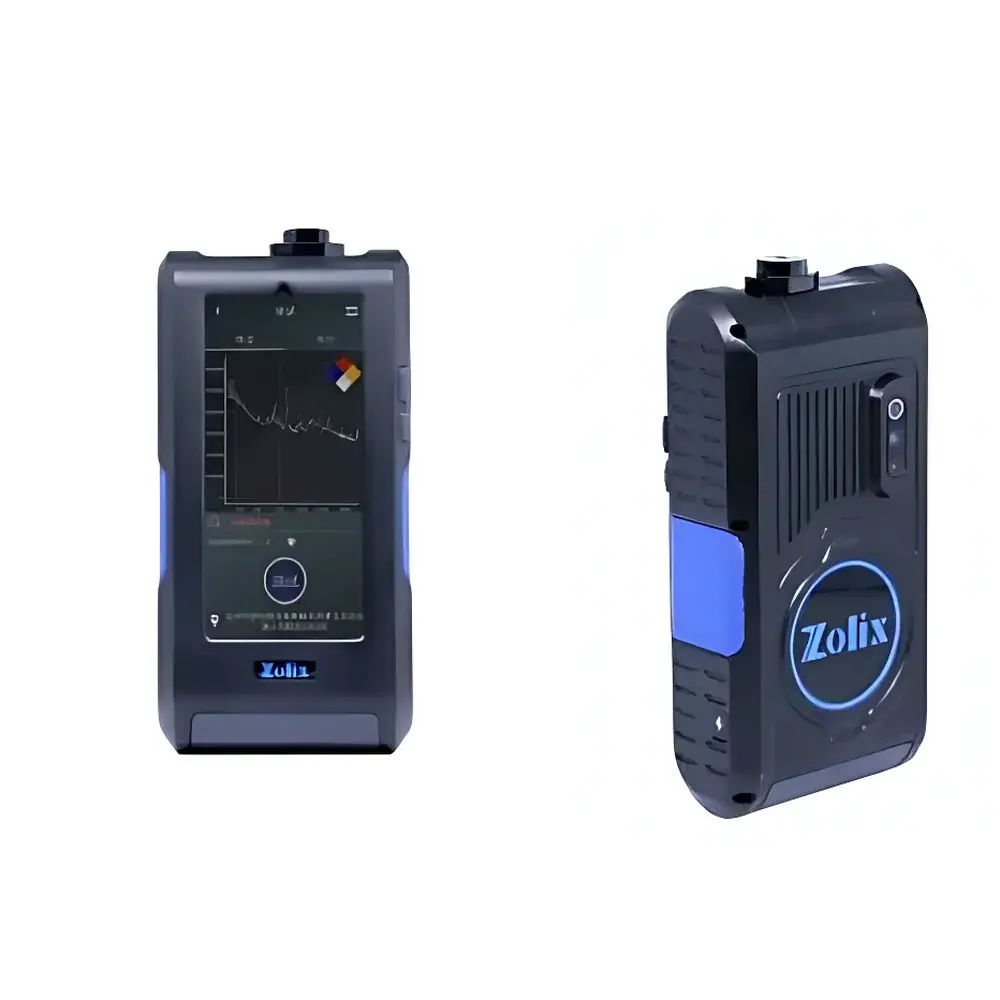
ZOLIX Finder Edge 1064 nm Handheld Raman Spectrometer
| Brand | ZOLIX |
|---|---|
| Origin | Beijing, China |
| Manufacturer Type | Original Equipment Manufacturer (OEM) |
| Product Category | Domestic |
| Model | Finder Edge 1064 nm |
| Instrument Type | Handheld Raman Spectrometer |
| Spectral Range | 200–2500 cm⁻¹ |
| Spectral Resolution | <14 cm⁻¹ @ 1262.339 nm |
| Detector | Cooled InGaAs array |
| Excitation Wavelength | 1064 nm (NIR) |
| Spatial Resolution | Not specified in datasheet |
| Minimum Detectable Wavenumber | Not specified in datasheet |
| Spectral Reproducibility | Not specified in datasheet |
Overview
The ZOLIX Finder Edge 1064 nm Handheld Raman Spectrometer is a purpose-engineered portable analytical instrument designed for rapid, non-destructive molecular identification of solid, liquid, and powdered samples in field-deployable environments. Operating at the near-infrared (NIR) excitation wavelength of 1064 nm, this spectrometer leverages the fundamental principles of inelastic light scattering—Raman spectroscopy—to generate vibrational fingerprint spectra with high chemical specificity. Unlike visible- or NIR-785 nm–based handheld systems, the 1064 nm configuration significantly suppresses fluorescence background—a dominant source of spectral interference in organic dyes, biological tissues, pharmaceuticals, and illicit substances—thereby enabling reliable detection where conventional Raman systems fail. The instrument integrates a thermoelectrically cooled InGaAs linear array detector to maximize signal-to-noise ratio (SNR) and quantum efficiency in the 900–1700 nm detection window, supporting robust performance under variable ambient conditions.
Key Features
- 1064 nm diode laser excitation optimized for fluorescence suppression across diverse sample matrices including pigments, polymers, botanical extracts, and forensic trace evidence
- Compact, ergonomic handheld form factor (< 1.8 kg) with integrated touchscreen interface and battery-powered operation (≥4 hours continuous use)
- Cooled InGaAs detector delivering enhanced sensitivity for low-concentration analytes and weak Raman scatterers
- On-device spectral library matching with multi-level user authentication (administrator, operator, viewer) to enforce data integrity and prevent unauthorized access or modification
- Integrated GPS module and high-resolution camera for geotagged spectral acquisition and evidentiary documentation compliant with chain-of-custody protocols
- Cloud-ready architecture supporting secure TLS-encrypted data upload to centralized analytics platforms for statistical modeling, trend analysis, and regulatory reporting
Sample Compatibility & Compliance
The Finder Edge 1064 nm accommodates heterogeneous sample geometries without requiring extensive preparation: bulk solids, powders, tablets, gels, liquids in sealed vials, and even coated surfaces. Its NIR excitation minimizes photodegradation risk for light-sensitive compounds. From a regulatory standpoint, spectral acquisition workflows align with GLP-compliant documentation practices; metadata logging (time stamp, GPS coordinates, operator ID, instrument calibration status) satisfies traceability requirements under ISO/IEC 17025 and supports audit readiness for law enforcement and pharmaceutical quality control applications. While not FDA 21 CFR Part 11–certified out-of-the-box, the system’s audit trail functionality—including immutable spectral file hashing and role-based access logs—provides a foundational framework for validation in GxP environments.
Software & Data Management
The embedded firmware runs ZOLIX SpectraView™ Lite—a lightweight, real-time spectral processing engine supporting baseline correction, cosmic ray removal, peak detection, and Euclidean distance–based library search against customizable spectral databases (e.g., NIST, SDBS, proprietary forensic libraries). All raw and processed spectra are stored in standardized JCAMP-DX format with embedded metadata. Cloud synchronization enables remote database updates, collaborative spectral annotation, and AI-assisted classification via optional server-side machine learning modules trained on validated reference sets. Data export options include CSV, PNG, and PDF reports with configurable templates suitable for laboratory notebooks or regulatory submissions.
Applications
- Forensic science: Identification of narcotics, explosives precursors, and counterfeit pharmaceuticals directly in customs checkpoints or crime scenes
- Pharmaceutical QA/QC: Verification of active pharmaceutical ingredients (APIs) and excipients in final dosage forms without dissolution or extraction
- Materials science: Rapid screening of carbon allotropes (graphene, CNTs), catalysts, and battery electrode materials
- Environmental monitoring: Detection of hydrocarbon contaminants in soil or water samples with minimal sample handling
- Food safety: Authentication of edible oils, detection of adulterants (e.g., Sudan dyes), and verification of geographical origin markers
- Art conservation: Non-invasive pigment analysis on historical manuscripts and painted surfaces
FAQ
What is the primary advantage of 1064 nm excitation over 785 nm in handheld Raman systems?
The 1064 nm wavelength reduces fluorescence emission by approximately two orders of magnitude compared to 785 nm for many organic chromophores, resulting in cleaner spectra with higher signal fidelity for fluorescent-prone samples.
Does the Finder Edge 1064 nm support quantitative analysis?
While primarily optimized for qualitative identification, semi-quantitative assessment is feasible using internal standard normalization or multivariate calibration models developed with reference standards.
Is spectral calibration traceable to NIST standards?
Yes—the instrument includes factory-applied wavelength and intensity calibration verified against NIST-traceable Raman standards (e.g., silicon, cyclohexane), with user-accessible recalibration routines.
Can the device operate in direct sunlight or high-temperature outdoor environments?
Designed for field use, it features an anti-reflective optical housing and thermal management that maintains detector stability up to 40 °C ambient temperature; however, prolonged exposure to direct solar irradiance on the sampling window is discouraged.
How is data security implemented for sensitive field-collected spectra?
All stored and transmitted data are encrypted using AES-256; user roles enforce read/write/delete permissions; and local storage uses hardware-locked eMMC with secure erase capability.




