
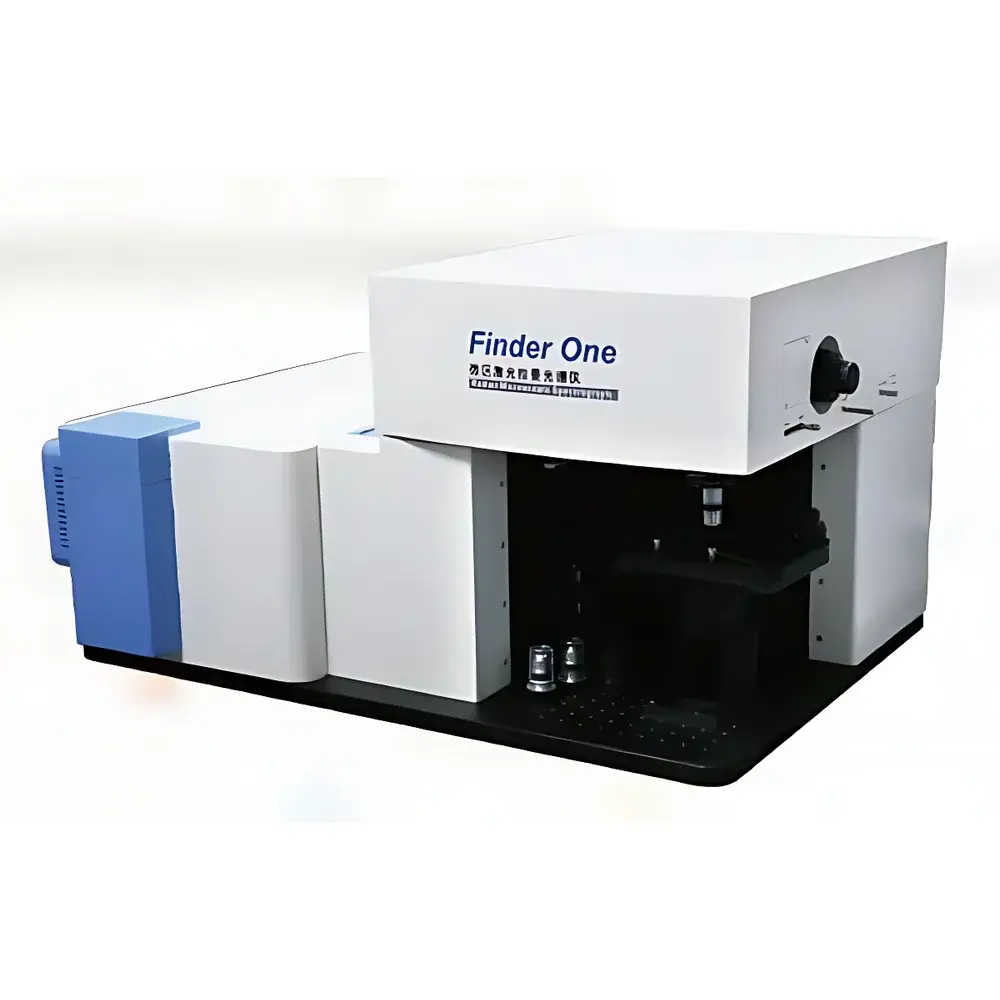
ZOLIX Finder One Micro-Raman Spectrometer
| Brand | ZOLIX |
|---|---|
| Origin | Beijing, China |
| Manufacturer Type | Original Equipment Manufacturer (OEM) |
| Product Category | Domestic |
| Model | Finder One |
| Instrument Type | Confocal Micro-Raman Spectrometer |
| Spectral Range | 100–5,000 cm⁻¹ |
| Spectral Resolution | <3 cm⁻¹ |
| Spatial Resolution | 1 µm |
| Minimum Wavenumber | 100 cm⁻¹ |
| Spectral Reproducibility | ≤ ±0.15 cm⁻¹ |
Overview
The ZOLIX Finder One Micro-Raman Spectrometer is a confocal micro-Raman system engineered for high-sensitivity, spatially resolved vibrational spectroscopy at the micrometer scale. Based on spontaneous Raman scattering induced by monochromatic laser excitation, the instrument combines an optimized inverted microscope optical path with a high-throughput, aberration-corrected Czerny–Turner spectrograph and a thermoelectrically cooled back-illuminated CCD detector. Its integrated mechanical architecture minimizes optical path drift and thermal instability, ensuring long-term spectral fidelity and measurement repeatability. Designed for rigorous academic and industrial research environments, the Finder One delivers quantitative Raman spectra with sub-micron spatial localization—enabling non-destructive, label-free chemical identification and structural characterization of heterogeneous samples without vacuum or conductive coating requirements.
Key Features
- Confocal optical design with diffraction-limited spatial resolution of 1 µm (at 532 nm excitation), enabling precise micro-domain analysis and depth profiling.
- Wide spectral coverage from 100 cm⁻¹ to 5,000 cm⁻¹, supporting both high-wavenumber functional group analysis and low-wavenumber lattice mode detection (e.g., phonons in 2D materials).
- Spectral resolution better than 3 cm⁻¹ (typical value ≤2 cm⁻¹ at 585.25 nm), calibrated using neon emission lines and traceable to NIST standards.
- Automated exposure control with real-time signal-to-noise optimization, reducing operator dependency and improving acquisition consistency across diverse sample types.
- Real-time fluorescence background subtraction via polynomial fitting and iterative baseline correction algorithms, preserving weak Raman bands beneath strong autofluorescence.
- Modular laser platform: standard 532 nm TEM₀₀ laser (≥50 mW); optional wavelengths include 325 nm (UV resonance enhancement), 633 nm (reduced fluorescence in organics), and 785 nm (deep-penetration for biological tissues).
- TE-cooled back-illuminated CCD detector with >90% peak quantum efficiency, 1000 × 100 effective pixels, and active area >24 × 1.4 mm²—optimized for low-light Raman signal capture.
Sample Compatibility & Compliance
The Finder One accommodates solid, powder, thin-film, liquid, and biological specimens—including unstained cells, geological sections, polymer blends, and nanomaterials—without destructive preparation. Its open-stage configuration supports custom sample holders, cryo-stages, heating stages, and electrochemical cells for in situ and operando measurements. The system complies with ISO/IEC 17025:2017 general requirements for competence of testing and calibration laboratories. Spectral data integrity adheres to GLP principles, with full audit trail support in optional software modules compliant with FDA 21 CFR Part 11 for regulated environments (e.g., pharmaceutical polymorph screening). All optical components meet RoHS directives; laser safety conforms to IEC 60825-1 Class 3B requirements.
Software & Data Management
Controlled via ZOLIX’s proprietary RamanStudio software (Windows 10/11 compatible), the system provides intuitive hardware synchronization, multi-point mapping, spectral library matching (including commercial databases such as RRUFF and ICDD), and batch processing pipelines. Raw spectra are stored in standardized JCAMP-DX format (.dx) with embedded metadata (laser wavelength, grating, exposure time, objective magnification, stage coordinates). Advanced analysis tools include peak deconvolution (Voigt/Gaussian fitting), stress/strain quantification (via band shift calibration), crystallinity index calculation, and multivariate statistical analysis (PCA, cluster mapping). Software architecture supports API integration for LIMS and ELN systems, and export to MATLAB, Python (via .csv/.h5), and OriginLab formats.
Applications
- Materials science: Characterization of carbon allotropes (graphene, CNTs, diamond), perovskite phase transitions, and strain distribution in semiconductor heterostructures.
- Life sciences: Label-free cellular component mapping (lipids, proteins, nucleic acids), tissue histopathology, and drug–cell interaction studies.
- Geosciences & archaeology: Mineral phase identification in thin sections, pigment analysis in historical artifacts, and fluid inclusion characterization.
- Forensics: Non-invasive identification of illicit substances, explosives residues, and counterfeit pharmaceuticals on trace evidence.
- Polymers & composites: Crystallinity assessment, filler dispersion homogeneity, and interfacial adhesion analysis in multi-phase systems.
- Quality control: In-line verification of raw material identity and batch consistency in GMP-compliant manufacturing workflows.
FAQ
What laser wavelengths are supported, and how do they affect measurement performance?
The system ships with a 532 nm laser as standard. Optional 325 nm enhances resonance Raman signals in conjugated systems; 633 nm reduces fluorescence in aromatic compounds; 785 nm enables deeper penetration in turbid or highly fluorescent samples. Spectral range and sensitivity vary per configuration—consult technical specifications for grating and detector optimization.
Is the Finder One suitable for quantitative analysis?
Yes—when coupled with internal standard calibration (e.g., silicon reference peak at 520.7 cm⁻¹) and controlled experimental conditions (temperature, laser power, focus stability), the system achieves wavenumber reproducibility ≤±0.15 cm⁻¹ and intensity linearity over three orders of magnitude.
Can the system be integrated with other analytical platforms?
Absolutely. Standard RS-232, USB 3.0, and Ethernet interfaces support synchronization with SEM-EDS, AFM, and thermal analysis systems. OEM SDKs enable third-party software control for hybrid correlative microscopy workflows.
What maintenance is required to ensure long-term spectral accuracy?
Annual wavelength calibration using certified neon or argon lamp sources is recommended. Routine cleaning of objective lenses and spectrometer entrance slit, plus periodic verification of laser alignment and CCD dark current, ensures sustained performance per ISO 17025 guidelines.







