
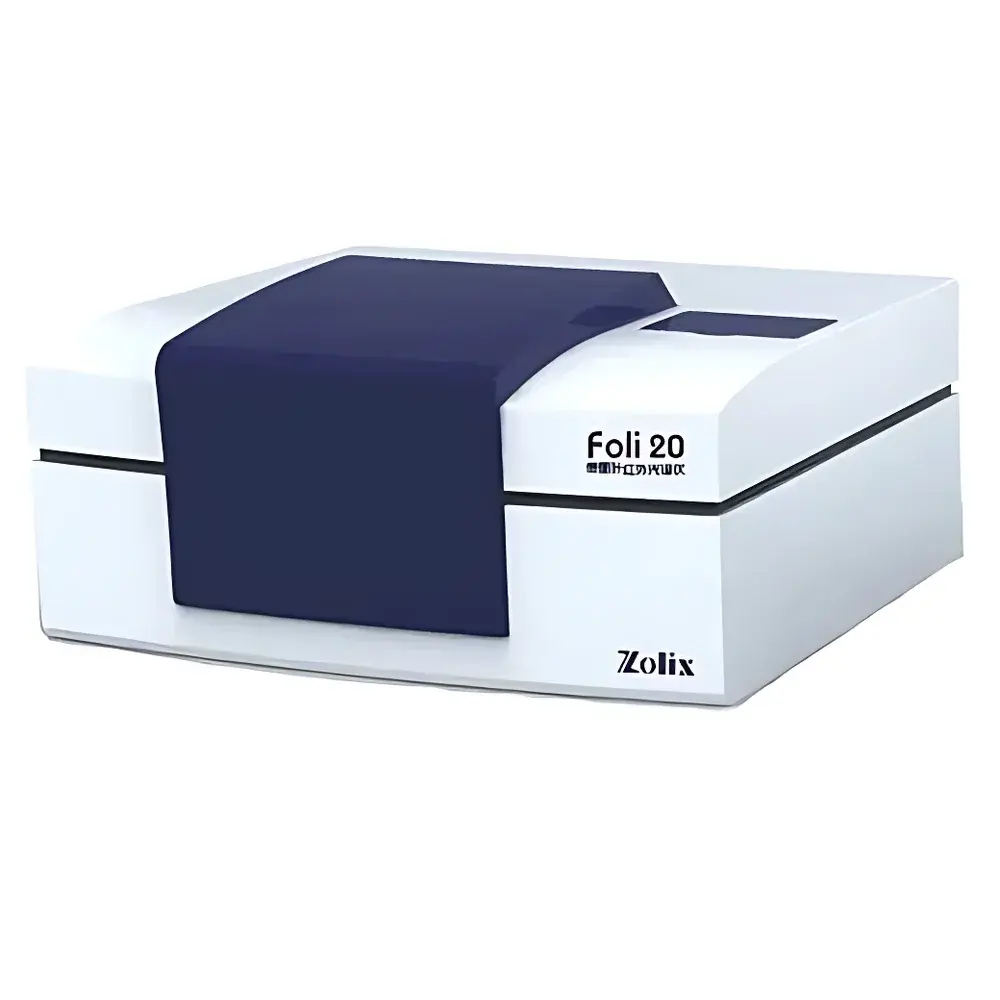
ZOLIX FOLI 20-Z Fourier Transform Infrared (FTIR) Spectrometer
| Brand | ZOLIX |
|---|---|
| Origin | Beijing, China |
| Manufacturer Type | Original Equipment Manufacturer (OEM) |
| Instrument Type | Laboratory FTIR Spectrometer |
| Spectral Range | 5000–500 cm⁻¹ (FOLI 20-Z) / 7500–400 cm⁻¹ (FOLI 20-ZE) |
| Resolution | ≤2 cm⁻¹ |
| Wavenumber Accuracy | ≤0.01 cm⁻¹ |
| Signal-to-Noise Ratio (S/N) | ≥40,000:1 (at 4 cm⁻¹, 1 min scan) |
| Transmittance Accuracy | ≤0.1% τ |
| Beam Splitter | ZnSe (standard) or KBr (FOLI 20-ZE models) |
| Detector | Standard DLaTGS |
| Laser | Solid-state He–Ne reference laser |
| Dimensions | 550 × 450 × 230 mm |
| Weight | 20 kg |
Overview
The ZOLIX FOLI 20-Z is a benchtop Fourier Transform Infrared (FTIR) spectrometer engineered for high-fidelity molecular fingerprinting across research, quality control, and regulatory-compliant laboratories. Based on Michelson interferometry with a monolithic corner-cube interferometer, the system acquires full mid-infrared spectra by measuring the interference pattern (interferogram) generated from broadband infrared radiation modulated through a moving mirror assembly. The resulting time-domain signal is digitized and converted to frequency-domain spectra via Fast Fourier Transform (FFT) algorithms. Designed for operational robustness in variable ambient conditions, the FOLI 20-Z integrates a sealed, dust- and moisture-resistant optical enclosure with thermally stabilized optics—ensuring long-term baseline stability and minimal drift during extended acquisition sequences. Its compact footprint and modular architecture support both routine analysis and method development in academic, pharmaceutical, polymer, forensic, and materials science settings.
Key Features
- Monolithic corner-cube interferometer with precision air-bearing translation stage, delivering high mechanical reproducibility and immunity to vibration-induced phase errors.
- Gold-coated mirrors throughout the optical path, optimized for >98% reflectivity across 12,500–400 cm⁻¹, combined with oxidation resistance for sustained spectral fidelity over years of operation.
- Dual-beam configuration with internal solid-state He–Ne laser (632.8 nm) for real-time path-length calibration, enabling wavenumber accuracy better than ±0.01 cm⁻¹ (ASTM E1421).
- Large-volume sample compartment (≥12 L) accommodating standard and custom accessories—including PIKE TECHNOLOGY™ ATR, specular reflection, diffuse reflectance, and variable-angle accessories—without optical realignment.
- Modular detector interface supporting interchangeable DLaTGS (room-temperature, broad dynamic range) and liquid-nitrogen-cooled MCT (high sensitivity, fast response) detectors, selectable per application requirements.
- ZnSe or KBr beam splitters pre-aligned and factory-calibrated; ZnSe for general-purpose use (5000–500 cm⁻¹), KBr for extended near-IR coverage (7500–400 cm⁻¹) in FOLI 20-ZE variants.
Sample Compatibility & Compliance
The FOLI 20-Z supports non-destructive, label-free chemical identification and quantification of solids (powders, films, tablets), liquids (solutions, oils), pastes, and gases (with optional gas cell). Its compatibility with PIKE TECHNOLOGY™ accessories enables standardized measurement geometries aligned with ASTM E1252 (ATR), ASTM E1421 (specular reflectance), and ISO 18380 (diffuse reflectance). The instrument’s optical design conforms to ISO 17025 traceability requirements when used with NIST-traceable polystyrene film standards. Data acquisition and processing workflows comply with GLP and GMP documentation practices, supporting audit trails, user access controls, and electronic signatures when integrated with validated laboratory software platforms.
Software & Data Management
Controlled via ZOLIX SpectraPro™ v3.x (Windows-based), the system provides intuitive instrument setup, real-time interferogram monitoring, spectral preprocessing (zero-filling, apodization, phase correction), and quantitative analysis (peak integration, baseline correction, multivariate regression). Raw interferograms and processed spectra are saved in open-format .SPA files compatible with OMNIC™, GRAMS/AI™, and MATLAB®. The software includes built-in spectral libraries (e.g., SDBS, NIST, polymer databases) and supports custom library creation with spectral matching (correlation coefficient, Euclidean distance). All data operations—scan averaging, background subtraction, ratioing—are timestamped and logged with operator ID, instrument parameters, and environmental metadata for full traceability under FDA 21 CFR Part 11 guidelines.
Applications
- Pharmaceutical QC: Polymorph screening, excipient compatibility testing, and counterfeit drug detection per USP and ICH Q5A.
- Materials Science: Crosslink density analysis in elastomers, crystallinity assessment in polyolefins, and degradation kinetics in UV-exposed polymers.
- Forensic Chemistry: Identification of illicit substances, paint chip layering, and fiber composition without sample destruction.
- Academic Research: Reaction monitoring in situ (via flow cells), thin-film thickness determination (using interference fringes), and surface functional group mapping (with ATR imaging adapters).
- Environmental Analysis: Microplastic identification in water filtrates and soil extracts using automated spectral search against curated environmental libraries.
FAQ
What spectral resolution options are available on the FOLI 20-Z?
The instrument delivers nominal resolution down to ≤2 cm⁻¹ (user-selectable from 0.5 cm⁻¹ to 16 cm⁻¹), with optimal performance at 4 cm⁻¹ for routine analysis and 0.5 cm⁻¹ for high-resolution gas-phase studies.
Can the FOLI 20-Z be used for quantitative analysis under regulated environments?
Yes—when operated with validated methods, calibrated standards, and SpectraPro™’s audit-trail-enabled workflow, it meets data integrity requirements for ISO/IEC 17025-accredited labs and supports 21 CFR Part 11 compliance through third-party validation packages.
Is the MCT detector permanently installed or field-swappable?
The MCT detector is housed in a vacuum-sealed Dewar and is user-replaceable without optical realignment; however, cryogen refills require trained service personnel and follow manufacturer-specified cooldown protocols.
Does the system support external triggering for time-resolved measurements?
Yes—the rear-panel TTL I/O port enables synchronization with external events (e.g., reaction initiation, pump pulses) for step-scan or rapid-scan kinetic experiments.
Are PIKE TECHNOLOGY™ accessories fully interoperable without firmware modification?
All listed PIKE accessories (F20ACC- series) mount mechanically and optically align natively; no firmware update is required—only appropriate accessory-specific measurement templates must be loaded in SpectraPro™.




