
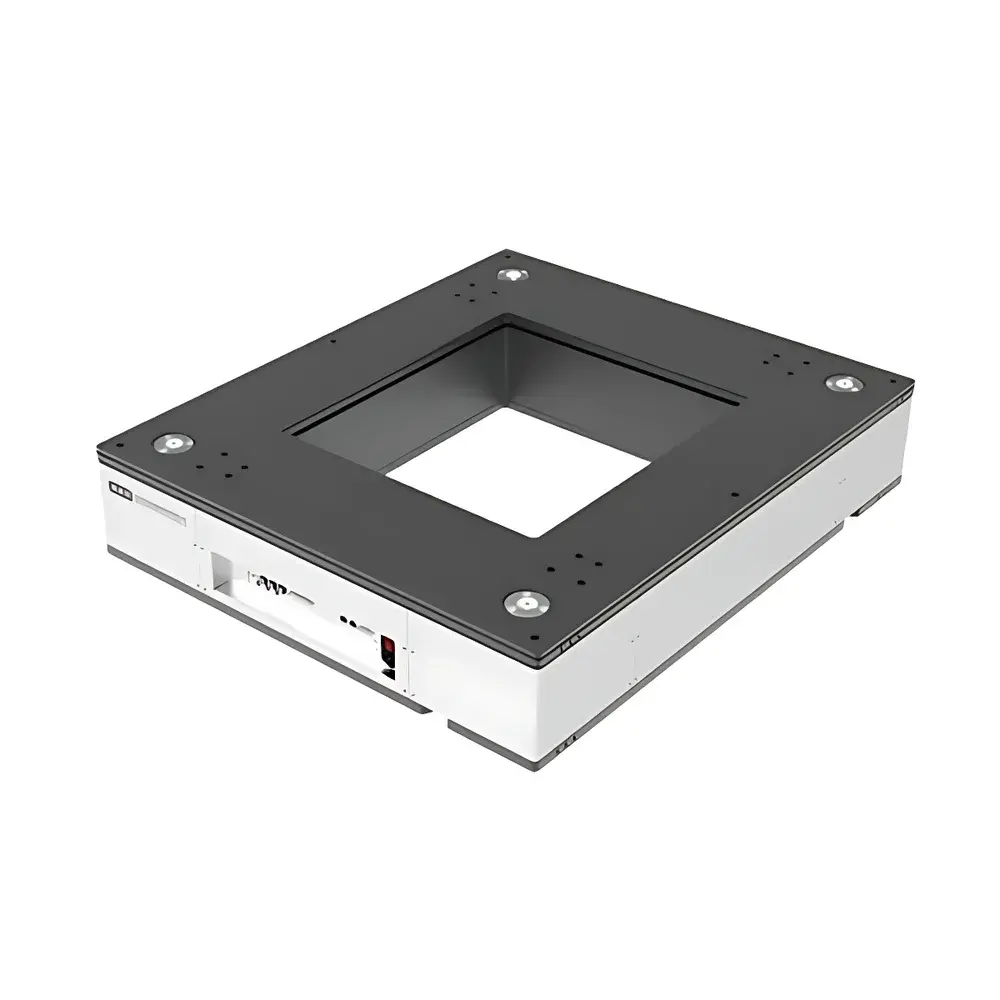
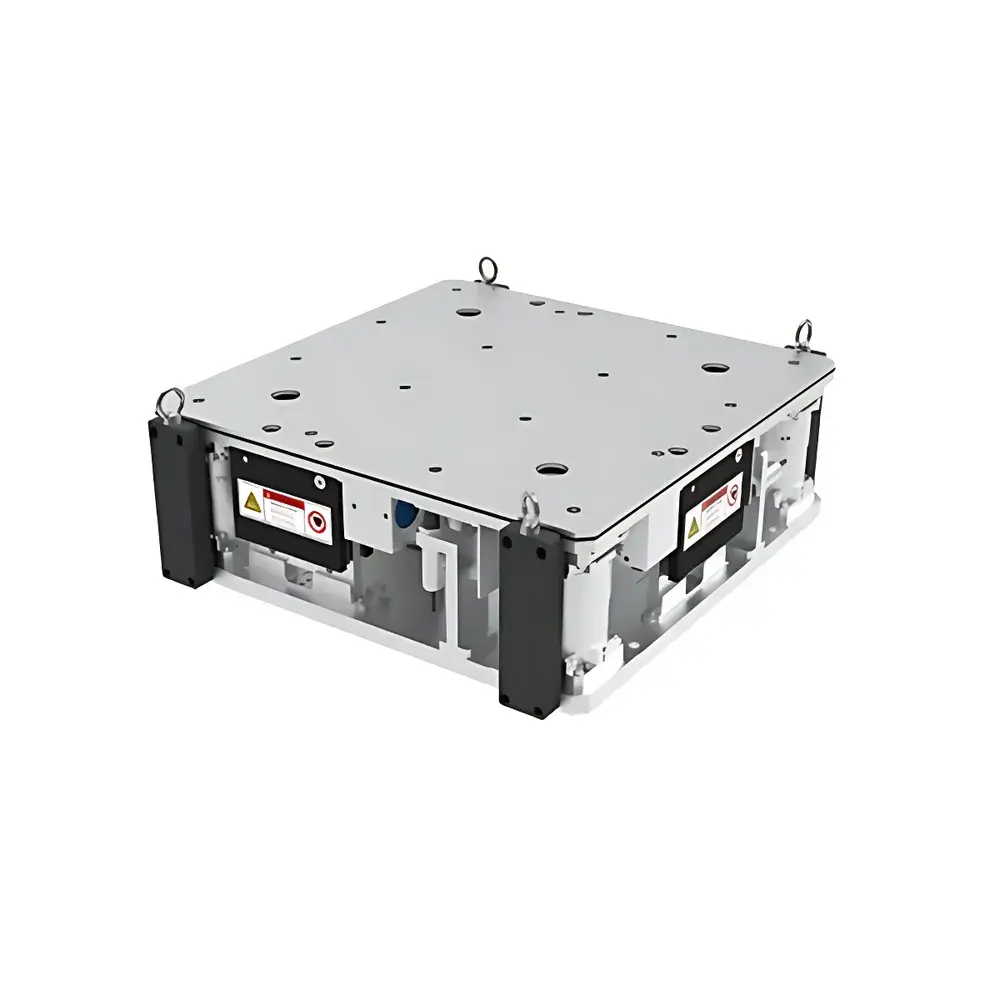
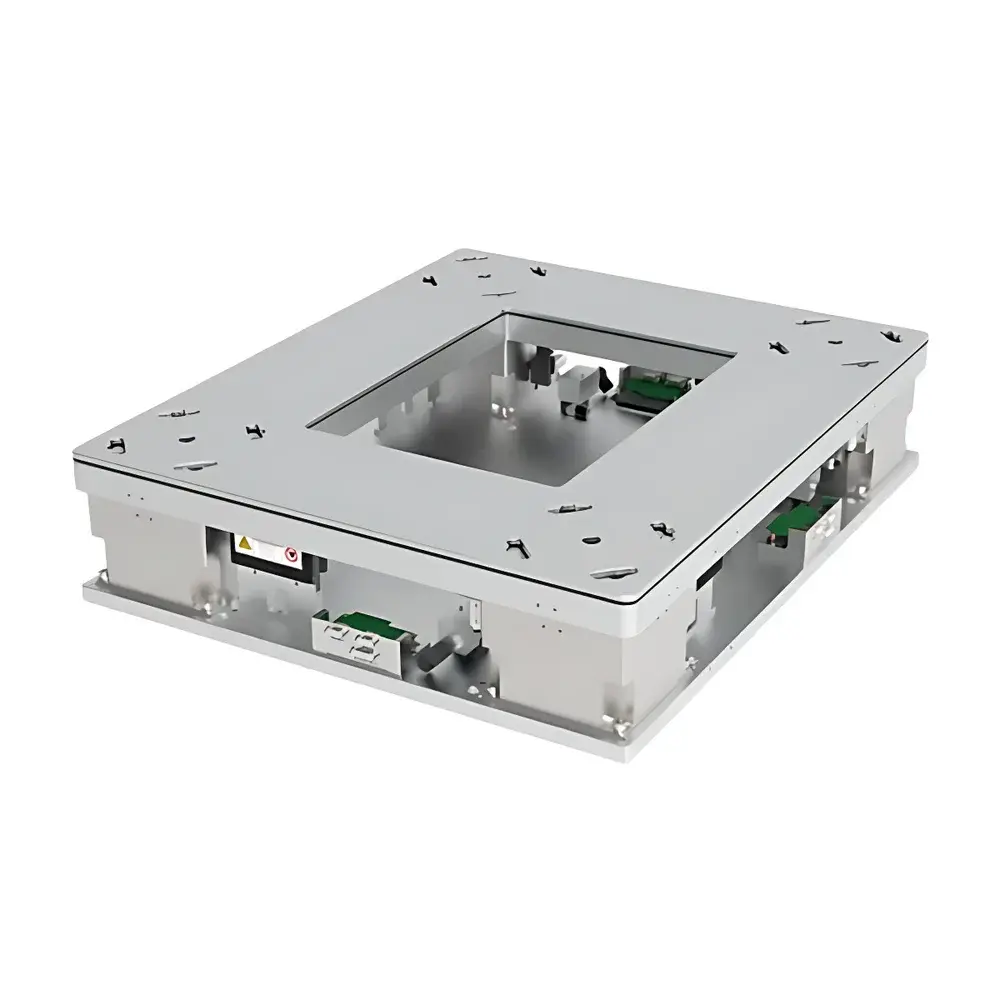
ZOLIX FSD100A Integrated Active Vibration Isolation Platform
| Brand | ZOLIX |
|---|---|
| Origin | Beijing, China |
| Manufacturer | ZOLIX Optics |
| Model | FSD100A |
| Form Factor | Integrated (Monolithic) Platform |
| Degrees of Freedom | 6-DOF Active Isolation |
| Active Bandwidth | ≥0.8 Hz |
| Vertical Transmissibility | ≤−3 dB @ 2 Hz, ≤−12 dB @ 5 Hz, ≤−25 dB @ 10 Hz |
| Horizontal Peak Thrust per Actuator | 640 N |
| Vertical Peak Thrust per Actuator | 1280 N |
| Platform Dimensions (L×W×H) | 1000 × 700 × 150 mm |
| Mass per Leg | 138 kg |
| Main Support Element | Steel Coil Spring |
| Load Capacity | 1000 kg |
| Compliance | ISO 20483 (Vibration Isolation Performance), ASTM E1776 (Laboratory Vibration Criteria), GLP-Compatible Control Architecture |
Overview
The ZOLIX FSD100A Integrated Active Vibration Isolation Platform is an engineered solution for high-sensitivity optical and electron microscopy applications requiring sub-Hz vibration attenuation in laboratory and cleanroom environments. Based on a six-degree-of-freedom (6-DOF) active control architecture, the system combines inertial sensing (high-resolution accelerometers and position transducers), real-time digital signal processing, and electromagnetic actuation to suppress both ground-borne and structure-borne disturbances. Unlike passive spring or air-damped platforms, the FSD100A achieves broadband isolation starting at 0.8 Hz—critical for atomic force microscopy (AFM), scanning electron microscopy (SEM), transmission electron microscopy (TEM), and ultra-stable interferometric setups where low-frequency floor motion (<5 Hz) dominates image drift and measurement uncertainty. The monolithic mechanical design integrates all actuators, sensors, and structural support into a single rigid frame, eliminating inter-unit coupling and reducing footprint by up to 40% compared to modular multi-platform configurations.
Key Features
- Monolithic 6-DOF active isolation architecture with fully integrated control electronics and power conditioning
- Real-time adaptive feedback loop operating at ≥2 kHz sampling rate, enabling dynamic compensation of transient and harmonic disturbances
- Electromagnetic actuators delivering 1280 N peak vertical thrust and 640 N peak horizontal thrust per leg, ensuring robust response under variable payload conditions
- Steel coil spring primary suspension optimized for high static stiffness (>10⁵ N/m) and low dynamic compliance, minimizing settling time after load change
- Self-developed ZOLIX Active Control Firmware (v3.2+) supporting auto-tuning (FSD Auto-Calibration Protocol), gain scheduling, and disturbance spectrum logging
- Domestically sourced core components—including MEMS-grade accelerometers, Class-H amplifiers, and FPGA-based controller—ensuring supply chain resilience and long-term serviceability
Sample Compatibility & Compliance
The FSD100A supports payloads ranging from 200 kg to 1000 kg with center-of-gravity height ≤300 mm above platform surface. It is mechanically compatible with standard optical breadboards (e.g., 1000 × 700 mm, M6 tapped arrays) and integrates seamlessly with SEM/TEM column mounts, laser cavity bases, and nanomechanical test stages. The platform conforms to ISO 20483:2021 Annex B for quantification of transmissibility curves and meets ASTM E1776–18 Category A vibration criteria for high-resolution imaging laboratories. Its control firmware implements audit-trail logging (timestamped parameter changes, calibration events, and fault records), satisfying GLP documentation requirements for regulated R&D environments. While not FDA-certified as a medical device, its deterministic response and traceable calibration protocol align with ISO/IEC 17025 principles for accredited testing laboratories.
Software & Data Management
ZOLIX ActiveControl Suite (Windows 10/11, 64-bit) provides GUI-based configuration, real-time spectral monitoring (FFT up to 200 Hz), and offline analysis of transmissibility and residual motion data. All control parameters—including proportional-integral-derivative (PID) gains, notch filter frequencies, and sensor weighting matrices—are exportable in CSV and HDF5 formats. The software supports SCPI command set over Ethernet (TCP/IP port 5025), enabling integration into LabVIEW, Python (PyVISA), or MATLAB automation workflows. Firmware updates are performed via signed binary packages with SHA-256 verification; no external internet connection is required during field deployment. System logs include full metadata (temperature, supply voltage, actuator current, RMS displacement), facilitating root-cause analysis during QA/QC audits.
Applications
- Stabilization of high-magnification electron microscopes (SEM, TEM, AC-TEM) where floor vibrations induce scan-line jitter and defocus drift
- Support of low-coherence interferometers, gravitational wave prototype sensors, and quantum optics experiments requiring <1 nm RMS displacement stability
- Vibration mitigation for tabletop X-ray diffractometers, nanoindentation systems, and optical coherence tomography (OCT) platforms
- Integration into ISO Class 5–7 cleanrooms where HVAC-induced low-frequency turbulence must be decoupled from metrology-grade instruments
- Research-grade atomic force microscopes (AFM) operating in tapping, non-contact, or force spectroscopy modes with sub-piconewton force resolution
FAQ
What is the minimum resolvable vibration frequency the FSD100A can attenuate?
The system achieves measurable active attenuation starting at 0.8 Hz, verified per ISO 20483 using swept-sine excitation and laser Doppler vibrometry.
Can the platform accommodate asymmetric payloads or off-center mounting?
Yes—the 6-DOF control algorithm automatically compensates for moment imbalances up to ±150 N·m about all axes, provided CoG remains within the central 60% of the platform area.
Is remote monitoring and diagnostics supported?
Yes—via Ethernet interface with SNMP v3 and HTTP REST API endpoints for status polling, alarm notification, and firmware health reporting.
Does the system require compressed air or external cooling?
No—it operates passively cooled and requires only 230 VAC / 50 Hz single-phase input; no pneumatic or liquid cooling infrastructure is needed.
How often does the system require recalibration?
Factory calibration is valid for 24 months under normal lab conditions; annual verification using ZOLIX VCAL-100 reference shaker kit is recommended for GLP-compliant labs.





