
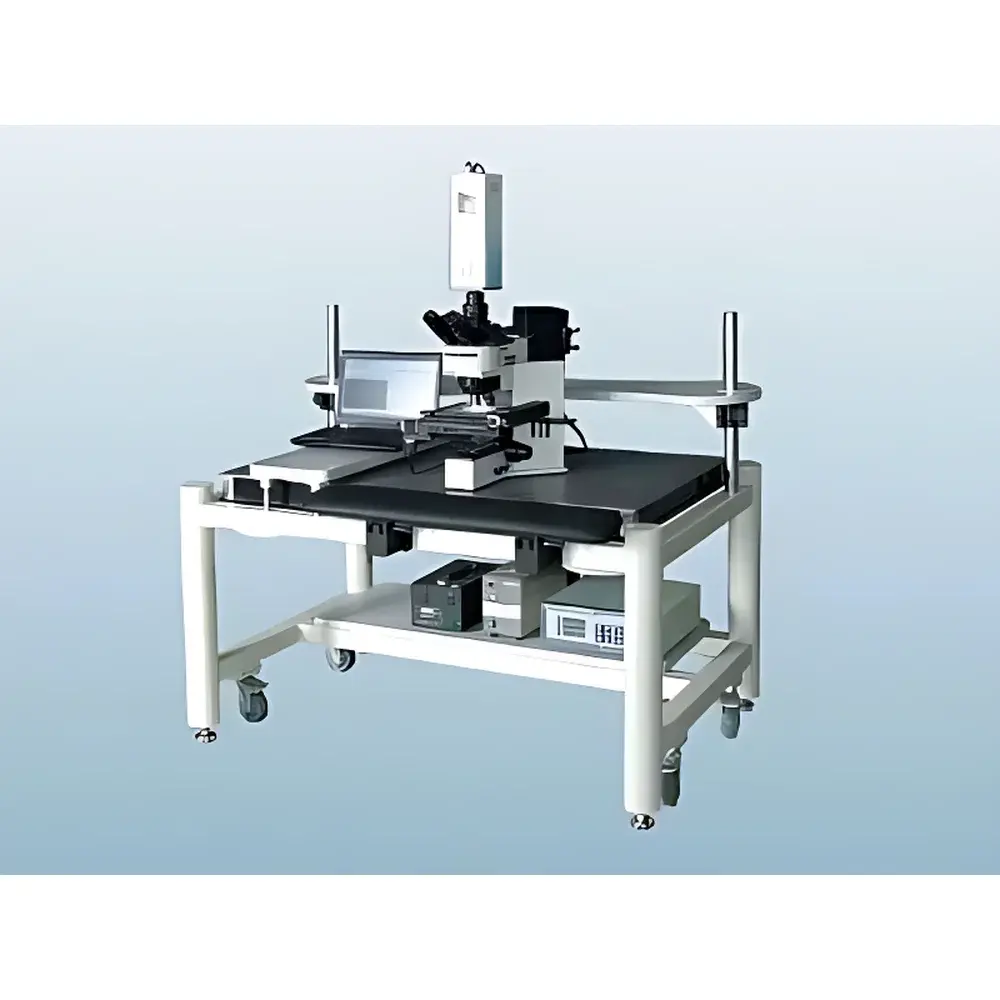
ZOLIX GaiaMicroscope Hyperspectral Microscope
| Brand | ZOLIX |
|---|---|
| Origin | Beijing, China |
| Manufacturer Type | Original Equipment Manufacturer (OEM) |
| Country of Origin | China |
| Model | GaiaMicroscope |
| Pricing | Available upon Request |
Overview
The ZOLIX GaiaMicroscope Hyperspectral Microscope is an integrated optical instrumentation platform that combines high-resolution optical microscopy with push-broom hyperspectral imaging technology. It enables spatially resolved spectral acquisition across the visible to near-infrared (VNIR) range—typically 400–1000 nm—with spectral sampling intervals down to 2.5 nm and spatial resolution governed by the selected microscope objective (e.g., 0.3 µm at 100× magnification under diffraction-limited conditions). The system operates on the principle of line-scan spectral imaging: as the sample stage moves precisely in one dimension, the hyperspectral camera captures a continuous sequence of spectral line data, reconstructing a full three-dimensional data cube (x, y, λ). This architecture ensures high signal-to-noise ratio (SNR) and pixel-level spectral fidelity without spectral interpolation or spatial aliasing—critical for quantitative microspectral analysis in heterogeneous samples.
Key Features
- Modular microscope base compatible with standard infinity-corrected objectives (including 10×, 20×, 50×, and 100× dry and oil-immersion lenses), supporting Köhler illumination and optional polarization contrast.
- High-quantum-efficiency CMOS-based VNIR hyperspectral camera with >60% peak quantum efficiency and thermoelectric cooling (−10 °C stabilization) to minimize dark current drift during extended acquisitions.
- Precision motorized XYZ stage with sub-micron repeatability (±0.1 µm) and programmable scan trajectories, synchronized in real time with camera exposure timing via TTL triggering.
- Integrated spectral calibration using NIST-traceable tungsten-halogen and mercury-argon lamp sources; wavelength accuracy maintained within ±0.5 nm across the full spectral range.
- Rugged optomechanical design with vibration-damped baseplate and enclosed optical path to ensure measurement stability in shared laboratory environments.
Sample Compatibility & Compliance
The GaiaMicroscope accommodates standard glass slides (1 × 3 inches), coverslips (0.13–0.17 mm thickness), petri dishes, and custom-mounted tissue sections or thin-film substrates. It supports both transmission and reflectance measurement geometries, with optional fiber-coupled illumination modules for oblique-angle or dark-field configurations. All optical components comply with ISO 10110 surface quality standards, and mechanical tolerances adhere to ISO 2768-mK general tolerancing guidelines. While not certified for clinical diagnostics per FDA 510(k) or CE-IVD, the system meets essential requirements for research-grade instrumentation under ISO/IEC 17025:2017 for testing laboratories—including documented traceability of calibration, environmental monitoring logs, and operator-accessible audit trails for instrument configuration changes.
Software & Data Management
Acquisition and processing are managed through ZOLIX HyperStudio—a cross-platform application built on Qt and Python (PyQt5, NumPy, SciPy). The software provides real-time preview of spectral cubes, region-of-interest (ROI) extraction, spectral library matching (with user-expandable libraries in ENVI-compatible .hdr/.img format), and multivariate analysis tools including PCA, MCR-ALS, and cluster segmentation. Raw data are saved in HDF5 format with embedded metadata (wavelength vector, stage coordinates, exposure time, lens ID, calibration timestamps), ensuring FAIR (Findable, Accessible, Interoperable, Reusable) data principles. Export options include CSV (per-pixel spectra), TIFF stacks (band-wise), and PDF reports with embedded spectral overlays. Audit trail functionality records all parameter modifications, user logins, and processing steps—supporting GLP-compliant documentation workflows when deployed with networked storage and role-based access control.
Applications
- Food Science: Detection and mapping of mycotoxin-contaminated cereal grains via characteristic absorption features near 980 nm; differentiation of adulterated olive oil blends using lipid-specific spectral fingerprints between 700–900 nm.
- Biomedical Research: Label-free histopathology of unstained formalin-fixed paraffin-embedded (FFPE) tissue sections; quantification of hemoglobin oxygen saturation gradients in ex vivo tumor models using dual-band ratiometric analysis.
- Materials Science: Spatial profiling of oxidation states in transition-metal oxide thin films (e.g., NiOₓ, Co₃O₄) via subtle shifts in d–d transition bands; identification of polymer phase separation in blend films using C–H and C=O vibrational overtone regions.
- Pharmaceutical Development: Uniformity assessment of active pharmaceutical ingredient (API) distribution in tablet cross-sections; detection of crystalline vs. amorphous domains in lyophilized formulations based on scattering slope differences in the 650–850 nm window.
FAQ
What spectral range does the GaiaMicroscope cover?
Standard configuration operates from 400 nm to 1000 nm with configurable spectral binning; extended-range versions supporting up to 1700 nm are available upon request with InGaAs detector options.
Is the system compatible with third-party microscope bodies?
Yes—the GaiaMicroscope optical interface follows standard C-mount and RMS threading conventions, enabling integration with Olympus BX series, Nikon Eclipse Ci, and Zeiss Axio Imager platforms using adapter kits.
Can I perform real-time spectral unmixing during acquisition?
No—real-time unmixing is not supported due to computational latency constraints; however, post-acquisition unmixing with user-defined endmembers completes in under 90 seconds for a 1024 × 1024 × 200 spectral cube on a workstation with 32 GB RAM and NVIDIA RTX A4000 GPU.
Does the system meet FDA 21 CFR Part 11 requirements?
While the software includes electronic signature support and audit trail logging, full Part 11 compliance requires site-specific validation protocols, secure network infrastructure, and administrative controls—none of which are supplied by ZOLIX as part of standard delivery.
What maintenance is required for long-term spectral stability?
Annual recalibration using factory-provided reference standards is recommended; users should also perform daily dark-current correction and weekly wavelength verification using onboard Hg-Ar lamp if operating in regulated environments.





