
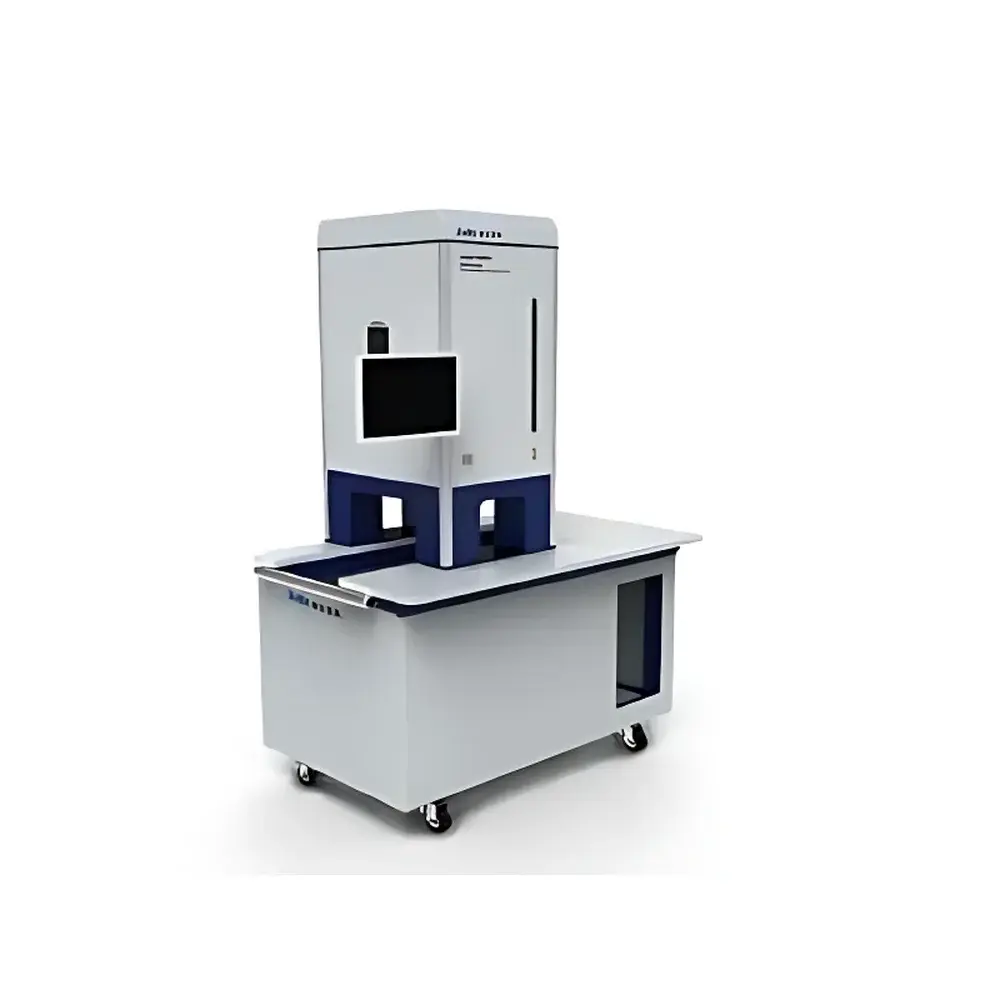
ZOLIX GaiaSorter Hyperspectral Sorting System
| Brand | ZOLIX |
|---|---|
| Origin | Beijing, China |
| Manufacturer | ZOLIX Optics |
| Type | GaiaSorter |
| Spectral Range | 350–2500 nm |
| Spectral Resolution | 2.8 nm (at VNIR band) |
| Spatial Resolution (IFOV) | 30 µm / 50 µm |
| Imaging Resolution | 1392 × 1040 pixels |
| Field of View (TFOV) | 20° |
| Frame Rate | 25–120 fps |
| Imaging Mode | Push-broom Hyperspectral Scanning |
| Deployment | Ground-based & Airborne Compatible |
| Compliance | Designed for ISO/IEC 17025-aligned lab environments and industrial QA/QC workflows |
Overview
The ZOLIX GaiaSorter Hyperspectral Sorting System is a laboratory- and production-grade push-broom hyperspectral imaging platform engineered for non-destructive, label-free chemical and physical characterization of heterogeneous solid samples. It operates on the principle of spatial-spectral data acquisition: as a sample moves continuously under uniform illumination across a precision motorized stage or conveyor, a line-scan hyperspectral camera captures sequential spectral profiles at each spatial position—generating a three-dimensional hypercube (x, y, λ) where x-y encodes spatial geometry and λ encodes reflectance/emission intensity across hundreds of contiguous narrowband channels. This architecture enables pixel-level spectral unmixing, chemometric modeling, and multivariate classification—critical for quantifying internal quality attributes (e.g., moisture content, soluble solids, acidity) and detecting structural anomalies (e.g., bruising, necrosis, bone fragments, foreign contaminants) without contact or sample preparation.
Key Features
- Multi-band modular optical design supporting three standardized spectral configurations: VNIR (400–1000 nm), NIR (900–1700 nm), and SWIR (1000–2500 nm), with selectable spectrometers (e.g., Imspector V10, EN17, EN25E) to match application-specific resolution and signal-to-noise requirements.
- High-fidelity spectral acquisition with ≤2.8 nm spectral resolution (VNIR), 50% optical throughput, and calibrated radiometric response traceable to NIST standards.
- Push-broom imaging engine using interline CCD (1392 × 1040, 6.45 µm pixels) for VNIR/NIR and thermoelectrically cooled InGaAs/MCT detectors for SWIR bands—ensuring stable dark current and low-noise performance across extended exposure windows (1 µs to 120 s).
- Integrated uniform broadband illumination source (350–2500 nm, ≥100 W, diffuse geometry) with >85% lens transmission and spectral flatness ±5% over operational range.
- Modular mechanical architecture: standard 400 mm travel motorized translation stage; optional conveyor integration (100–200 mm/s) for continuous inline sorting validation; configurable field-of-view (20° TFOV) and spatial sampling (30 µm or 50 µm IFOV) via interchangeable C-mount lenses (25 mm focal length).
- Fully programmable acquisition interface supporting real-time preview, region-of-interest (ROI) spectral extraction, exposure/gain control, and hardware-triggered synchronization with external PLCs or robotic sorters.
Sample Compatibility & Compliance
The GaiaSorter accommodates solid, opaque, or semi-translucent samples up to 300 mm × 300 mm × 100 mm in dimension. It has been validated for agricultural commodities (fruits, vegetables, grains, meat cuts), recycled materials (plastic polymers, e-waste fragments), and municipal waste streams. Its optical design meets requirements for GLP-compliant spectral data collection and supports audit-ready metadata logging—including timestamp, stage position, lamp intensity, and environmental temperature. While not certified for FDA 21 CFR Part 11 out-of-the-box, the system’s raw data export (binary .raw format) and open API enable integration into validated LIMS or MES platforms compliant with ISO 17025, ASTM E1710 (hyperspectral imaging performance testing), and USP (near-infrared spectroscopy validation guidelines).
Software & Data Management
The bundled acquisition software provides real-time spectral visualization, interactive pixel spectrum plotting, and batch-compatible raw data storage in vendor-neutral binary format—fully compatible with ENVI, MATLAB, Python (scikit-learn, hsi), and commercial chemometrics suites (Unscrambler X, Pirouette). All acquisition parameters (exposure time, gain, stage velocity, ROI coordinates) are embedded in header metadata. A comprehensive SDK (C/C++, Python bindings) supports custom algorithm deployment, classifier training pipelines, and direct interfacing with industrial PLCs or pneumatic ejection systems. Audit trails record user actions, parameter changes, and calibration events—facilitating reproducibility and regulatory documentation.
Applications
- Non-invasive assessment of fruit maturity (chlorophyll, anthocyanin, starch index), internal defects (brown heart, watercore, fungal infection), and post-harvest stress markers.
- Quantitative detection of pesticide residues on leafy greens and citrus peels via spectral fingerprint matching against reference libraries (LOD dependent on compound absorbance cross-section and matrix interference).
- Automated identification and rejection of bone fragments in poultry processing lines, metal shards in cereal products, or plastic contaminants in food-grade packaging recyclates.
- Sorting of polymer types (PET, HDPE, PP) in mixed plastic waste streams based on C–H, C=O, and aromatic vibrational signatures in SWIR.
- Soil organic matter mapping, vegetation health monitoring (NDVI, PRI), and water stress quantification in precision agriculture trials.
- Forensic material discrimination (paint chips, textile fibers, document inks) and cultural heritage pigment analysis.
FAQ
What spectral calibration standards are supported?
Factory-calibrated using NIST-traceable tungsten-halogen and mercury-argon lamps; user-accessible dark/light reference routines support daily recalibration.
Can the system be integrated into an existing production line?
Yes—via GigE Vision interface and SDK-triggered I/O signals; conveyor speed synchronization and ejection timing can be synchronized to frame timestamps.
Is spectral data export compatible with third-party chemometric tools?
Yes—raw hypercubes are saved in binary .raw + header (.hdr) format, fully readable by ENVI, HDF5, and Python h5py/scikit-image workflows.
What is the minimum detectable feature size under standard configuration?
At 30 µm IFOV and 300 mm working distance, theoretical spatial resolution is ~1 mm for objects placed on the standard stage; resolution scales linearly with working distance and inversely with magnification.
Does the system support real-time classification during acquisition?
Basic thresholding and PCA-based anomaly detection run in real time; full PLS-DA or SVM models require post-acquisition processing unless deployed via compiled edge inference modules (available upon request).





