
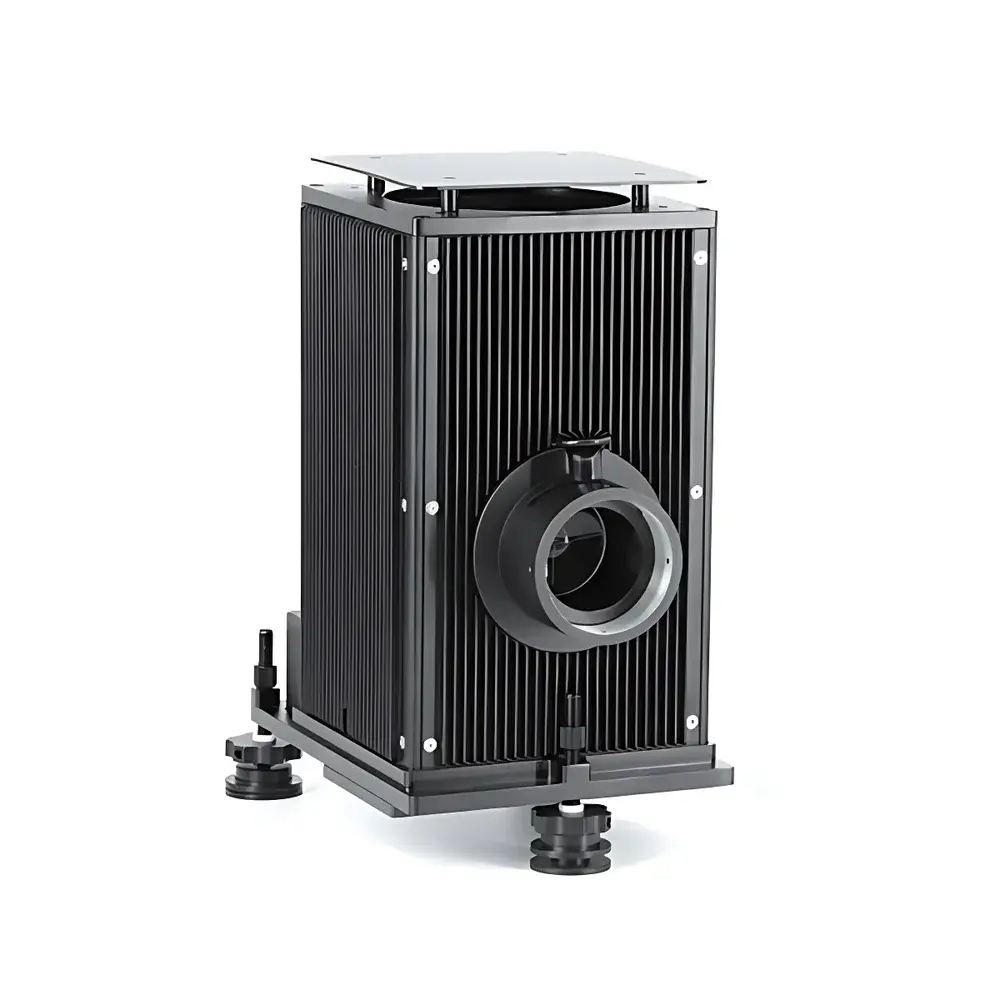
ZOLIX GLORIA-X500A 500W Xenon Arc Light Source
| Brand | ZOLIX |
|---|---|
| Origin | Beijing, China |
| Manufacturer Type | Direct Manufacturer |
| Product Category | Domestic |
| Model | GLORIA-X500A |
| Light Source Type | Xenon Arc Lamp |
| Illumination Mode | External Irradiation |
| Spectral Range | 250–2500 nm |
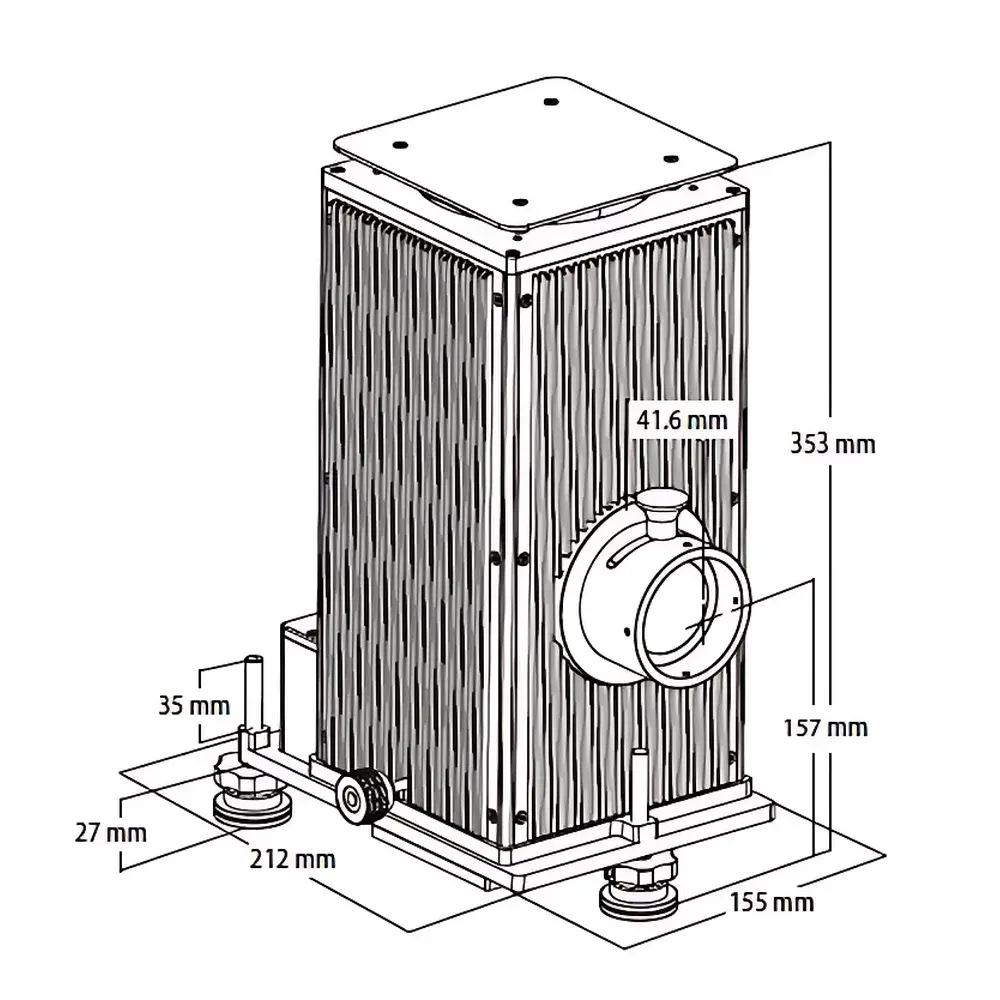
| Output Beam Diameter | 46 mm |
| Optical Axis Height Adjustment Range | 157–193 mm |
| Light Collection Efficiency Gain | >60% (vs. standard parabolic reflector) |
| Intensity Stability | ≤2% (with imported lamp bulb, under constant-current power supply) |
| Max. Envelope Temperature (Bulb Wall) | <500 °C at 600 W equivalent load |
| Max. Anode Temperature | <180 °C |
| Lamp Replacement & Realignment Time | ≤5 minutes |
| Safety Features | Interlocked lid cutoff, thermal shutdown, ignition timeout protection (10 s) |
Overview
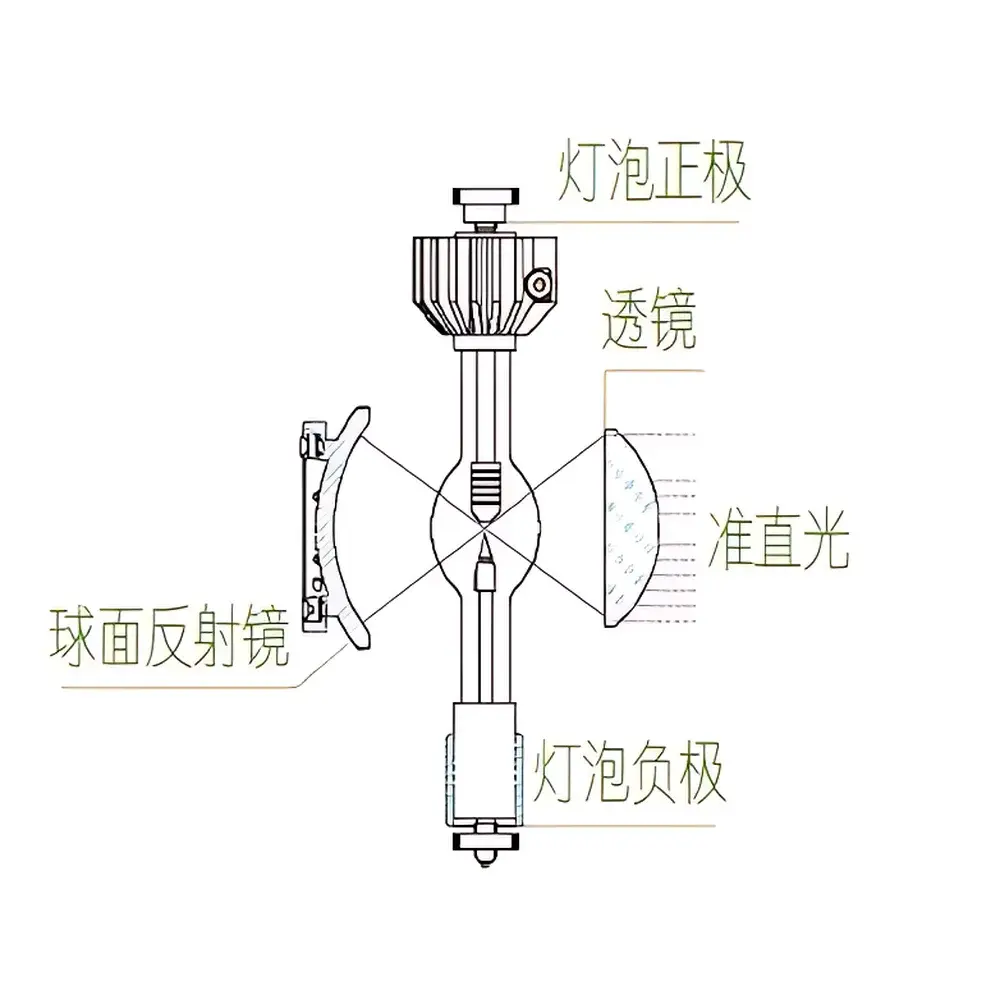
The ZOLIX GLORIA-X500A is a high-power, externally irradiating xenon arc light source engineered for precision optical laboratories requiring broadband spectral output with high radiometric stability and reproducible beam geometry. Based on the principle of direct-current (DC) stabilized arc discharge in high-pressure xenon gas, the system generates a continuous spectrum spanning 250–2500 nm — covering deep UV, visible, and near-infrared regions — with a correlated color temperature of approximately 5800 K, closely matching natural solar irradiance. This makes it especially suitable for applications demanding solar-simulated illumination, such as photovoltaic quantum efficiency testing, accelerated weathering studies, photochemical reaction kinetics, and spectrophotometric calibration. The source integrates a spherical mirror-based collector optics design, which increases radiant flux collection efficiency by over 60% compared to conventional parabolic configurations. Its modular architecture supports rapid reconfiguration between 350 W, 500 W xenon, and mercury-xenon lamps via standardized mechanical and electrical interfaces — enabling lab-scale adaptability without hardware redesign.
Key Features
- High-efficiency spherical reflector optics delivering >60% improvement in light collection versus standard parabolic systems
- Precise external adjustment knobs for real-time alignment of lamp filament and reflected beam — enabling optimal overlap and maximum energy throughput
- Thermally optimized forced-air cooling architecture maintaining bulb wall temperature <500 °C and anode temperature <180 °C even under sustained 20% overload conditions (i.e., 600 W equivalent)
- Robust high-voltage circuit isolation design minimizing risk of corona discharge or arcing during ignition and operation
- Interlock-enabled safety system: automatic power cutoff upon lid opening, thermal shutdown above safe operating thresholds, and ignition failure lockout after 10 s of unsuccessful triggering
- Adjustable optical axis height (157–193 mm) accommodating diverse optical benches and spectrometer coupling geometries
- Stable DC power supply delivering ≤2% intensity fluctuation (RMS) when paired with certified imported xenon bulbs
Sample Compatibility & Compliance
The GLORIA-X500A is compatible with standard 350–500 W xenon, mercury, and mercury-xenon short-arc lamps (e.g., LSB-GX500), provided matching current-rated power supplies and mechanical adapters are used. Its external irradiation configuration allows seamless integration into custom optical trains, monochromator input ports, integrating spheres, and environmental exposure chambers. From a regulatory standpoint, the system’s electrical architecture complies with IEC 61000-6-3 (EMI emission limits) and IEC 61000-6-2 (immunity requirements). While not certified as a Class 3B laser product, its UV output necessitates adherence to ANSI Z136.1 and IEC 60825-1 safety protocols: users must employ UV-blocking eyewear (OD ≥4 @ 250–400 nm), avoid direct viewing through optical elements, and implement physical beam enclosures where applicable. The unit supports GLP-compliant documentation workflows when operated with audit-trail-capable external controllers.
Software & Data Management
The GLORIA-X500A operates as a standalone analog-controlled instrument; no embedded firmware or proprietary software is required for basic functionality. However, its power supply features analog voltage input (0–5 V or 0–10 V) and TTL-compatible status outputs (lamp-on, fault, interlock open), enabling full integration into LabVIEW, Python (via DAQ cards), or PLC-based automation platforms. Optional digital interface modules (sold separately) provide RS-232/RS-485 communication for remote start/stop, intensity ramping, and real-time thermal monitoring — supporting traceable parameter logging aligned with 21 CFR Part 11 requirements when deployed with validated third-party data acquisition systems.
Applications
- Solar simulation for PV cell EQE and IPCE measurements per ASTM E948 and IEC 60904-8
- Accelerated material aging tests (paints, polymers, textiles) per ISO 4892-2 and ASTM G154
- Photochemical reactor illumination in catalysis and environmental chemistry research
- Broadband calibration of spectroradiometers, hyperspectral imagers, and UV-VIS-NIR detectors
- Fluorescence excitation source for widefield microscopy when coupled with appropriate bandpass filters
- UV curing process development and validation in semiconductor and display manufacturing
FAQ
Does the GLORIA-X500A include a lamp bulb?
No — the GLORIA-X500A system includes only the lamp housing and constant-current power supply. The 500 W xenon lamp (e.g., LSB-GX500) must be ordered separately.
Can I use mercury or mercury-xenon lamps with this source?
Yes — the mechanical and electrical interfaces support interchangeable 350–500 W short-arc lamps, including Hg and Hg-Xe variants, provided the corresponding ballast and igniter are used.
What safety certifications does the unit carry?
The system conforms to IEC 61000 electromagnetic compatibility standards. It is not CE-marked as a complete medical or industrial device but meets general laboratory equipment safety expectations per IEC 61010-1 when installed per manual instructions.
Is water cooling available?
No — the design relies exclusively on low-turbulence forced-air cooling to preserve optical stability; liquid cooling is neither supported nor recommended due to vibration and condensation risks.
How often should the reflector be cleaned or replaced?
The fused silica spherical mirror requires periodic inspection; cleaning with spectroscopic-grade methanol and lint-free wipes is recommended every 200 operational hours. Mirror replacement is typically needed after ~5,000 hours of cumulative use under clean-room conditions.



